
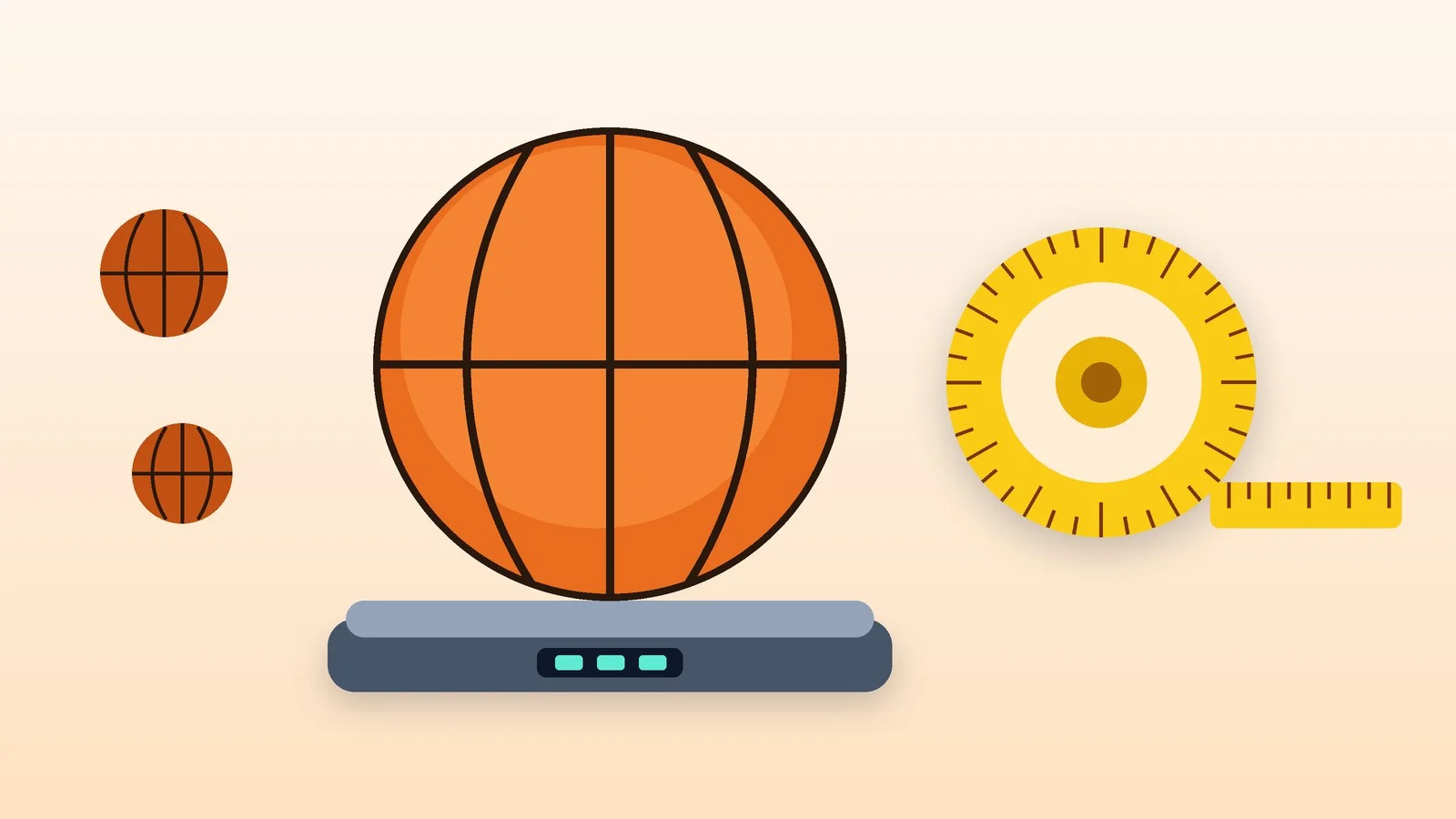
FIBA rules set the size and weight of a basketball: the standard ball is a size 7, with a circumference of 75–77 cm and a weight of 580–620 g. Women play with a size 6 (71.5–73 cm, 510–550 g), and kids in mini-basketball use a size 5 (68.5–70 cm, 465–495 g) or a lightweight size 5 weighing 360–390 g. These tolerances come from the edition of the rules in force since October 1, 2026.
Below you’ll find a summary size chart, the balls used in 3×3, the NBA and the WNBA, sizing by age, ways to tell the size of your ball, and a pressure check based on bounce. The figures were checked against FIBA and NBA rules and data from Spalding, Wilson and Molten as of October 6, 2026.
580–620 g
Weight of a size 7 ball
FIBA men’s competitions
75–77 cm
Circumference of a size 7 ball
750–770 mm per the rules
103.5–108.5 cm
Bounce from 1.8 m
measured to the bottom of the ball
Source: FIBA Rules 2026, Basketball Equipment section · data as of 6 October 2026
Basketball Size and Weight: FIBA Chart
Ball size is defined by two parameters: circumference and weight. The tolerances below come from the Basketball Equipment section of FIBA’s 2026 Official Basketball Rules and from the FIBA 3×3 equipment appendix.
| Size | Circumference, cm | Weight, g | Who plays it under FIBA rules |
|---|---|---|---|
| 7 | 75–77 | 580–620 | All men’s competitions |
| 6 | 71.5–73 | 510–550 | All women’s competitions |
| 5 | 68.5–70 | 465–495 | Mini-basketball |
| Lightweight 5 | 68.5–70 | 360–390 | Mini-basketball |
| 3×3 ball | 72–74 | 580–620 | All 3×3 categories |
The rules don’t specify a diameter, but it’s easy to calculate: circumference divided by π (≈3.14). That gives roughly 23.9–24.5 cm for a size 7, 22.8–23.2 cm for a size 6 and 21.8–22.3 cm for a size 5.
Beyond size, FIBA requires the ball to be spherical, with no more than 12 seams up to 6.35 mm wide, and in a single shade of orange or a FIBA-approved color combination. The size number and the recommended pressure or pressure range must be printed on the ball.
Which Ball Is Used in FIBA, the NBA, the WNBA and 3×3
FIBA rules name the size for each category outright: 7 in all men’s competitions, 6 in all women’s, and 5 or lightweight 5 in mini-basketball. American leagues follow their own rules, but the sizes are the same: men play with a size 7, women with a size 6.
| Competition | Size | Circumference and weight | Pressure |
|---|---|---|---|
| FIBA, men | 7 | 75–77 cm, 580–620 g | Printed on the ball |
| FIBA, women | 6 | 71.5–73 cm, 510–550 g | Printed on the ball |
| FIBA, mini-basketball | 5 or lightweight 5 | 68.5–70 cm, 465–495 or 360–390 g | Printed on the ball |
| FIBA 3×3 | 3×3 ball | 72–74 cm, 580–620 g | 7.5–8 psi |
| NBA | 7 | 29.5″ (74.9 cm), per Wilson | 7.5–8.5 psi |
| WNBA | 6 | 28.5″ (72.4 cm), per Wilson | — |
The 3×3 ball is a standard of its own. Under the FIBA 3×3 appendix, its circumference is 720–740 mm and its weight 580–620 g: almost the size of a size 6 with the weight of a size 7. That’s also how Wilson, which makes the official FIBA 3×3 ball, describes it. All 3×3 categories play only with a FIBA 3×3-approved ball, and the official ball is inflated to 7.5–8 psi (about 0.52–0.55 bar).
About the ball itself, the NBA rules say only that it must be officially approved by the league and inflated to 7.5–8.5 psi. Wilson makes the official NBA ball; according to the company, it’s a size 7 with a genuine Horween leather cover. The official WNBA ball, also by Wilson, is a size 6. Molten makes the ball for FIBA competitions: its top model, the BG5000, is leather and comes in sizes 7 and 6.
What Size Ball Does a Child Need
FIBA rules don’t name ages: mini-basketball is played with a size 5 or lightweight size 5 ball, and the FIBA Foundation mini-basketball program is designed for children aged 5–12. American charts move kids up to a size 6 earlier, from age 9. Here’s what manufacturers and the NBA recommend:
| Age | Size | Source |
|---|---|---|
| 4 and under | Mini (size 3) | Wilson |
| 5–8 | 5 | Wilson, Spalding, NBA |
| 9–12 | 6 | Spalding, Wilson, NBA |
| 13+: girls and women | 6 | Spalding, FIBA rules |
| 13+: boys and men | 7 | Spalding, FIBA rules |
The key fork is ages 9–12. In the American system, kids switch to a size 6 at 9: the NBA and USA Basketball explain that a ball proportional to a child’s hands gives better control and helps build skills faster. In competitions under FIBA rules, kids play with a size 5 until the end of mini-basketball. If your child plays on a team, ask the coach which ball their age group uses in tournaments and buy the same one.
Don’t buy a ball for a child to “grow into.” Wilson warns that playing with the wrong size ball can hurt a player’s technique in the long run, and Spalding recommends a size 7 only from age 13.
How to Tell the Size of a Basketball
The easiest way is to look at the ball itself; if the print has worn off, measure and weigh it.
- Find the size number. FIBA rules require the size number and the recommended pressure to be printed on the ball. With Molten, the size is even part of the product code: B7G5000 is a size 7, B6G5000 a size 6, B5G4000 a size 5.
- Measure the circumference. Wrap a soft tape measure around the widest part of the inflated ball and compare with the chart: 75–77 cm is a size 7, 71.5–73 cm a size 6, 68.5–70 cm a size 5.
- Weigh the ball on a kitchen scale: a size 7 weighs 580–620 g, a size 6 510–550 g, a size 5 465–495 g, and a lightweight size 5 360–390 g.
- Convert inches and ounces. American balls and websites give the circumference in inches and the weight in ounces: 29.5″ is 74.9 cm (size 7), 28.5″ is 72.4 cm (size 6), 27.5″ is 69.9 cm (size 5); 22 oz is about 624 g, 20 oz is 567 g, 18 oz is 510 g.
The figures in American charts don’t exactly match FIBA’s tolerances. For example, Spalding lists 18–20 oz (510–567 g) for a size 6, while FIBA allows 510–550 g. For tournaments, FIBA’s numbers are what count; for a pickup game, the label on the ball is enough.
Pressure and the FIBA Bounce Test
FIBA defines ball pressure not with a number but with a bounce. Dropped onto the floor from a height of about 1,800 mm (measured from the bottom of the ball), the ball must bounce to 1,035–1,085 mm, or 103.5–108.5 cm, also measured to the bottom of the ball. The FIBA 3×3 rules use the same figures.
Here’s how to check it at home:
- Inflate the ball to the pressure printed on it.
- Mark a height of 180 cm on a wall, and below it a band at 103.5–108.5 cm.
- Hold the ball so its bottom is at the 180 cm mark and let it go, without pushing, over a hard, level floor.
- Note where the bottom of the ball is at the top of the first bounce. It’s easier to film this on your phone in slow motion.
- If it falls short of the band, add air; if it goes higher, let out a little air and try again.
The rules describe a drop onto a playing floor, and the surface affects the bounce, so a home test is a guide, not an exact measurement. If you need a number, go with the one printed on the ball. For comparison: Spalding recommends 7–9 psi (about 0.48–0.62 bar), the NBA rules 7.5–8.5 psi, and the official FIBA 3×3 ball is inflated to 7.5–8 psi. A pump with a pressure gauge is the most convenient option: you can see how much air you’ve added.
Indoor or Outdoor Ball: Leather, Composite, Rubber
FIBA divides competitions into two levels. At Level 1 — FIBA national team and club competitions and other elite-level competitions — the ball’s cover may be made only of leather or artificial (composite, synthetic) leather. At Level 2, meaning all other competitions, rubber is allowed too.
| Material | Where to play | What makers say |
|---|---|---|
| Genuine leather | Indoor only | Slick at first, softens with play |
| Composite (synthetic) | Indoor and outdoor | Needs almost no break-in |
| Rubber | Outdoor | Durable, grippy even in the rain |
Leather balls, as Spalding describes them, are for indoor use only. A new leather ball is slick: it needs no special products, you break the leather in by playing. Composite balls, according to Wilson, are the most popular: they work both indoors and outdoors and are more durable than leather. Rubber balls are cheaper and built for asphalt and outdoor hoops with metal nets.
Spalding marks its outdoor and indoor/outdoor balls right on the cover — look for the same label on other brands. In Molten’s BG line, the leather model is the BG5000, the BG4500, BG4000 and BG3800 are composite, and the BG2000, BG2010 and BG1600 are rubber.
How to Choose a Ball and What to Do If It Doesn’t Fit
The choice comes down to four questions:
- Who’s playing. Boys 13 and older and men need a size 7, girls and women a size 6, kids aged 5–8 a size 5, and at 9–12 a size 5 or 6, depending on which rules the team plays by.
- Where you’ll play. Indoors, leather or composite; outdoors, rubber or composite marked indoor/outdoor.
- Whether you need a ball for competition. At FIBA Level 1 tournaments, all equipment must be FIBA Approved; for other competitions, FIBA strongly recommends approved balls. In 3×3, every category requires a FIBA 3×3-approved ball.
- How you’ll inflate it. You need a pump with a needle, ideally with a pressure gauge; inflate to the pressure printed on the ball.
If the ball still isn’t right:
- Your child struggles to dribble and shoot — go down a size using the chart: the NBA and USA Basketball recommend a size 5 for kids aged 7–8 and a size 6 for ages 9–11.
- A new leather ball feels slippery — that’s normal: according to Spalding, the leather softens as you play. Composite needs almost no break-in.
- The ball bounces poorly or too high — check the pressure against the label on the ball and test the bounce from 1.8 m.
- A leather ball wore out quickly on asphalt — these balls are made for indoor use only. Outdoors, you need rubber or composite marked indoor/outdoor.
- You bought a size 7 ball for a women’s team — under FIBA rules, women’s competitions use a size 6.
For practice, you’ll also want your own water bottle. And if you want to see your heart rate and workload while you play, check out our roundup of fitness trackers.
Sources and methodology
Analysis of public sourcesChecked 6 October 2026
- FIBA: Official Basketball Rules 2026, Basketball Equipment assets.fiba.basketball
- FIBA 3×3: Official 3×3 Basketball Equipment and Software Appendix fiba3x3.com
- NBA Rulebook 2026-27, Rule No. 1 official.nba.com
- Spalding: Product FAQs on basketballs spalding.com
- Wilson: How to Choose a Basketball wilson.com
FAQ
How much does a basketball weigh?
Under FIBA’s 2026 rules, a size 7 ball weighs 580–620 g, a size 6 510–550 g, a size 5 465–495 g, and a lightweight size 5 360–390 g. A 3×3 ball weighs the same as a size 7: 580–620 g.
What size ball is used in basketball?
Men play with a size 7, women with a size 6, and kids in mini-basketball with a size 5 or lightweight size 5. 3×3 uses its own ball: 72–74 cm around, with the weight of a size 7.
What is the standard basketball size?
The standard, or official, size is 7: 75–77 cm in circumference and 580–620 g. It’s used in all FIBA men’s competitions and in the NBA.
How do I tell what size my basketball is?
Look for the size number on the ball: under FIBA rules, it must be printed on the cover. If the print has worn off, measure the circumference with a soft tape measure: 75–77 cm is a size 7, 71.5–73 cm a size 6, 68.5–70 cm a size 5.
What pressure should a basketball have?
Whatever is printed on the ball. As a guide, Spalding recommends 7–9 psi (0.48–0.62 bar), and the NBA rules call for 7.5–8.5 psi. Under FIBA rules, the ball is properly inflated if, dropped from 1.8 m, it bounces to 103.5–108.5 cm, measured to the bottom of the ball.


Leave a Reply