
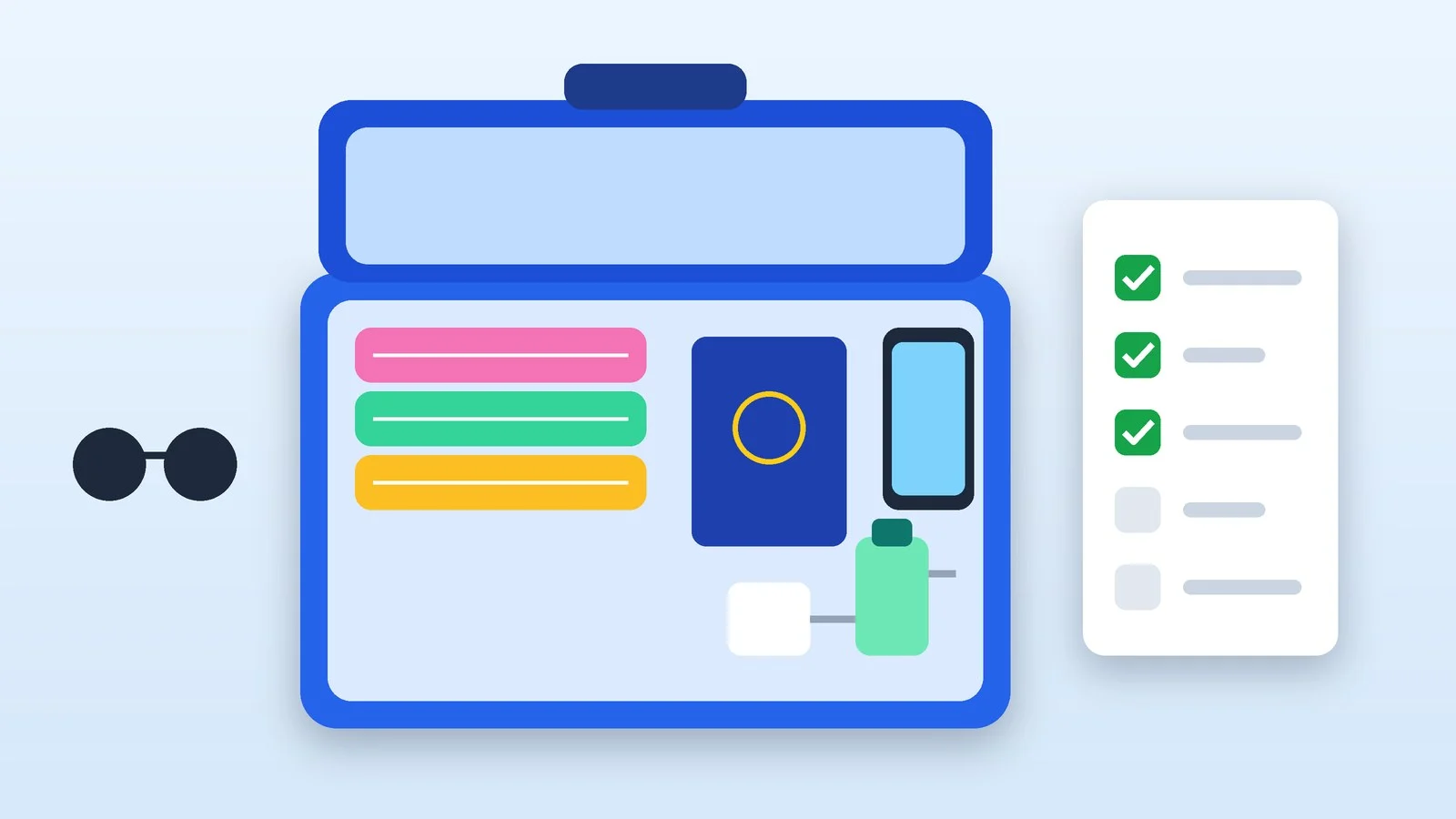
What to pack for a trip, in short: documents and money, travel insurance, medicines with prescriptions, a phone with a charger and a power bank, a plug adapter, clothes for the weather and a travel toiletry kit. Everything the trip depends on — passport, cards, medicines and devices with batteries — goes in your carry-on: power banks and spare batteries are banned from checked baggage.
Below are a packing plan, a packing list by category, the 2026 rules for power banks and liquids, a printable checklist and the things people forget most often. The rules were checked against official ICAO, IATA, European Commission and UK Government pages as of October 6, 2026.
Check documents, insurance and cards a week ahead
Check your passport’s expiry date: many countries require it to stay valid for several more months after you leave. Check visas, electronic travel authorizations and other entry conditions only on the official website of the country or its consulate — summaries on social media go out of date.
An example: as of October 6, 2026, the EU’s ETIAS travel authorization for visa-exempt travelers is not yet operating and is not accepting applications. Websites that already “process ETIAS” have nothing to do with the EU — check the status on the official ETIAS website.
Get medical travel insurance for every day of the trip and check that it covers your plans — skiing or diving, for example. Save the policy and the assistance phone number on your phone.
In your banking app, check card expiry dates, limits and whether payments abroad are blocked. Take two cards from different banks or payment networks, keep them separately, and carry a little local cash for the first expenses.
Result: Your passport is valid, entry rules are checked, insurance is in place and your cards work abroad.
Set up your phone service and pack medicines 3–4 days ahead
Ask your carrier about roaming prices. Since January 1, 2026, the EU’s “Roam Like at Home” has also covered Ukraine and Moldova: EU carriers’ customers pay domestic prices there, and Ukrainian and Moldovan carriers’ customers do the same in EU countries. Carriers may cap data; details are on the European Commission’s roaming page. The UK, Switzerland and Turkey are outside this zone.
The alternative to roaming is a local or travel eSIM. iPhone XS, iPhone XR and later models support eSIM, but you can add another carrier’s eSIM only if the phone isn’t locked to a carrier: in Settings → General → About, Carrier Lock should show “No SIM Restrictions.” Activation usually needs Wi-Fi, so set up the eSIM at home, following Apple’s guide.
You can keep your home number on for calls and texts with sign-in codes and use the travel eSIM for data. Apple warns that with both lines active, your home line may still incur roaming fees.
Pack your regular medicines for the whole trip plus extra in case of delays, in their original packaging, with copies of your prescriptions.
Result: Your phone service is set up for the trip, and your regular medicines and copies of prescriptions are packed.
Charge your devices and pack your carry-on the day before
Charge your phone, laptop and headphones: security staff may ask you to switch a device on, and on flights to the UK a device that won’t switch on won’t be allowed on board. Your power bank is the opposite — don’t charge it at the last minute: IATA says airlines prefer power banks and spare batteries charged below 25%, and a battery should cool down after charging.
Download offline maps, boarding passes, bookings and copies of documents, and check that they open in airplane mode. Check in online if your airline offers it.
Put your documents, money, medicines, battery-powered devices, chargers and a change of clothes for one day in your carry-on in case your suitcase is delayed. Pack liquids according to your departure airport’s rules.
Result: Your devices are charged, your carry-on is packed, and offline maps and tickets open without internet.
Check the essentials before you leave home
- Passport, tickets and insurance — in one compartment of your carry-on.
- Phone, cable and power bank — on you, not in your suitcase.
- Cards and cash — in different places, travel medicines — within reach.
- Appliances are off, windows are closed, and spare keys are with someone you trust.
Result: Your passport, phone, cards and keys are with you, and everything at home is switched off.
Packing list by category
These are basic lists — cross out what your trip doesn’t need and tick items off in the printable checklist below.
Documents and money
- Your passport or another document required by the country you’re entering, plus a visa or travel authorization if you need one.
- Tickets, boarding passes, accommodation and transfer bookings — on your phone and as copies.
- Medical travel insurance and the assistance phone number.
- Your driver’s license if you plan to rent a car; ask the rental company which licenses it accepts.
- Two bank cards and a little cash in the local currency.
- Copies of documents in the cloud and offline on your phone, with a paper copy kept apart from the originals.
First aid kit
- Medicines you take regularly — enough for the whole trip, plus extra.
- Pain and fever relievers, and remedies for allergies, an upset stomach and motion sickness.
- Adhesive bandages, gauze and antiseptic.
- Sunscreen and insect repellent, depending on the season.
- For children, pregnant women and people with chronic conditions, put the kit together with a doctor.
Toiletries and cosmetics
- Toothbrush and toothpaste, deodorant, razor, comb.
- Shampoo and shower gel in travel-size bottles.
- Wet wipes and hand sanitizer.
- Contact lenses, lens solution and a spare pair of glasses.
- Personal hygiene products.
Pastes, creams, gels, sprays and lens solution count as liquids at security — see the rules below.
Clothes and shoes
- Underwear and socks for each day plus one or two spare sets.
- Basics that go together: T-shirts, pants or shorts, a sweater.
- A light waterproof jacket, and in cold weather a warm layer, a hat and gloves.
- Sleepwear, a swimsuit and a sun hat, depending on your plans.
- One or two pairs of comfortable, broken-in shoes plus the pair you wear.
Gadgets and chargers
- Phone, charger and cable; one charger with several USB-C ports is more convenient.
- A power bank of up to 100 Wh — in your carry-on only.
- A plug adapter for your destination’s outlets.
- Headphones — noise-canceling models are more comfortable on a plane.
- A laptop or tablet with its charger, and an e-reader.
- A camera, memory cards and spare batteries if you shoot more than phone photos: current models are in our list of the best cameras for photo, video and travel.
- A tracker in your checked suitcase: under IATA rules, baggage trackers are not restricted.
Power banks and batteries on a plane: 2026 rules
An ICAO addendum to the rules for transporting dangerous goods by air has been in effect since March 27, 2026, and airlines are already applying it. Power banks travel in carry-on baggage only, no more than two per person, and you may not charge them on board.
- Up to 100 Wh — allowed without airline approval.
- 100–160 Wh — ICAO allows them only with airline approval, but IATA’s 2026 passenger guidance lists such power banks as forbidden, and from 2027 IATA drops this exception from its regulations. A power bank of up to 100 Wh is the safe choice.
- Over 160 Wh — forbidden.
- In flight, power banks may not be charged from the aircraft’s outlets. ICAO recommends not using them to charge a phone, and IATA advises against it during taxi, takeoff and landing. Your airline may forbid more, so read its rules.
- Storage — on you, not in the overhead bin: IATA advises against putting power banks there. Protect each power bank from short circuits with its original packaging, a separate bag or taped terminals.
A lithium-ion battery must have its watt-hour (Wh) rating marked on the case. If the rating can’t be verified from the case or the manual, the airline may refuse to carry the power bank. If only milliamp-hours are listed, multiply amp-hours by the cells’ nominal voltage: 20,000 mAh × 3.7 V = 74 Wh, which is within the limit, while 30,000 mAh × 3.7 V = 111 Wh is already over 100 Wh.
Spare batteries for a camera or drone also travel in the cabin only: up to 100 Wh without approval, and 100–160 Wh with airline approval and no more than two. Keep your laptop in your carry-on; if a device does go in checked baggage, it must be fully switched off, not in sleep mode.
E-cigarettes go in carry-on baggage only and may not be charged on board. On “smart” luggage with a removable battery, take the battery out before checking the bag and carry it in the cabin; IATA does not allow luggage with a non-removable battery of more than 2.7 Wh.
Gadgets on a trip: outlets, offline maps and data security
Outlets and voltage
There are more than a dozen plug types in use worldwide, and the International Electrotechnical Commission (IEC) has retired its World Plugs guide. Check the outlet type on the country’s official tourism website or in your adapter’s description.
An adapter changes only the plug shape, not the voltage. “100–240V” in the INPUT line of a power supply means it works on 100–240 V grids and only needs a plug adapter. Don’t plug single-voltage appliances, such as some hair dryers, into a grid with a different voltage without a converter. Japan, for example, uses 100 V, at 50 Hz in the east and 60 Hz in the west.
Offline maps and documents on your phone
Download maps in advance over Wi-Fi: in Google Maps, tap your profile picture → “Offline maps” → “Select your own map” → “Download.” Without internet, Google Maps offers driving directions only, without traffic or alternate routes; walking, cycling and transit directions are unavailable offline. Offline maps must be updated before they expire — when 15 days or fewer remain, the app tries to update them on Wi-Fi by itself.
In Apple Maps on iPhone, offline maps give directions for driving, walking, cycling and transit, and place cards still show opening hours and ratings. In both services, offline maps aren’t available in every country. Add boarding passes to Apple Wallet or Google Wallet if your airline supports it.
How to protect your phone and data
- Turn on a screen lock and device tracking: Find My on iPhone or Find Hub on Android. Update the system and back up your photos.
- Check how you’ll get sign-in codes: if they come by text message and you switch off your home SIM, you won’t be able to sign in to your bank or email. An authenticator app or passkeys are more reliable, and keep passwords in a password manager.
- Don’t charge your phone from USB ports on other people’s computers. If your iPhone asks “Trust This Computer?”, tap “Don’t Trust” — then the computer can’t access your photos, contacts and other data.
- If you signed in to an account on a hotel or shared computer, sign out and clear the browser’s cookies and cache.
Liquids in your carry-on: 100 ml or 2 liters
The basic EU rule: liquids go through security in containers of no more than 100 ml, all in one transparent resealable 1-liter bag. Medicines and special or baby food needed during the trip are exempt from this limit. A container larger than 100 ml won’t pass even if it’s only half full, and pastes, creams, gels, sprays, honey and jam also count as liquids.
New cabin baggage scanners (EDSCB, standard C3) allow more. From September 1, 2024, the European Commission temporarily restored the 100 ml limit at airports with these scanners too; since summer 2025, under its new rules, some airports again allow containers of up to 2 liters. Rome Fiumicino has done so since July 26, 2025, and at Dublin liquids and electronics can also stay in your bag at security.
Even there, exceptions apply: at Fiumicino, the old 100 ml rule still applies to flights to the US and Israel from Terminal 1. And on the way back, another airport may require 100 ml again — Dublin Airport explicitly advises checking the rules of the airport you’re returning from.
In the UK, the rule also depends on the airport: most allow 100 ml, some up to 2 liters, and not every airport requires a separate bag. Medicines, special dietary food and baby food can be carried in containers of up to 2 liters at all UK airports, according to the UK Government’s page (checked October 6, 2026).
Medicines abroad: what to check
Keep medicines in your carry-on, in their original labeled packaging, with copies of your prescriptions and the generic names of the drugs. If you take controlled substances or use injectable medicines such as insulin, bring a letter from your doctor — that is the advice of the US Centers for Disease Control and Prevention (CDC).
Rules for medicines containing narcotic drugs and psychotropic substances differ from country to country. According to the International Narcotics Control Board (INCB), most countries require a doctor’s prescription, sometimes translated into the local language or English, and many don’t allow more than a 30–90-day supply.
Look up your destination and transit countries in the “Regulations by Country” list on the INCB page for travelers and confirm with the embassy or consulate: the INCB itself advises contacting them, because governments are responsible for keeping the information up to date.
Liquid medicine over 100 ml will be allowed through security, but in the UK you need proof that it was prescribed to you — a doctor’s letter or a copy of the prescription. Tablets and liquids of 100 ml or less need no proof.
Printable checklist
Print the table or save it to your notes and tick off what you’ve packed.
| Category | What to pack | Note |
|---|---|---|
| Documents | Passport, visa, tickets, bookings | Entry rules — on the country’s website |
| Insurance | Policy, assistance number | Copy on your phone |
| Money | Two cards, a little cash | Keep them apart |
| Copies | Document scans | In the cloud and offline on your phone |
| Medicines | Regular drugs, prescriptions | In carry-on, in original packaging |
| First aid | Pain relief, bandages, antiseptic | Check the kit with a doctor |
| Toiletries | Toothbrush, toothpaste, mini bottles | Liquids — per airport rules |
| Clothes | Underwear, basics, jacket | One day’s set — in the cabin |
| Shoes | 1–2 pairs plus the ones you wear | Comfortable and broken in |
| Phone | Charger, USB-C cable | Offline maps, roaming or eSIM |
| Power bank | Up to 100 Wh, no more than two | Carry-on only |
| Adapter | For local outlets | Check INPUT on your chargers |
| Laptop, camera | Chargers, memory cards | Batteries — cabin only |
| Small items | Headphones, bottle, laundry bag | Fill the bottle after security |
What not to pack and what people often forget
What not to pack
- Power banks and spare batteries in checked baggage — this is forbidden.
- More than two power banks, or power banks over 100 Wh without airline approval.
- Containers over 100 ml in your carry-on unless your departure airport allows up to 2 liters.
- Knives with a sharp blade and scissors with blades longer than 6 cm in your carry-on: in the UK, for example, they may only go in checked baggage.
- “Just in case” items you’ll never wear.
What people often forget
- The cable, the plug adapter and the power bank itself.
- Prescriptions and a supply of regular medicines.
- Offline copies of tickets, bookings and documents.
- Turning on roaming or an eSIM — and checking how sign-in codes for your bank will arrive.
- Sunscreen, a laundry bag, earplugs and a sleep mask.
Sources and methodology
Analysis of public sourcesChecked 6 October 2026
- IATA — Passengers travelling with lithium batteries, 2026 guidance iata.org
- ICAO — New power bank restrictions from March 27, 2026 icao.int
- European Commission — Liquids, aerosols and gels in cabin baggage transport.ec.europa.eu
- UK Government — Hand luggage restrictions at UK airports gov.uk
- INCB — Travelling with medicines containing controlled substances incb.org
FAQ
Can I take a power bank on a plane?
Yes, but only in your carry-on and no more than two per person — that is what ICAO rules have required since March 27, 2026. Power banks of up to 100 Wh need no approval; you may not charge them on board, and your airline may ban using them in flight.
How much liquid can I take in my carry-on?
At most airports, containers of up to 100 ml in one transparent 1-liter bag. Airports with new scanners, such as Dublin and Rome Fiumicino, allow containers of up to 2 liters, so check the rules of your departure and return airports.
How do I take medicines abroad?
In your carry-on, in the original packaging and with a copy of the prescription. For medicines containing narcotic drugs or psychotropic substances, check your destination’s rules in the INCB list and with its embassy: many countries limit the supply to 30–90 days.
What should I pack for a 1–2 day trip?
Documents, a bank card, a phone with a charger and a power bank, regular medicines, a change of underwear, a toothbrush and mini bottles. This fits in a small backpack — check your airline’s rules for the free carry-on size.



Leave a Reply