
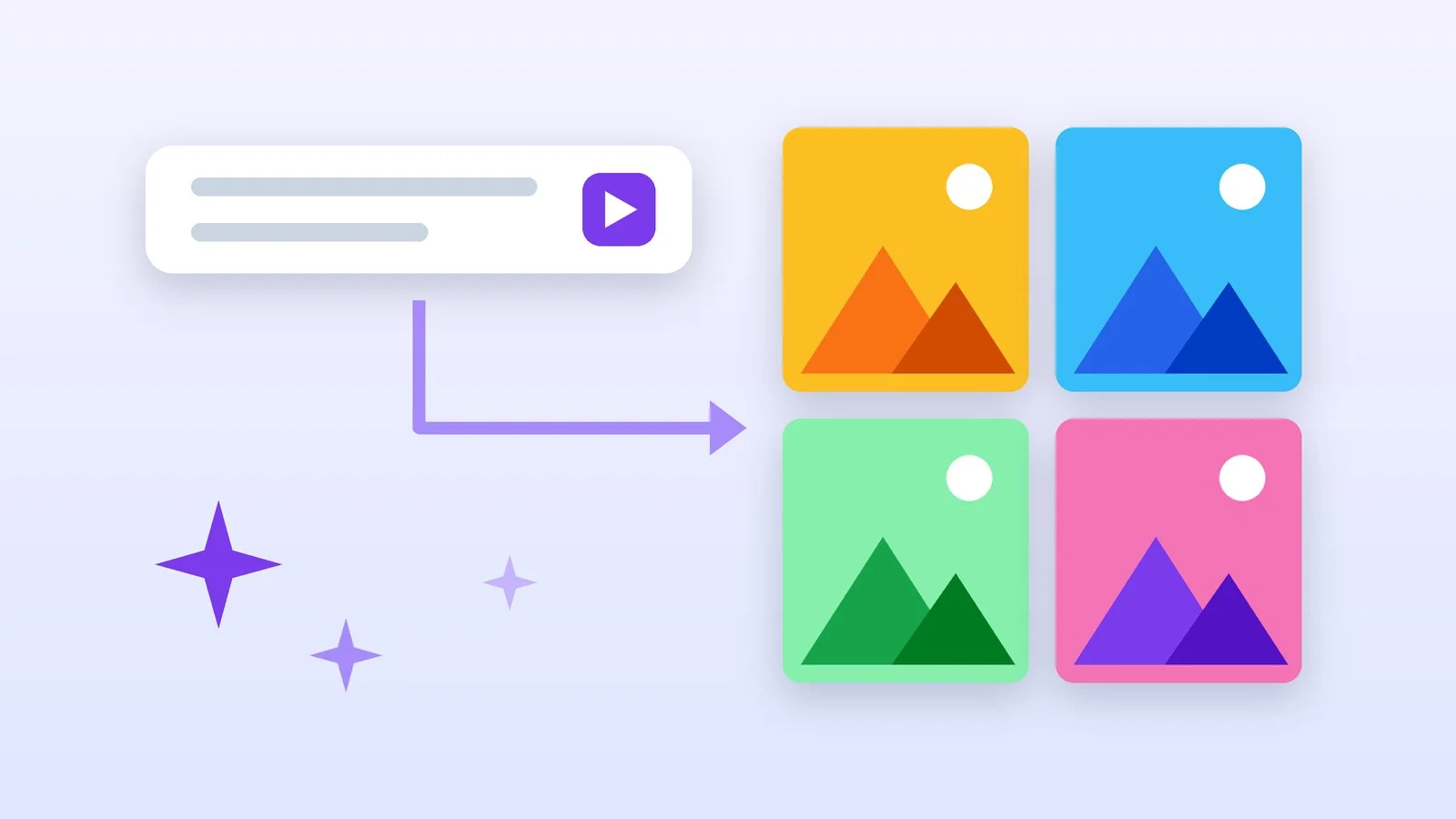
The easiest way to create an image with AI for free is Gemini or ChatGPT: open the image mode, describe what you want to see, and you get a finished picture you can refine in plain words and download. All you need is an account. Neither Google nor OpenAI publishes exact free limits — the service tells you when you run out.
Below: what seven services give you for free as of October 10, 2026, step-by-step instructions for the three easiest ones, a prompt formula with examples in Russian, Ukrainian and English, plus who owns the images and which AI labels stay in them. The terms come from each service’s own help and pricing pages. We used the same approach — service by service, and what is free in each — when we covered how to make a track with AI.
Free AI image generators compared
Free tiers differ mostly in limits and in your rights to the result. Only Canva and Ideogram publish an exact number of free generations; the others say there is a limit and that it can change without notice.
| Service | What’s free | Limits | Notable features |
|---|---|---|---|
| Google Gemini | Nano Banana 2: create and edit | Daily, number not published | Downloads about 1,000 px wide |
| ChatGPT | ChatGPT Images 2.5 on all plans | Separate, number not published | Any aspect ratio, area edits |
| Microsoft Copilot and Designer | Images after signing in | Not published | Designer is non-commercial only |
| Adobe Firefly | Daily generations on some models | Refresh every day | Commercial use |
| Canva (Magic Media) | Generation right inside a design | Up to 20 AI uses a month | Three layouts, styles, reference |
| Ideogram | 30 credits with Google, Apple or Microsoft sign-in | Refresh weekly | Free images are public |
| Midjourney | No; limited trial in niji·journey | Plans from $10 a month | Private images from the Pro plan |
Pick a service and sign in
Any of the three easiest options works for a first image. Gemini and ChatGPT draw right in the chat and let you refine the result in words. Canva is handier when the image goes straight into a post, a presentation or a card: it appears in your design, next to the text and template.
Gemini is officially available in Ukraine and supports Ukrainian and Russian; Ukraine is also on ChatGPT’s list of supported countries, with a note about certain exceptions. If you’re still choosing an everyday AI assistant, see our ChatGPT vs Gemini vs Claude comparison.
Result: You’re signed in to Gemini, ChatGPT or Canva.
Open the image creation mode
Gemini
On a computer, go to gemini.google.com, click Open Sidebar and choose Images. In the Android app, tap Menu → Images. You don’t even have to open that section: Google suggests simply starting your chat prompt with words like “draw,” “generate” or “create.”
ChatGPT
Ask in a regular chat, “create an image of…,” or select More → Images. The Images section has Templates: choose a category such as a poster or a logo, then a template, and add your details.
Canva
Open or create a design, click Magic Media in the editor side panel (if you can’t see it, find it under Apps) and go to the Images tab.
Result: A box for describing your image opens.
Describe the image
Write a description of a scene, not a pile of keywords: who or what is in the picture, what is happening, where, how the shot is framed, the lighting, style and format. For example: “A ginger cat sleeping on a windowsill on a rainy evening, side view, warm lamp light, watercolor, 4:5 format.”
In Canva you pick the style (photography, digital art or fine art) and the layout (square, landscape or portrait) in the same panel, where you can also upload a reference image. In ChatGPT you set the aspect ratio in the aspect ratio picker or right in your prompt. A ChatGPT image sometimes takes a few minutes, and you can keep chatting meanwhile. More examples and tips for text in images are in the prompt section below.
Result: An image appears; in Canva, a whole set of options.
Refine the result
Gemini. Type your changes in the next message. To get back to an earlier image, open Menu → Library, select it, click Chat under it, enter your change and click Submit. You can also upload your own photo, or several photos, and ask Gemini to combine them into a new image. Editing is available only to users 18 and over.
ChatGPT. Select the image to open the editor. Select lets you highlight an area and describe what to change in it, Aspect ratio regenerates the image in a different format, and Save finishes the edit. Highlights aren’t always precise, so an edit may spill over into nearby areas.
Canva. Generate a new set, or open the menu on the option you like and ask for similar images — that way the result changes step by step.
Result: The image looks the way you pictured it.
Download the image
Gemini. In the browser, hover over the image and click Download full size; in the app, touch and hold the image, then tap Save. Without a Google AI plan, the file is about 1,000 pixels wide; with one, about 2,000.
ChatGPT. Every image is saved automatically under Images: open the one you need and select Save. You can only remove an image from there by deleting the chat it was created in.
Canva. Click an option to add it to your design, then download the whole design.
Result: The file is saved on your computer or phone.
What each service offers for free
Google Gemini
Free images come from the Nano Banana 2 model. Google highlights its accurate text rendering in all supported languages, consistent character appearance across images and edits to specific parts of a picture. With a Google AI plan, you can redo an image with a stronger model — the Redo with Pro button — and download it at a higher resolution.
Google doesn’t give a specific number of free images: the help center mentions only a daily quota, and Gemini limits “may change without notice,” with media generation using them up faster than regular chat.
ChatGPT
The ChatGPT Images generator, now at version 2.5, is available on all plans, including Free — on the web and in the iOS and Android apps. It can put text in an image, make the background transparent and create images in any aspect ratio, and in the mobile app it turns a hand-drawn sketch into a picture.
The Free plan has its own image limit, separate from chat. OpenAI doesn’t publish the numbers — ChatGPT warns you when you hit the limit. Paid plans get higher limits, and Plus, Pro and Business also get Images with thinking.
Microsoft Copilot and Designer
The free Microsoft Copilot creates images once you sign in with a personal Microsoft account. The Microsoft Designer graphics app is free too: from a description, it makes images, greeting cards, invitations, banners and stickers, can expand a short prompt on its own and upscale images to 4K.
Microsoft doesn’t publish limits: Designer is free, and according to the company a subscription may be needed if you want to create more often. The key restriction is that Designer is licensed for personal, non-commercial use only. In Microsoft 365 Personal and Family, image generation comes with “standard” usage; in Premium and Pro, with “extensive” usage.
Adobe Firefly
Without a plan, Firefly gives a limited number of free daily generations on a curated set of models. The limit refreshes every day, and Adobe doesn’t state the exact number. The paid Firefly Standard, Pro, Pro Plus and Premium plans unlock unlimited “standard” generations and 2,000 to 50,000 monthly credits for “premium” features — video and partner models, including Google and OpenAI.
Firefly’s strong point is commercial use: Adobe allows outputs from features without a beta label to be used in commercial projects. The company says it trained its first commercial Firefly model on Adobe Stock, openly licensed content and public domain content.
Canva (Magic Media)
On Canva Free, the shared AI allowance is up to 20 uses of Standard or Premium AI tools a month; it resets on the 1st at 12:00 a.m. UTC. Once it runs out, Canva Free doesn’t switch generation off but adds short pauses between requests. On Canva Pro, Standard tools, including image generation, don’t draw from the allowance, and Premium tools get up to 200 uses a month.
Ideogram
The free plan gives 30 credits a week, but only if you sign in with Google, Apple or Microsoft: accounts created with an email and password get no free credits. Everything made on the free plan is public, and PNG downloads require a paid plan. Plus costs $20 a month ($15 a month billed yearly) and includes 2,400 credits.
Midjourney
Midjourney has no free plan: there is no free trial on the website or in Discord, only a limited trial in the niji·journey app for iOS and Android. Basic costs $10 a month (3.3 hours of fast generation), Standard $30 with unlimited images in the slower Relax mode, Pro $60 and Mega $120; annual billing is 20% cheaper. Stealth mode, which hides your images from others on the Midjourney website, is available only on Pro and Mega.
How to write a prompt: formula and examples
In its tips for its own models, Google suggests building a prompt from several parts and then fine-tuning the framing and lighting the way a cinematographer would. Others ask for detailed descriptions too: the ChatGPT, Firefly and Canva help pages also advise being specific.
- Subject. Who or what is in the picture — specifically: not “a cat” but “a ginger Maine Coon with green eyes.”
- Action. What is happening: sleeping, running, brewing coffee.
- Place and time. A rainy evening in the city, a cafe on Mars, a meadow at sunset.
- Composition. Close-up, wide shot, low angle, portrait.
- Lighting and camera. Soft window light, backlighting at sunset, shallow depth of field.
- Style. Photography, watercolor, 3D animation, flat vector illustration, film noir.
- Format. 1:1 for an avatar or a post, 9:16 for stories, 16:9 for a video thumbnail.
Examples in three languages
- «Создай фотореалистичное изображение: пожилой часовщик чинит карманные часы в мастерской, крупный план рук, тёплый свет настольной лампы, малая глубина резкости, формат 4:5».
- «Намалюй акварельну ілюстрацію: лисиця в шарфі читає книжку під деревом восени, загальний план, м’які пастельні кольори, формат 1:1».
- “A minimalist flat vector logo of a coffee cup with steam forming a leaf, two colors, white background.”
- In Midjourney you set the format with a parameter at the end of the prompt:
a lighthouse on a rocky coast during a storm, cinematic wide shot, dramatic backlight --ar 16:9. Without it, the image comes out square.
How to refine an image
- Be direct and specific, as Google advises: “change the man’s tie to green,” “remove the car in the background.”
- If you upload several photos, state the role of each: “take the pose from the first one and the style from the second.”
- For a targeted edit, select the area in ChatGPT; in Gemini, name the part of the image in your prompt.
- Google says complex edits and image blending can sometimes produce unnatural artifacts, and a character’s appearance may drift from edit to edit. If that happens, go back to a good version or start over with a sharper prompt.
Text in images
AI models handle lettering better and better, but mistakes still happen. Google admits that small text and accurate spelling don’t always come out right, and that text in different languages may contain grammar mistakes. Microsoft warns that text in Designer may come out in the wrong language or with spelling errors.
- Put the exact words in quotation marks, as Ideogram’s help suggests, and specify the font and position: “the headline ‘AUTUMN FAIR’ in large white sans-serif type at the top.”
- Short text is easier to get right; long text is more reliably added afterward in an editor such as Canva.
- If only one word is wrong, fix just that word: select the area in ChatGPT or ask Gemini to replace it.
- Check the numbers on infographics and diagrams: Google explicitly advises verifying the factual accuracy of such images.
Image rights and AI labels
Services describe your rights to the output differently, and the law in many countries is still unsettled: Canva explicitly warns that you may not be the copyright owner of an AI-generated image. The table shows only what the services’ own terms and help pages say.
| Service | Rights to the image | Commercial use | AI labels in the file |
|---|---|---|---|
| Gemini | Google doesn’t claim ownership | At your discretion, under Google’s rules | Visible mark, SynthID, C2PA |
| ChatGPT | You own them | Not prohibited; don’t pass it off as human-made | C2PA and SynthID |
| Microsoft Designer | Not stated in help | Personal, non-commercial only | C2PA |
| Adobe Firefly | Not stated in help | Allowed; beta features with caveats | Content Credentials (C2PA) |
| Canva | Yours if you follow the terms | Allowed, including selling | Not stated in help |
| Midjourney | Subscribers may use them in almost any way | Companies with over $1 million a year in revenue need Pro or Mega | Not stated in help |
SynthID, Content Credentials and the visible mark
Content Credentials, based on the C2PA standard, are file metadata: which tool created the image and when. SynthID is an invisible Google DeepMind watermark embedded in the image itself. OpenAI explains why both are used: metadata is lost when you take a screenshot or convert the file, while the watermark survives light edits and cropping but can disappear after heavy processing.
Gemini applies all three labels. You can turn off the visible mark under Settings → Media Watermark (in Vietnam, India and South Korea, only with an AI Ultra plan), but SynthID and the metadata stay. ChatGPT images carry C2PA and SynthID, and you can check a file at openai.com/verify. Firefly adds Content Credentials to fully generated images, and Designer to every image made with its AI features. In the EU, OpenAI labels text as well — see our story on OpenAI’s text watermarks.
You can check whether an image was made with Google AI in Gemini itself: upload it and ask whether it was created by AI. A negative answer doesn’t prove the photo is real: for now, Gemini recognizes only content created with Google’s tools.
What you can’t generate
- Someone’s likeness without consent. OpenAI prohibits using a person’s likeness, including a photorealistic image, without their consent in a way that could create a false impression of authenticity. Google prohibits impersonating an individual, living or dead, without explicit disclosure in order to deceive.
- Non-consensual intimate imagery and sexual content involving minors. Google’s and OpenAI’s policies explicitly prohibit both.
- Passing generated content off as human-made. OpenAI’s terms forbid it, and so do Google’s rules when the aim is to deceive.
- Recognizable characters and brands without permission. Canva warns that a design with recognizable people, characters or brands needs the rights holder’s permission, which the service can’t grant.
What happens to your uploads
- Gemini: some chats are reviewed by human reviewers. If you turn off Keep Activity, future chats won’t be used to train models, but they are still kept for 72 hours.
- ChatGPT: turn off Improve the model for everyone under Settings → Data controls, and your new chats won’t be used for training.
- Designer: personal photos you upload are saved to your OneDrive and count toward your Microsoft storage.
- Adobe Firefly: Adobe says it doesn’t train its models on Creative Cloud subscribers’ personal content.
Troubleshooting
Most problems are solved by refining the prompt or waiting for the limit to reset. For what AI models still do poorly in general, see our explainer on what artificial intelligence can do in 2026.
- The service refuses to draw — your prompt probably hit the rules: a real person, a brand, violence. Rephrase without names or recognizable details.
- You’ve hit the limit — wait for the reset: the next day in Gemini and Firefly, a week later in Ideogram, on the 1st of the month in Canva Free (until then, generation continues with pauses).
- Gemini won’t let you edit — editing is for users 18 and over only, and school accounts may have their own restrictions.
- An edit changes the whole image — select the area in ChatGPT’s editor or name the exact part of the image in your prompt.
- Typos in the lettering — put the text in quotes, shorten it, fix a single word with a targeted edit, or add the text in an editor.
- Wrong format — state the aspect ratio in the prompt (“16:9 format”), pick it in the menu in ChatGPT, choose square, landscape or portrait in Canva, or add
--ar 16:9in Midjourney. - The image is too small — without a plan, Gemini gives you a file about 1,000 pixels wide; Designer can upscale to 4K, but age restrictions apply.
Sources and methodology
Analysis of public sourcesChecked 10 October 2026
- Gemini Apps Help: generate and edit images support.google.com
- OpenAI Help Center: Images in ChatGPT help.openai.com
- Microsoft Designer FAQ support.microsoft.com
- Adobe: generative credits FAQ helpx.adobe.com
- Canva: understanding your AI usage canva.com
FAQ
Can I create an AI image for free without signing up?
Free, yes; without an account, usually not. Gemini creates images only after you sign in to Google, Copilot only after you sign in with a personal Microsoft account, and Ideogram gives free credits only if you sign in with Google, Apple or Microsoft.
How many images can I create for free?
Few services give a number: Canva Free allows up to 20 AI uses a month, and Ideogram gives 30 credits a week. Google, OpenAI, Microsoft and Adobe only say that there is a limit and that it can change; the service tells you when you’ve reached it.
Can I use AI-generated images in ads or sell them?
It depends on the service. Adobe allows commercial use of Firefly outputs, Canva lets you sell generated images as long as you follow its terms, and OpenAI assigns its rights in the output to you. Microsoft Designer is licensed for personal, non-commercial use only, and copyright in AI images is unsettled in many countries.
How do I remove the Gemini watermark from an image?
You can turn off the visible mark under Settings → Media Watermark (in Vietnam, India and South Korea, only with AI Ultra). The invisible SynthID and the C2PA metadata stay in the file regardless.
Can I turn my own photo into an AI image?
Yes. Gemini and ChatGPT edit uploaded images based on your description, and Gemini can combine several photos into a new image. In Gemini, editing is available only to users 18 and over; don’t upload other people’s photos without their consent.
Leave a Reply