
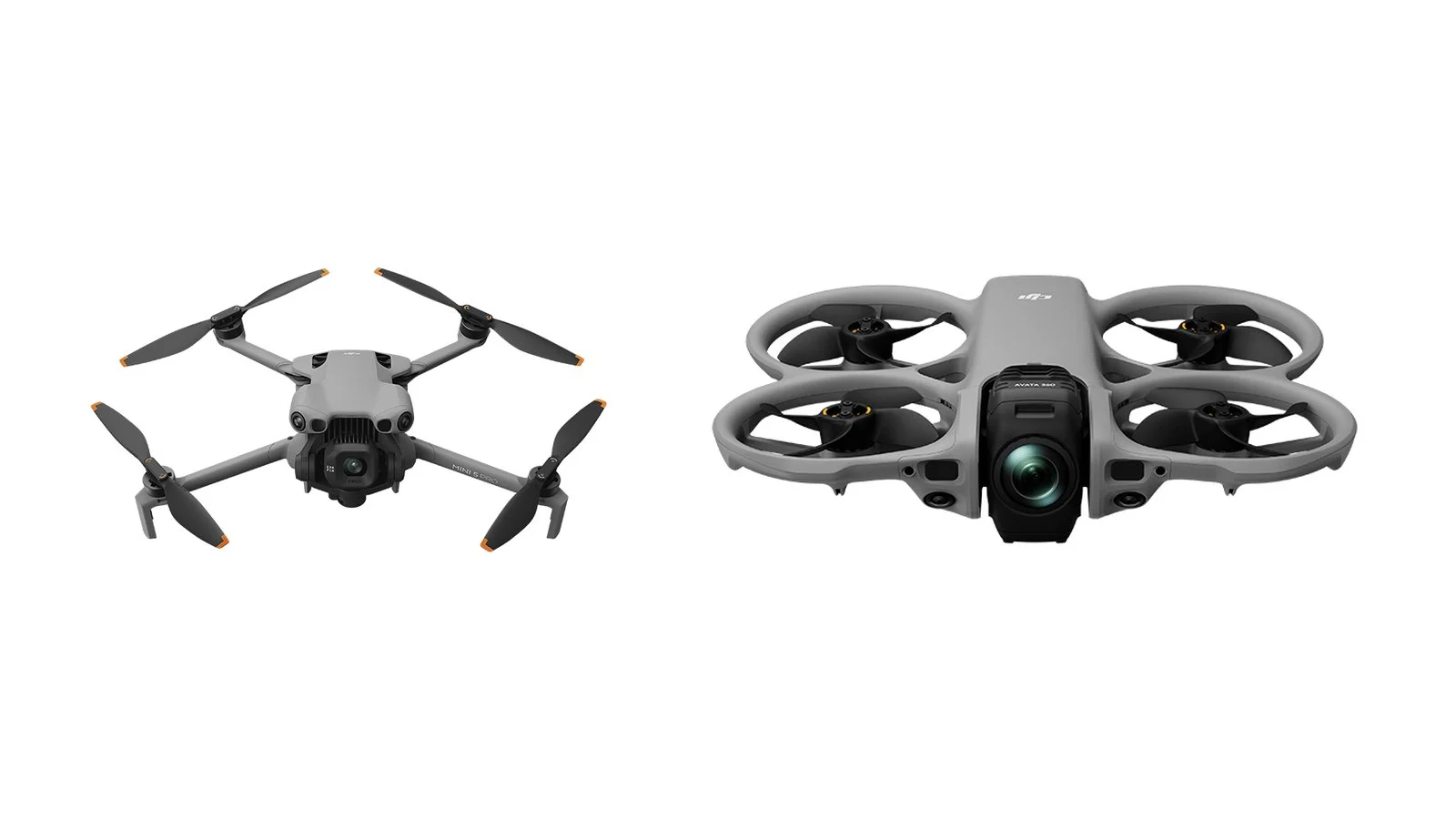
The best camera drones of 2026 are nine models on sale in September 2026, from the €239 DJI Neo 2 selfie drone to the €2,099 DJI Mavic 4 Pro with its Hasselblad camera. First place goes to the DJI Mini 5 Pro: a 1-inch sensor, 4K at up to 120 fps and obstacle sensing in all directions at 249.9 g. With a budget under €450, the DJI Lito X1 is the better buy, and for travel it’s the dual-camera Air 3S.
Below is the ranking with specs from the makers’ official sites and prices from DJI’s official store for Germany as of September 25, 2026, plus summary tables, buying tips and the rules for flying in the EU and Ukraine. We also cover how long drones actually fly and how far they transmit video in a city: DJI publishes these numbers itself, but roundups rarely quote them.
How we picked
- The model is current. The drone is listed on the maker’s site and on sale in September 2026. Models that DJI marks as discontinued didn’t make the list.
- A camera on a mechanical gimbal. Seven models have a 3-axis gimbal, the Neo 2 has a 2-axis one and the Avata 360 a single-axis one, but that drone shoots 360° video.
- Official specs. Weight, sensor, flight time, video transmission range and obstacle sensing come from DJI and Potensic product pages.
- Dated prices. DJI prices are from its official store for Germany on September 25, 2026; for Potensic, it’s the recommended price for Europe.
- Different jobs. Sub-250 g drones for beginners and trips, models with two and three cameras, a vlogging drone, a selfie drone and an FPV drone with a 360° camera.
We haven’t tested these drones ourselves: the comparison is based on manufacturer data. Models that suit most people come first, followed by drones for specific jobs.
1. DJI Mini 5 Pro
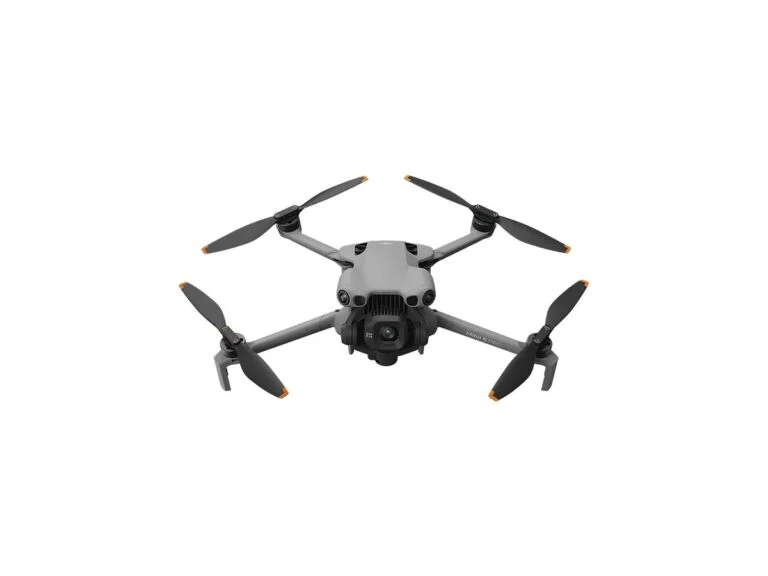
Best for most peopleSub-250 g drone
DJI Mini 5 Pro
- Weight
- 249.9 g, class C0 (EU)
- Camera
- 1-inch, 50 MP, 24 mm, f/1.8
- Video
- 4K at up to 120 fps, 10-bit, D-Log M and HLG
- Flight time
- up to 36 min (typical 21 min), up to 52 min with the Plus battery
- Video transmission
- O4+, up to 10 km (CE) and 20 km (FCC)
- Obstacle sensing
- all directions, forward LiDAR
- Gimbal
- 3-axis, 225° rotation, vertical shooting
- Internal storage
- 42 GB
Price€799 with the DJI RC-N3 remotechecked 25 September 2026
For anyone who wants the best image in a sub-250 g drone: a 1-inch sensor, night-capable obstacle sensing and up to 36 minutes in the air.
- 1-inch sensor and 4K at up to 120 fps
- All-direction sensing plus LiDAR
- 42 GB of internal storage
- Priciest sub-250 g drone on the list
- With the Plus battery it’s class C1
DJI released the Mini 5 Pro in September 2025, and it’s the only drone on this list that combines a 1-inch sensor with class C0. The camera shoots 4K at up to 120 fps and records 10-bit video in D-Log M and HLG, and the gimbal rotates 225°, so you can shoot vertical video by turning the camera 90°.
Obstacle sensing covers all directions, even at night in light down to 1 lux, according to DJI, with an extra LiDAR up front. Maximum flight time is 36 minutes, but DJI’s typical scenario with a transit flight and 4K/60 recording gives 21 minutes. The Plus battery stretches that to 52 minutes, but it takes the drone over 250 g: the Fly More Combo Plus is certified as C1.
At DJI’s store for Germany, the Mini 5 Pro with the RC-N3 remote costs €799, the Fly More Combo with three batteries and a charging hub €999, and the same kit with the RC 2 remote with a built-in screen €1,129.
2. DJI Lito X1
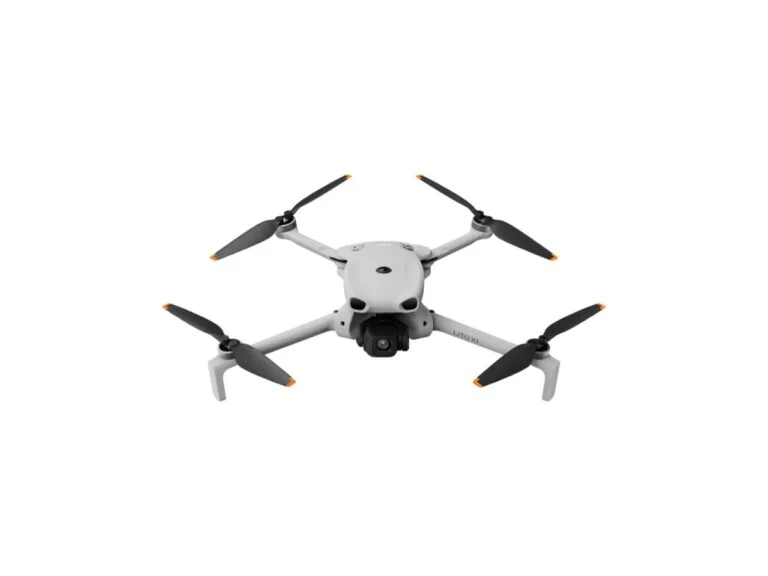
Best valueSub-250 g drone
DJI Lito X1
- Weight
- about 249 g, class C0 (EU)
- Camera
- 1/1.3-inch, 48 MP, 24 mm, f/1.7
- Video
- 4K/60 HDR, 4K slow motion at up to 100 fps, 10-bit, D-Log M
- Flight time
- up to 36 min (typical 23 min)
- Video transmission
- O4, up to 8 km (CE)
- Obstacle sensing
- all directions, forward LiDAR
- Gimbal
- 3-axis
- Internal storage
- 42 GB
Price€419 with the DJI RC-N3 remotechecked 25 September 2026
For a first serious drone: a 1/1.3-inch sensor, D-Log M and all-direction collision protection for €419.
- All-direction sensing plus forward LiDAR
- D-Log M and 42 GB of storage
- Typical flight time of 23 min
- Smaller sensor than the Mini 5 Pro
- O4 transmission, not O4+
DJI launched the Lito X1 in April 2026 as a drone for beginners. Still, it has what serious footage needs: a 48 MP 1/1.3-inch sensor, 4K/60 HDR, 4K/100 slow motion and a 10-bit D-Log M profile for color grading. Internal storage is 42 GB, the same as on the Mini 5 Pro.
Obstacle sensors look in all directions, with LiDAR up front. Compared with the Mini 5 Pro, it has a smaller sensor, O4 transmission instead of O4+ and less range: 8 km under the European CE standard versus 10 km. On the other hand, DJI rates its typical flight time while shooting 4K/60 at 23 minutes, two more than the Mini 5 Pro.
With the RC-N3 remote, the Lito X1 costs €419; the Fly More Combo with three batteries is €579. In the EU, the 52-minute Plus battery is approved only for the drone from the Fly More Combo Plus (DJI RC 2) at €759, and with it the Lito X1 is class C1.
3. DJI Air 3S
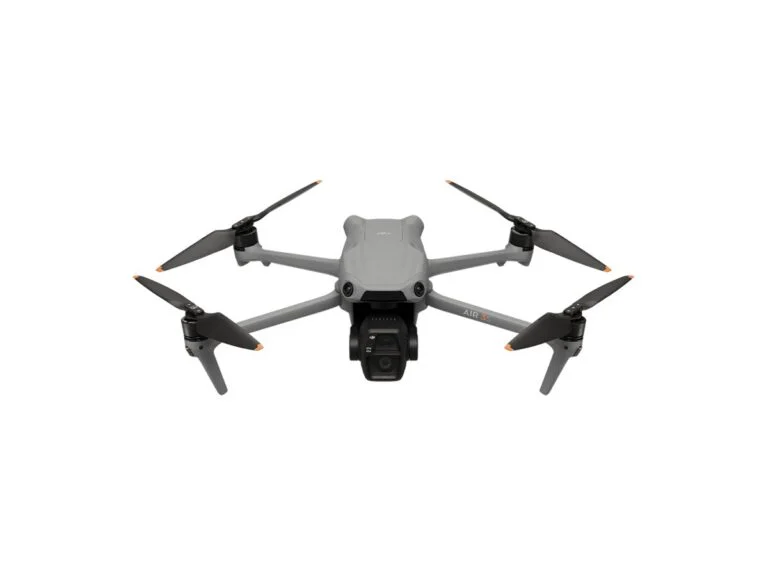
Best for travelDual-camera drone
DJI Air 3S
- Weight
- 724 g, class C1 (EU)
- Cameras
- 1-inch, 50 MP, 24 mm and 1/1.3-inch, 48 MP, 70 mm
- Video
- 4K at up to 120 fps on both cameras, 10-bit, D-Log M and HLG
- Flight time
- up to 45 min
- Video transmission
- O4, up to 10 km (CE) and 20 km (FCC)
- Obstacle sensing
- all directions, forward LiDAR
- Internal storage
- 42 GB
Price€989 with the DJI RC-N3 remote (regular price €1,099)checked 25 September 2026
For travel and landscapes: two focal lengths, a 1-inch sensor and up to 45 minutes in the air.
- Two cameras: 24 and 70 mm
- Up to 45 minutes of flight
- All-direction sensing plus LiDAR
- Class C1: online course and test required
- 724 g, much heavier than sub-250 g drones
The Air 3S came out in October 2024 and is still the current model in the Air series. Next to the main camera with a 1-inch sensor and a 24 mm lens sits a 70 mm camera that compresses perspective and makes distant subjects larger without digital zoom. Both cameras record 4K at up to 120 fps in 10-bit, including D-Log M and HLG.
What sets the Air 3S apart from sub-250 g drones is flight time, up to 45 minutes, and class: at 724 g it’s C1, so in the EU the pilot needs the A1/A3 online course and test and must register as an operator. Like the Mini 5 Pro, it senses obstacles in all directions and has LiDAR up front.
As of September 25, 2026, DJI’s store for Germany has the Air 3S on sale: €989 instead of €1,099 with the RC-N3 remote and €1,259 instead of €1,399 for the Fly More Combo.
4. DJI Mavic 4 Pro
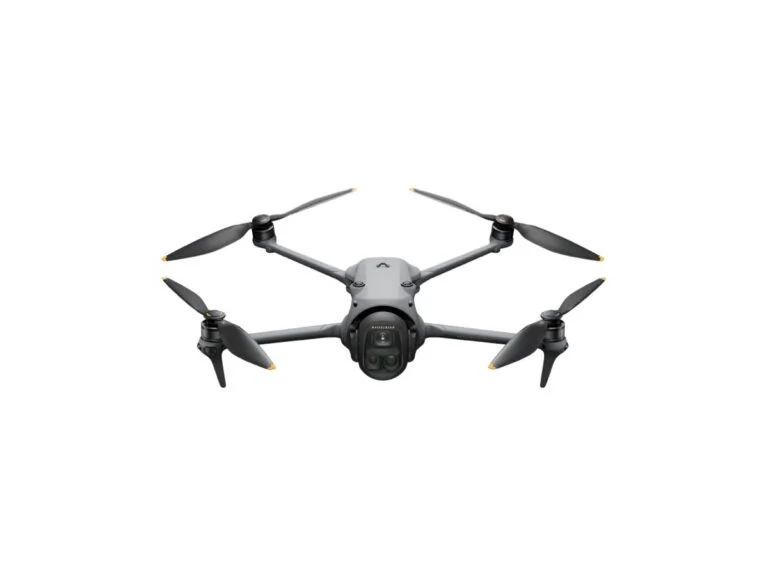
Best for pro workProfessional drone
DJI Mavic 4 Pro
- Weight
- about 1,063 g, class C2 (EU)
- Cameras
- Hasselblad 4/3, 100 MP, 28 mm, f/2.0–11; 70 mm (1/1.3-inch, 48 MP); 168 mm (1/1.5-inch, 50 MP)
- Video
- 6K at up to 60 fps, 4K at up to 120 fps, 10-bit, D-Log, D-Log M and HLG
- Flight time
- up to 51 min
- Video transmission
- O4+, up to 15 km (CE) and 30 km (FCC)
- Obstacle sensing
- all directions, forward LiDAR
- Gimbal
- 360° rotation
- Internal storage
- 64 GB (about 42 GB available)
Price€2,099 with the DJI RC 2 remotechecked 25 September 2026
For commercial work, real estate and weddings: three cameras, 6K and up to 51 minutes of flight.
- Three cameras: 28, 70 and 168 mm
- Aperture f/2.0–11
- Up to 51 minutes of flight
- Class C2: A2 certificate needed near people
- About 1 kg and from €2,099
The Mavic 4 Pro is DJI’s flagship for photo and video, released in May 2025. The main Hasselblad camera with a 100 MP 4/3 sensor and an adjustable f/2.0–11 aperture shoots 6K at up to 60 fps, joined by 70 mm and 168 mm cameras. Video is recorded in 10-bit, in D-Log, D-Log M and HLG.
The Infinity Gimbal rotates 360°, O4+ transmission reaches up to 15 km under the CE standard, and flight time goes up to 51 minutes. But at about 1 kg it’s class C2: to fly closer than 30 m to uninvolved people in the EU, you need an A2 certificate; without it, you’re limited to subcategory A3, far from people.
The Mavic 4 Pro with the RC 2 remote costs €2,099, the Fly More Combo €2,699, and the Creator Combo with 512 GB of storage and the RC Pro 2 remote €3,539.
5. DJI Lito 1
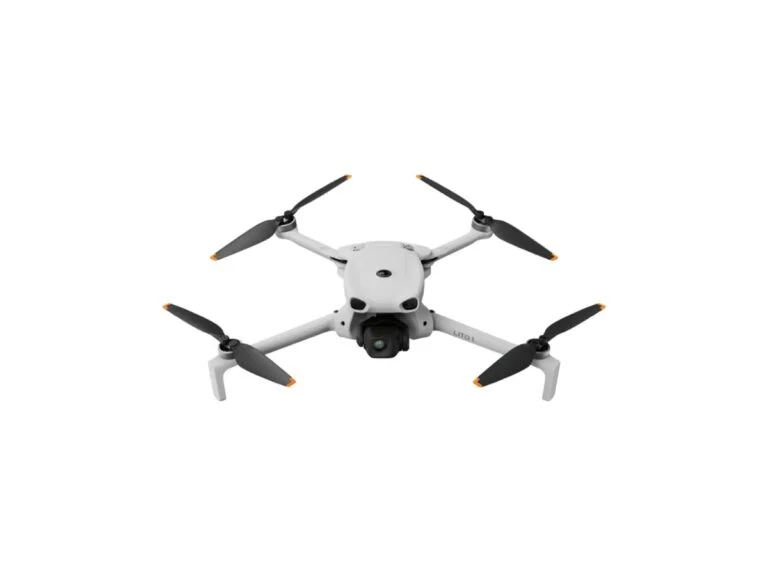
Best first droneSub-250 g drone
DJI Lito 1
- Weight
- about 249 g, class C0 (EU)
- Camera
- 1/2-inch, 48 MP, f/1.8
- Video
- 4K/60, 4K slow motion at up to 100 fps
- Flight time
- up to 36 min (typical 23 min)
- Video transmission
- O4, up to 8 km (CE)
- Obstacle sensing
- all directions
- Gimbal
- 3-axis
- Internal storage
- none, microSD only
Price€288 with the DJI RC-N3 remote (regular price €339)checked 25 September 2026
For a first taste of drones: all-direction sensing and up to 36 minutes of flight for minimal money.
- All-direction obstacle sensing
- Up to 36 minutes of flight
- €288 on sale
- 1/2-inch sensor, no D-Log M
- No LiDAR or internal storage
The Lito 1 is the entry model of the Lito series and the most affordable drone on this list with obstacle sensing in all directions. Its camera is simpler than the Lito X1’s: a 1/2-inch sensor and no D-Log M, though 4K/60 and 4K/100 slow motion are there.
Beyond the sensor, it differs from the X1 by having no LiDAR and no internal storage: it records only to a microSD card. The Plus battery isn’t supported for the Lito 1 in the EU and the UK, so the drone stays in class C0. As of September 25, 2026, DJI sells it for €288 instead of €339; the Fly More Combo costs €479.
6. Potensic ATOM 3
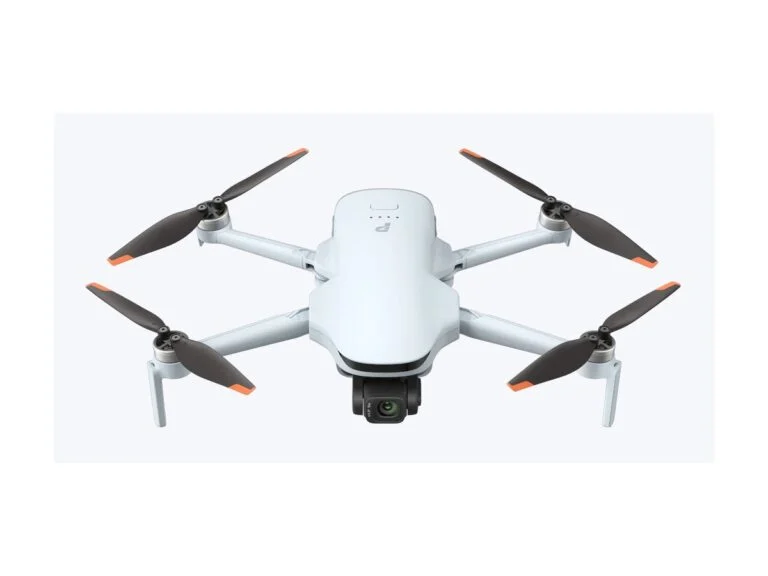
DJI alternativeSub-250 g drone
Potensic ATOM 3
- Weight
- under 249 g, class C0 (EU)
- Camera
- 1/1.3-inch, 50 MP, f/2.8, focus from 2 m
- Video
- 4K at up to 60 fps, HDR and P-Log, 48 mm mode
- Flight time
- up to 40 min (European version)
- Video transmission
- PixSync 5.0, up to 16 km
- Obstacle sensing
- none, downward positioning system only
- Gimbal
- 3-axis
Pricefrom €379.99checked 25 September 2026
For anyone who wants a non-DJI drone: a 1/1.3-inch sensor and up to 40 minutes of flight, but no obstacle avoidance.
- 1/1.3-inch, 50 MP sensor
- Up to 40 minutes of flight
- 48 mm mode for close-ups
- No obstacle sensors
- Focus from 2 m, f/2.8 aperture
Potensic released the ATOM 3 on June 10, 2026, making it the newest model on this list. It has a 50 MP 1/1.3-inch sensor, 4K video at up to 60 fps with HDR and a P-Log log profile, a 3-axis gimbal and a 48 mm mode for close-ups.
The main trade-off is safety: Potensic’s specs list only a downward vision positioning system, with no sensors for avoiding obstacles. The camera focuses from 2 m, and the aperture is f/2.8. For Europe, the maker claims up to 40 minutes of flight, PixSync 5.0 video transmission up to 16 km and a price from €379.99.
7. DJI Flip
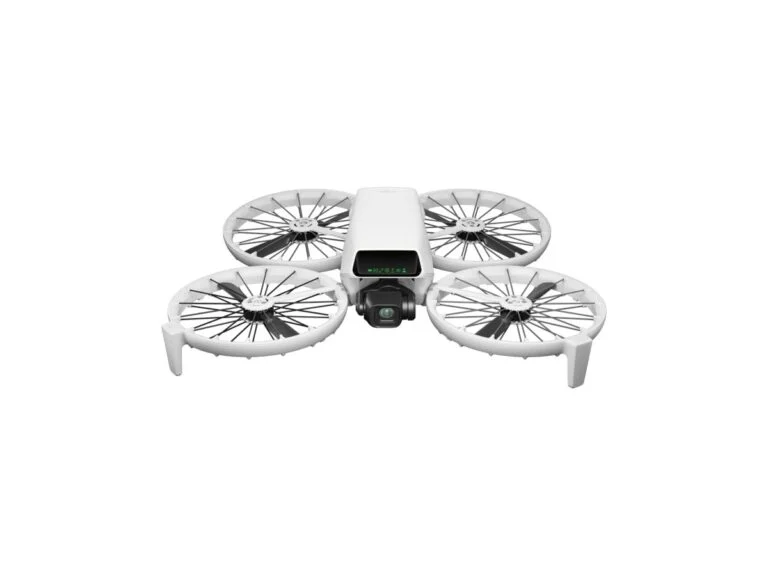
Best for vloggingVlogging drone
DJI Flip
- Weight
- under 249 g, class C0 (EU)
- Camera
- 1/1.3-inch, 48 MP, f/1.7
- Video
- 4K at up to 100 fps, D-Log M
- Flight time
- up to 31 min
- Video transmission
- O4, up to 8 km (CE) and 13 km (FCC)
- Obstacle sensing
- front and below
- Propeller guard
- foldable, fully covers the propellers
- Internal storage
- 2 GB
Price€349 with the DJI RC-N3 remotechecked 25 September 2026
For vloggers and trips: palm takeoff, filming without a remote and a propeller guard that makes flying near people less stressful.
- Foldable propeller guard
- Palm takeoff and filming without a remote
- 1/1.3-inch sensor and D-Log M
- Sensors only in front and below
- No obstacle avoidance while tracking
The Flip came out in January 2025 as DJI’s first drone with a foldable guard that fully covers the propellers. It takes off from your palm and films without a remote, and in the DJI Fly app it responds to voice commands, for now only in English and Chinese.
Its sensor is the same size as the Lito X1’s: 1/1.3-inch, 48 MP, 4K at up to 100 fps and D-Log M. The weak spot is sensing: the Flip sees obstacles only in front and below, and in intelligent modes, including subject tracking, obstacle avoidance doesn’t work. It costs €349 with the RC-N3 remote and €509 with the RC 2.
8. DJI Neo 2
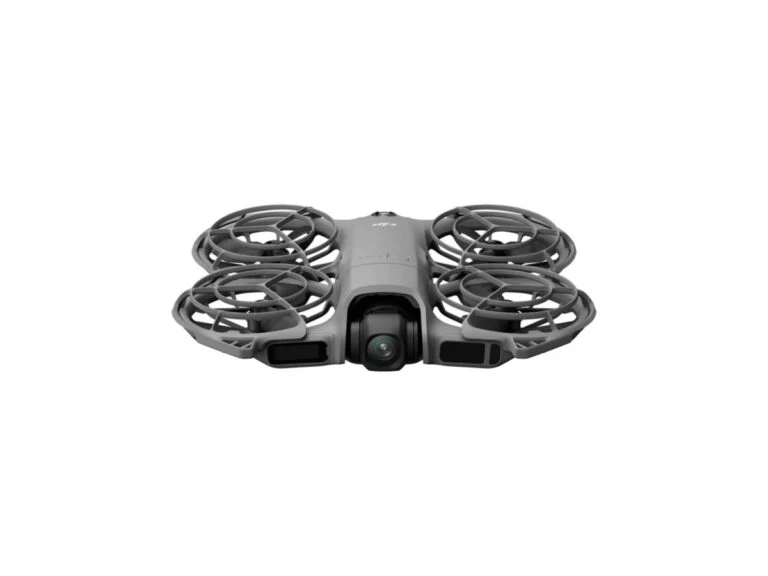
LightestSelfie drone
DJI Neo 2
- Weight
- 151 g (160 g with the O4 module), class C0 (EU)
- Camera
- 1/2-inch, 12 MP, f/2.2
- Video
- 4K at up to 60 fps, 4K/100 with a remote or motion controller
- Stabilization
- 2-axis gimbal plus electronic
- Flight time
- up to 19 min (17 min with propeller guards)
- Control
- gestures, smartphone over Wi-Fi up to 500 m, up to 6 km (CE) with the O4 module
- Obstacle sensing
- all directions, forward LiDAR
- Internal storage
- 49 GB
Price€239 without a remotechecked 25 September 2026
For selfie videos, sports and walks: it takes off from your palm, follows you and responds to gestures.
- 151 g, propeller guards included
- Gesture and smartphone control
- 49 GB of internal storage
- Up to 19 minutes of flight
- 12 MP photos, no D-Log M
The Neo 2 is the lightest drone on this list at 151 g. It takes off from and lands back on your palm, follows a person and responds to gestures: according to DJI, pointing your palm at the drone is enough to move it up, down or sideways. Without a remote, the Neo 2 is controlled from a smartphone over Wi-Fi at up to 500 m.
Compared with the first Neo, the second version adds obstacle sensing in all directions and forward LiDAR, and internal storage grows to 49 GB. The limits are up to 19 minutes of flight and a basic camera: 12 MP photos and video without a D-Log M profile. The drone alone costs €239; the Fly More Combo with the RC-N3 remote, the O4 transmission module and three batteries is €399.
9. DJI Avata 360
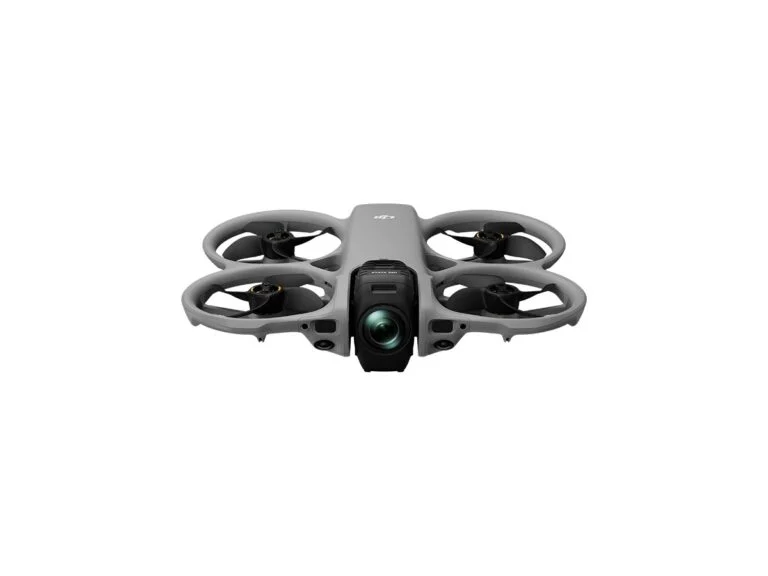
Best for 360° videoFPV drone with a 360° camera
DJI Avata 360
- Weight
- about 455 g, class C1 (EU)
- Cameras
- two 1/1.1-inch, 64 MP each
- Video
- 360° in 8K at up to 60 fps, single-lens 4K at up to 60 fps
- Flight time
- up to 23 min
- Video transmission
- O4+, up to 10 km (CE) and 20 km (FCC)
- Obstacle sensing
- all directions, forward LiDAR, built-in propeller guard
- Control
- RC 2, RC-N2 or RC-N3 remote, Goggles 3 or N3 with RC Motion 3
- Internal storage
- 42 GB
Price€459 without a remote, €719 with the DJI RC 2 remotechecked 25 September 2026
For fly-throughs and footage you frame in the edit: 8K 360° video and a propeller guard.
- 360° video in 8K at up to 60 fps
- Reframe in any direction after shooting
- Built-in propeller guard
- Up to 23 minutes of flight
- Class C1; goggles in the EU need an observer
DJI introduced the Avata 360 in March 2026. Two cameras with square 1/1.1-inch sensors shoot 360° video in 8K at up to 60 fps, so you can pick the framing in the edit and cut several clips from one flight. In single-lens mode, the drone shoots regular 4K video.
You can fly it with a regular remote or in Goggles 3/N3 with the RC Motion 3 controller for an immersive FPV experience. In the EU, when you fly with goggles, an observer who can see the drone must stand next to the pilot. Without a remote, the Avata 360 costs €459, an option for those who already own a compatible DJI remote or goggles; with the RC 2 remote, it’s €719.
Comparison
| Model | Best for | Key strength | Price |
|---|---|---|---|
| DJI Mini 5 Pro | Most people | 1-inch sensor under 250 g | €799 |
| DJI Lito X1 | Beginners with up to €450 | All-direction sensing and LiDAR | €419 |
| DJI Air 3S | Travel and landscapes | Two cameras: 24 and 70 mm | €989 (usually €1,099) |
| DJI Mavic 4 Pro | Professional work | Three cameras and 6K video | €2,099 |
| DJI Lito 1 | First drone | All-direction sensing | €288 (usually €339) |
| Potensic ATOM 3 | A DJI alternative | 1/1.3-inch sensor and 40 minutes | from €379.99 |
| DJI Flip | Vlogs, flying near people | Full propeller guard | €349 |
| DJI Neo 2 | Selfie videos and sports | 151 g and gesture control | €239 without a remote |
| DJI Avata 360 | FPV and 360° video | 360° video in 8K | €459 without a remote |
Sensor, weight, class and flight time, per the manufacturers:
| Model | Main camera sensor | Weight, g | EU class | Max flight time, min | Obstacle sensing |
|---|---|---|---|---|---|
| DJI Mini 5 Pro | 1-inch | 249.9 | C0 | 36 | All directions and LiDAR |
| DJI Lito X1 | 1/1.3-inch | about 249 | C0 | 36 | All directions and LiDAR |
| DJI Air 3S | 1-inch | 724 | C1 | 45 | All directions and LiDAR |
| DJI Mavic 4 Pro | 4/3 | about 1,063 | C2 | 51 | All directions and LiDAR |
| DJI Lito 1 | 1/2-inch | about 249 | C0 | 36 | All directions |
| Potensic ATOM 3 | 1/1.3-inch | under 249 | C0 | 40 | None |
| DJI Flip | 1/1.3-inch | under 249 | C0 | 31 | Front and below |
| DJI Neo 2 | 1/2-inch | 151 | C0 | 19 | All directions and LiDAR |
| DJI Avata 360 | Two 1/1.1-inch | about 455 | C1 | 23 | All directions and LiDAR |
How to choose a camera drone
- Start with weight and class. Class C0 drones weigh under 250 g, and in the EU reading the manual is enough to fly them, though the operator of a drone with a camera still has to register. C1 (Air 3S, Avata 360) requires an online course with a test, and C2 (Mavic 4 Pro) also needs an A2 certificate to fly near people.
- Compare sensor size, not megapixels. On this list, that’s 1/2-inch on the Lito 1 and Neo 2, 1/1.3-inch on the Lito X1, Flip and ATOM 3, 1-inch on the Mini 5 Pro and Air 3S, and 4/3 on the Mavic 4 Pro. The bigger the sensor, the better the footage in the evening and in high-contrast light.
- Look at typical flight time. DJI measures maximum flight time in a wind tunnel with no wind. For the Mini 5 Pro and the Lito series, it also gives a typical time with a transit flight and 4K/60 recording: 21 and 23 minutes instead of 36. That’s why the Fly More Combo with three batteries is the better buy from the start: for the Mini 5 Pro, it costs €200 more than the base kit. For what usually comes in the box, see our article on camera quadcopters and their essential equipment.
- Don’t count on 20–30 km of range. That’s the result in open terrain with no interference. In a city, DJI’s own estimates put video transmission at 1–2.5 km for the Flip, 1.5–3 km for the Lito and Neo 2, 1.5–4 km for the Mini 5 Pro, Air 3S and Avata 360, and 1.5–6 km for the Mavic 4 Pro, and behind buildings only up to 0.5–0.7 km. DJI gives these figures for the FCC and IC standards; under the European CE standard, maximum range is noticeably shorter.
- Check obstacle sensing. Seven models on this list sense obstacles in all directions. The Flip has sensors only in front and below, and the ATOM 3 has no sensors for avoiding obstacles.
- Pick a remote. The DJI RC-N3 uses your smartphone as the screen, while the RC 2 has its own 5.5-inch screen, but kits with it cost more: €160 more for the Flip.
- Plan for editing. 10-bit D-Log M and D-Log profiles leave room for color grading, but that footage has to be processed. Editing 4K calls for a powerful computer.
Drone rules in the EU and Ukraine
In EU countries, most leisure flying falls under EASA’s open category. It is split into subcategories A1 (you may fly over individual people, but not over assemblies of people), A2 (close to people) and A3 (far from people). The height limit is 120 m everywhere, and the drone must stay within visual line of sight. EASA makes exceptions for follow-me mode on C0, C1 and sub-250 g drones and for flying with goggles when an observer stands next to you.
| Class | Drones on this list | Subcategory | Pilot training | Operator registration |
|---|---|---|---|---|
| C0, under 250 g | Mini 5 Pro, Lito 1 and X1, ATOM 3, Flip, Neo 2 | A1, may fly over individual people | Read the manual | Yes, if it has a camera |
| C1, under 900 g | Air 3S, Avata 360, Mini 5 Pro and Lito X1 in Plus kits | A1, no flying over uninvolved people | A1/A3 online course and test | Yes |
| C2, under 4 kg | Mavic 4 Pro | A2: 30 m from people (5 m at low speed) or A3 | A2 certificate | Yes |
Ukraine is under martial law, and flying rules depend on wartime restrictions. According to an explanation from a district military administration, Ukraine’s airspace has been closed to civilian users, including drones, since February 24, 2022, and using a drone, for example in agriculture, has to be cleared with the military administration. Local councils are still reminding residents of these restrictions in 2026.
Before buying, check the procedure with your regional or district military administration. Other countries have their own rules, so check them on your national aviation authority’s website.
What happened to drones from older rankings
The previous version of this article featured the DJI Mavic Mini, Mavic 2 Pro, Mavic Air and Inspire 2. DJI’s site marks all of them as discontinued. The same series now include the Mini 5 Pro, Air 3S, Mavic 4 Pro and Inspire 3, the last with a full-frame 8K camera for filmmaking.
In July 2025, Autel Robotics stopped selling its EVO Nano and EVO Lite drones, including the EVO Lite+, which still turns up in roundups. The company promises to service them until July 18, 2030.
Sources and methodology
Analysis of public sourcesChecked 25 September 2026
- EASA — open category, classes C0–C4 easa.europa.eu
- DJI official store for Germany — prices as of September 25, 2026 store.dji.com
- Potensic — ATOM 3 press release for Europe prnewswire.com
- District military administration — explanation on drone use (in Ukrainian) volodymyrrada.gov.ua
- Specs — official DJI and Potensic pages, linked in the cards
FAQ
Do I need to register a drone under 250 g?
In the EU, it’s the operator who registers, not the drone. If the drone has a camera and isn’t a toy, registration is required even for a class C0 model under 250 g, but no exam is needed: reading the manual is enough. Class C1 also requires the A1/A3 online course and test.
Which camera drone should a beginner buy?
From this list, the DJI Lito 1 at €288 on sale or the Lito X1 at €419: both weigh under 250 g, sense obstacles in all directions and fly for up to 36 minutes. For selfie videos without a remote, the Neo 2 at €239 is a good fit.
How long does a drone really fly on one battery?
Less than the spec sheet says: DJI measures maximum flight time with no wind. In DJI’s typical scenario with a transit flight and 4K/60 recording, the Mini 5 Pro flies about 21 minutes, and the Lito 1 and Lito X1 about 23 minutes instead of 36.
How far does a drone transmit video in a city?
According to DJI, with strong interference in a city it ranges from 1–2.5 km for the Flip to 1.5–6 km for the Mavic 4 Pro, and behind buildings it’s up to 0.5–0.7 km. The advertised 8–30 km is achievable only in open terrain, and in the EU the drone has to stay within visual line of sight anyway.
Can I fly a drone in Ukraine right now?
Ukraine is under martial law: according to a military administration explanation, the airspace has been closed to civilian users, including drones, since February 24, 2022. Check the procedure for using a drone with your regional or district military administration.





Leave a Reply