
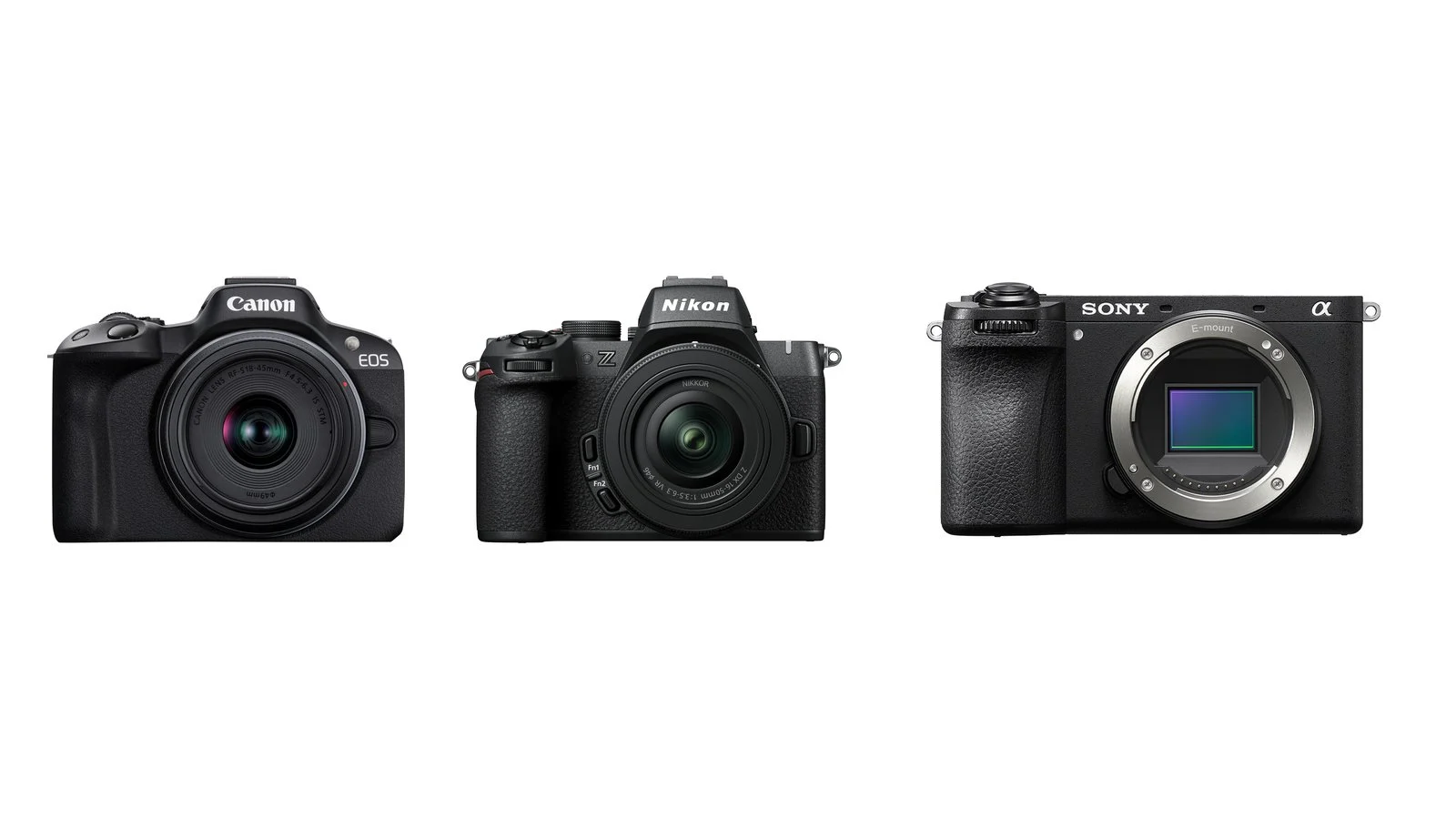
The best cameras of 2026 by task: for a first camera, the Canon EOS R50 at €855 with a lens or the Nikon Z50II at €1,149; for vlogging, the Sony ZV-E10 II; for enthusiasts, the Fujifilm X-T50 and the Sony α6700; for hiking, the OM System OM-5 Mark II; for your pocket, the Panasonic Lumix TZ300. If you want full frame, choose between the Nikon Z5II, the new Canon EOS R8 Mark II and the Sony α7 V.
Below are 10 cameras that their makers sell or have announced as of September 2026: nine mirrorless models with APS-C, Four Thirds and full-frame sensors, plus one compact. For each one you get the sensor size and resolution, the mount and kit lens, stabilization, video, weight, shots per charge under the CIPA standard and the official price as of September 25, 2026. After the list come a comparison table and tips on choosing a camera and budgeting for lenses.
How we picked
- Current models only. All 10 cameras are listed on their makers’ official websites in September 2026. The Canon EOS R8 Mark II was announced on September 15 and is still on preorder; the rest are already on sale. The cameras from the previous version of this article, such as the Canon EOS 5D Mark IV, Nikon D850 and Sony a6000, came out between 2014 and 2019, so they didn’t make the list.
- Different jobs. A first camera, vlogging, enthusiast shooting, hiking and travel, and moving up to full frame.
- Manufacturer data. Sensor, mount, stabilization, video, weight and battery life come from the official Canon, Nikon, Sony, Fujifilm, OM System and Panasonic websites.
- Official prices as of September 25, 2026. Fujifilm is the only brand here with an official online store in Ukraine that shows prices, so the X-T50 is listed in hryvnias. The Ukrainian websites of Canon, Nikon, Sony and Panasonic don’t show prices, and OM System has no Ukrainian website, so for these cameras we list the prices in the makers’ own online stores in Germany.
These aren’t our test results: we didn’t test the cameras, we compare manufacturer data. Prices in Ukrainian stores differ, and promotions run for a limited time.
1. Canon EOS R50
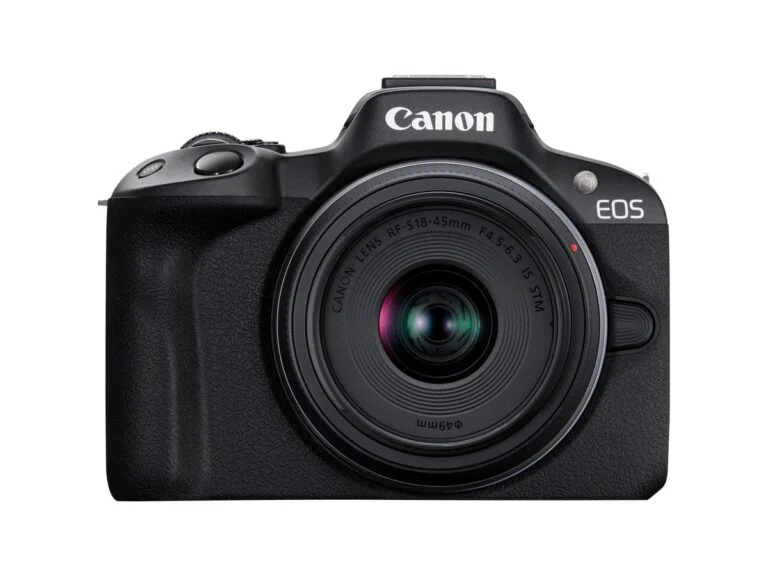
Best for beginnersAPS-C mirrorless camera
Canon EOS R50
- Sensor
- APS-C (22.3 × 14.9 mm), 24.2 MP
- Mount
- Canon RF
- Kit lens
- RF-S 18-45mm F4.5-6.3 IS STM
- Stabilization
- in the lens, none in the body; digital for video
- Video
- 4K up to 30 fps from 6K, Full HD up to 120 fps
- Weight
- 375 g with battery and card, body 328 g
- Battery
- LP-E17, up to 440 shots (CIPA)
Price€855 with RF-S 18-45mm, body €745checked 25 September 2026
A first interchangeable-lens camera for photos and video: light, affordable, with a viewfinder and a vari-angle touchscreen.
- Most affordable kit with a lens on the list
- 375 g with battery and card
- Vari-angle touchscreen
- No in-body stabilization
- 4K only up to 30 fps
- About 310 shots per charge with the viewfinder
The EOS R50 is the most affordable camera on the list: Canon’s own store in Germany sells it for €855 with the RF-S 18-45mm F4.5-6.3 IS STM zoom. Inside is a 24.2 MP APS-C sensor with Dual Pixel CMOS AF II autofocus; on top, an electronic viewfinder; on the back, a vari-angle touchscreen.
There’s no in-body stabilization: for stills, the kit lens handles shake, and for video there’s digital stabilization. Video tops out at 4K 30 fps, downsampled from 6K, plus Full HD at up to 120 fps for slow motion. If you mostly shoot video, look at the EOS R50 V at €759 body only: it adds 4K 60p, 6K oversampling and the Canon Log 3 profile. Cheaper still is the EOS R100 with the same zoom for €609.
2. Nikon Z50II
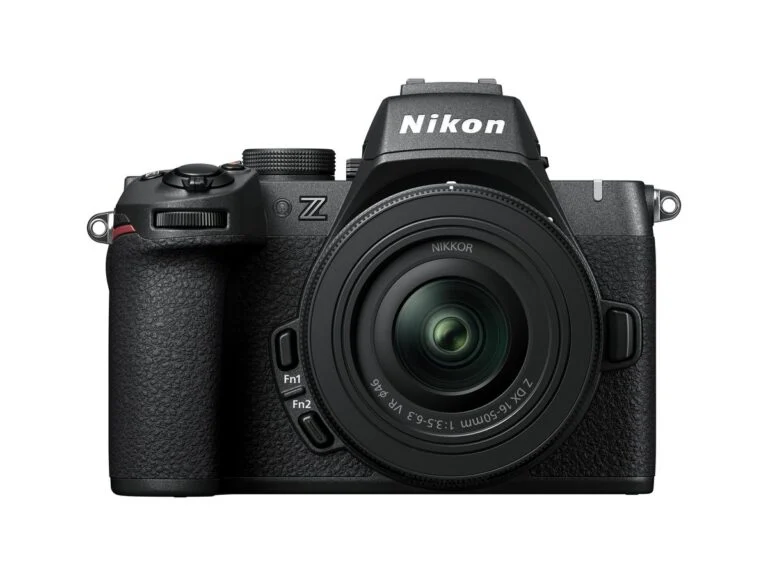
Beginner with room to growAPS-C mirrorless camera
Nikon Z50II
- Sensor
- APS-C (23.5 × 15.7 mm), 20.9 MP
- Mount
- Nikon Z
- Kit lens
- NIKKOR Z DX 16-50mm f/3.5-6.3 VR
- Stabilization
- in the lens, none in the body; electronic for video
- Video
- 4K up to 60 fps, Full HD up to 120 fps, N-Log
- Weight
- 550 g with battery and card, body 495 g
- Battery
- EN-EL25a, up to 250 shots (CIPA)
Price€1,149 with 16-50mm VR, body €999checked 25 September 2026
For people learning photography who want a 2.36-million-dot viewfinder, a built-in flash and 4K 60p video.
- 4K video up to 60 fps
- Built-in flash
- Bursts up to 30 fps
- Battery lasts up to 250 shots
- No in-body stabilization
- 175 g heavier than the Canon EOS R50
The Z50II is an APS-C camera (Nikon calls the format DX) with a 20.9 MP sensor and the Z mount. It also takes lenses made for full-frame Nikons, so if you later move to, say, the Z5II, you can keep your glass. It has a 2.36-million-dot viewfinder, a 3.2-inch vari-angle touchscreen and a built-in flash, and through the Nikon Imaging Cloud service you can load up to nine exclusive Imaging Recipes color profiles.
Video goes up to 4K 60 fps and Full HD 120 fps, with N-Log and HLG profiles and electronic stabilization for handheld shooting. The weak spot is the EN-EL25a battery: 230–250 shots with the screen and 220–240 with the viewfinder under CIPA. Nikon’s store in Germany sells the kit with the 16-50mm VR for €1,149, the body for €999, and a version with the brighter 16-50mm f/2.8 VR for €1,699.
3. Sony ZV-E10 II
For vloggingVlogging camera
Sony ZV-E10 II
- Sensor
- APS-C (23.3 × 15.5 mm), 26 MP
- Mount
- Sony E
- Kit lens (ZV-E10M2K)
- E PZ 16-50mm F3.5-5.6 OSS II
- Stabilization
- in the lens, electronic Active mode for video, none in the body
- Video
- 4K up to 60 fps, 10-bit 4:2:2, Full HD up to 120 fps
- Weight
- body 292 g
- Battery
- NP-FZ100, up to 610 shots or 130 minutes of video (CIPA)
Price€849.99 body onlychecked 25 September 2026
For vlogs, streams and social media clips: a light body, a vari-angle screen, mic and headphone jacks, and a big battery.
- Battery good for 610 shots or 130 minutes of video
- Mic and headphone jacks
- Lightest body on the list
- No viewfinder
- Electronic shutter only
- No in-body stabilization
The ZV-E10 II is an interchangeable-lens camera Sony builds for vloggers. You get a 26 MP APS-C sensor, 4K recording at up to 60 fps including 10-bit 4:2:2, Full HD at up to 120 fps, a vari-angle screen, a Cinematic Vlog setting, mic and headphone jacks, and streaming over USB and over the network (RTMP, SRT).
For stills it’s a compromise: there’s no viewfinder, the shutter is electronic only, and there’s no in-body stabilization either; for video, Sony offers the electronic Active mode. On the plus side, the NP-FZ100 battery is rated for 610 shots or 130 minutes of video under CIPA. Sony’s own store in Germany sells only the body, for €849.99; Sony’s lineup also includes a kit with the E PZ 16-50mm F3.5-5.6 OSS II zoom.
4. Fujifilm X-T50
For enthusiastsAPS-C mirrorless camera
Fujifilm X-T50
- Sensor
- APS-C X-Trans CMOS 5 HR (23.5 × 15.7 mm), 40.2 MP
- Mount
- Fujifilm X
- Kit lens
- XC 15-45mm F3.5-5.6 or XF 16-50mm F2.8-4.8 R LM WR
- Stabilization
- 5-axis in-body, up to 7 stops
- Video
- 6.2K up to 30 fps, 4K up to 60 fps, Full HD up to 240 fps, 10-bit 4:2:2
- Weight
- 438 g with battery and card, body 389 g
- Battery
- NP-W126S, 305 shots (CIPA), 390 in economy mode
PriceUAH 82,990 with XC 15-45mm, body UAH 77,990checked 25 September 2026
For walks and trips when you want finished shots with Fujifilm Film Simulations, while 40 MP leaves room for cropping.
- 40.2 MP, the most on the list
- In-body stabilization up to 7 stops
- Film Simulation dial
- Battery lasts 305 shots
- 20 fps only with a 1.29x crop
The X-T50 looks like Fujifilm’s film cameras, and its top plate has a dedicated Film Simulation dial with 20 modes, including the latest, REALA ACE. Its 40.2 MP APS-C X-Trans CMOS 5 HR sensor has the highest resolution on the list. The five-axis in-body stabilization is rated at up to 7 stops.
Video goes up to 6.2K 30 fps, 4K 60 fps and Full HD 240 fps, in 10-bit 4:2:2. The NP-W126S battery is small: 305 shots under CIPA, or 390 in economy mode. Fujifilm’s official online store in Ukraine sells the X-T50 for UAH 77,990 body only, UAH 82,990 with the XC 15-45mm and UAH 97,990 with the brighter XF 16-50mm F2.8-4.8 R LM WR.
5. Sony α6700
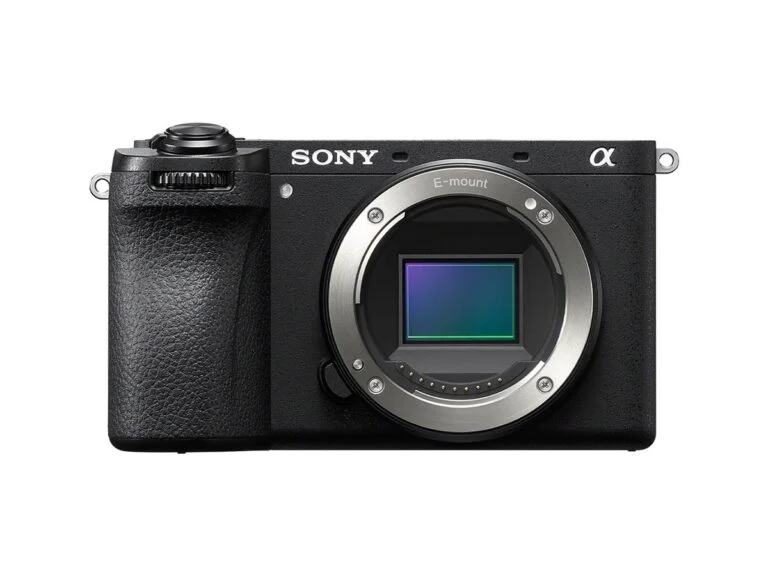
Photo and video alikeAPS-C mirrorless camera
Sony α6700
- Sensor
- APS-C (23.3 × 15.5 mm), 26 MP
- Mount
- Sony E
- Stabilization
- 5-axis in-body, 5 stops
- Video
- 4K up to 120 fps, 10-bit 4:2:2, Full HD up to 120 fps
- Weight
- 493 g with battery and card, body 409 g
- Battery
- NP-FZ100, up to 570 shots (CIPA)
Price€1,399 body onlychecked 25 September 2026
For people who shoot both photos and video: in-body stabilization, 4K 120p, a viewfinder and a battery good for 550–570 shots.
- 4K up to 120 fps
- Battery good for 550–570 shots
- AI unit for subject recognition
- Weaker stabilization than the X-T50
- Sony’s store sells the body only
The α6700 is Sony’s higher-end APS-C camera on this list: a 26 MP sensor, five-axis in-body stabilization rated at 5 stops, a viewfinder and a processor with a dedicated AI unit for subject recognition and focus tracking. For video there’s 4K at up to 120 fps and 10-bit 4:2:2, and it charges and runs on power over USB-C.
It uses the same battery as the ZV-E10 II: 550 shots with the viewfinder and 570 with the screen under CIPA, and up to 100 minutes of video. Sony’s store in Germany sells the α6700 body only, for €1,399, although Sony’s lineup includes kits with 16-50mm and 18-135mm zooms.
6. OM System OM-5 Mark II
For hikingFour Thirds mirrorless camera
OM System OM-5 Mark II
- Sensor
- Four Thirds (17.3 × 13 mm), 20.4 MP
- Mount
- Micro Four Thirds
- Kit lens
- M.Zuiko 12-45mm F4.0 PRO
- Stabilization
- 5-axis in-body, up to 6.5 stops, up to 7.5 with Sync IS
- Video
- C4K 24p, 4K up to 30 fps, Full HD up to 60 fps
- Protection
- IP53, works down to −10°C
- Weight
- 418 g with battery and card, body 366 g
- Battery
- BLS-50, 310 shots (CIPA)
Price€1,589 with 12-45mm F4.0 PRO on sale, regular price €1,699checked 25 September 2026
For hiking, travel and bad weather: IP53 sealing, strong stabilization and computational modes on a dedicated button.
- IP53 sealing, works down to −10°C
- Stabilization up to 7.5 stops
- Handheld 50 MP shots and Live ND
- Sensor smaller than APS-C
- 4K only up to 30 fps
- Battery lasts 310 shots
The OM-5 Mark II is for people who shoot on hikes and in bad weather. The body is IP53-rated against dust and splashes, works in temperatures down to −10°C and weighs 418 g with battery and card. Its Four Thirds sensor (17.3 × 13 mm) is smaller than those of the APS-C cameras on this list, with a resolution of 20.4 MP.
Its main strengths are in-body stabilization of up to 6.5 stops, or up to 7.5 stops with stabilized lenses (Sync IS), and computational modes on a dedicated button: handheld 50 MP shots, Live ND instead of a neutral density filter, and focus stacking. Video is more modest: 4K at up to 30 fps and C4K 24p.
OM System’s store in Germany currently sells the kit with the 12-45mm F4.0 PRO for €1,589 on sale, against a recommended price of €1,699, and the body for €1,299 instead of €1,399. IP53 means protection against dust and splashes, not submersion: shooting underwater takes different gear, which we cover in our article on underwater cameras.
7. Panasonic Lumix TZ300
Pocket zoomCompact zoom camera
Panasonic Lumix TZ300
- Sensor
- 1-inch, 20.1 MP
- Lens
- LEICA DC VARIO-ELMAR, 24–360 mm equivalent, F3.3–6.4, 15x zoom
- Stabilization
- optical POWER O.I.S., 5-axis HYBRID O.I.S.+ for video (except 4K)
- Video
- 4K 30p for up to 15 minutes at a time, Full HD 120 fps for slow motion
- Weight
- 337 g with battery and card
- Battery
- about 360 shots (CIPA), USB-C charging
Price€999checked 25 September 2026
For travel and walks when you want a pocket camera with a 15x optical zoom and a 1-inch sensor.
- 24–360 mm zoom in a pocketable body
- 1-inch sensor
- USB-C charging
- No viewfinder
- 4K clips capped at 15 minutes
The TZ300 is a pocket travel compact Panasonic announced on March 24, 2026. It has a 20.1 MP 1-inch sensor and a LEICA DC VARIO-ELMAR lens with a 15x zoom covering 24–360 mm equivalent, focusing as close as 3 cm in macro mode. The camera weighs 337 g with battery and card and charges over USB-C.
For stills there’s optical POWER O.I.S. stabilization; for video, five-axis HYBRID O.I.S.+ (except in 4K mode). Video is 4K 30p, but for no more than 15 minutes at a time, plus slow-motion Full HD captured at 120 fps. There’s no viewfinder, so you frame on the 3-inch screen. Panasonic’s store in Germany sells the TZ300 for €999.
If you want a longer zoom on a smaller budget, Panasonic also makes the TZ99 for €599: a 30x 24–720 mm zoom, a tilting screen and a weight of 322 g, but its sensor is only 1/2.3-inch with 20.3 MP.
8. Nikon Z5II
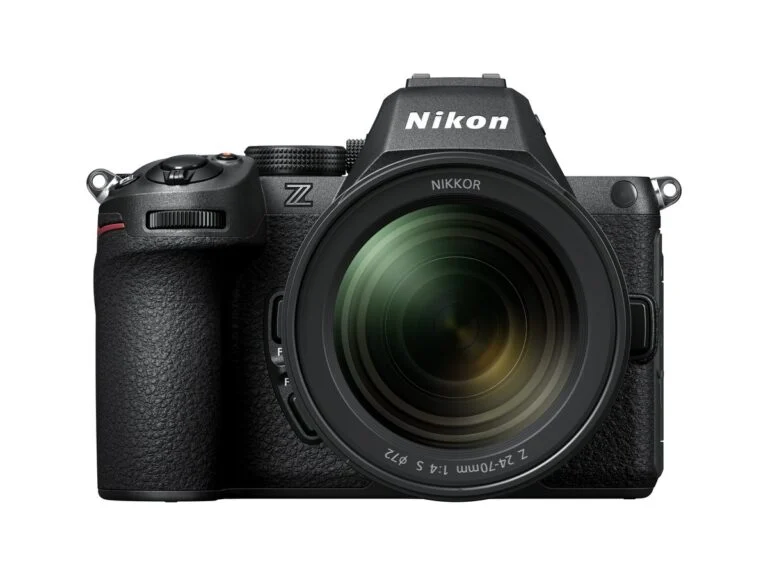
Affordable full frameFull-frame mirrorless camera
Nikon Z5II
- Sensor
- full frame, BSI CMOS (35.9 × 23.9 mm), 24.5 MP
- Mount
- Nikon Z
- Kit lens
- NIKKOR Z 24-50mm f/4-6.3
- Stabilization
- 5-axis in-body, 7.5 stops
- Video
- 4K up to 60 fps, Full HD up to 120 fps, N-RAW, N-Log
- Cards
- two SD UHS-II slots
- Weight
- 700 g with battery and card, body 620 g
- Battery
- EN-EL15c, up to 380 shots (CIPA)
Price€1,999 with 24-50mm, body €1,679checked 25 September 2026
For moving up to full frame: 7.5-stop stabilization, two card slots, a 3.69-million-dot viewfinder and RAW video at an entry-level price.
- 7.5-stop stabilization
- Two SD UHS-II slots
- Internal N-RAW recording
- Heaviest on the list at 700 g
- €850 more than the Z50II kit
The Z5II is the most affordable full-frame camera on the list: €1,679 body only and €1,999 with the compact NIKKOR Z 24-50mm f/4-6.3 zoom at Nikon’s store in Germany. It has a 24.5 MP BSI CMOS sensor, five-axis stabilization rated at 7.5 stops under the CIPA 2024 standard, a 3.69-million-dot viewfinder and two SD UHS-II card slots.
Video goes up to 4K 60 fps and Full HD 120 fps, with internal N-RAW recording and the N-Log profile. The EN-EL15c battery is rated under CIPA for 330–380 shots with the viewfinder and 350 with the screen. It’s the heaviest camera on the list: 700 g with battery and card.
On September 24, 2026, Nikon announced the Z5IIc, a version of the Z5II with the same 24.5 MP sensor but no viewfinder. Nikon’s store in Germany takes preorders for it at €1,549 body only.
9. Canon EOS R8 Mark II

New in September 2026Full-frame mirrorless camera
Canon EOS R8 Mark II
- Sensor
- full frame (36 × 24 mm), 24.2 MP
- Mount
- Canon RF
- Kit lens
- RF 24-105mm F4-7.1 IS STM
- Stabilization
- in-body, up to 7.5 stops at the center of the frame
- Video
- 4K up to 60 fps from 6K, Full HD up to 180 fps, Canon Log 3
- Burst
- up to 40 fps with the electronic shutter
- Weight
- 546 g with battery and card, body 499 g
- Battery
- LP-E17, up to 340 shots (CIPA)
Price€1,799 body only, €2,199 with RF 24-105mm, preorderchecked 25 September 2026
For traveling with a full-frame camera: in-body stabilization and 4K 60p at 546 g. Shipping is expected on October 20, 2026.
- Lightest full-frame camera on the list
- Stabilization up to 7.5 stops
- Dust and moisture resistance
- Battery lasts up to 340 shots
- Single card slot
- Preorder only for now
Canon announced the EOS R8 Mark II on September 15, 2026, as a compact full-frame travel camera. Unlike the original EOS R8, it has in-body stabilization, rated at up to 7.5 stops at the center of the frame. It has a 24.2 MP sensor, weighs 546 g with battery and card, and its body is dust- and moisture-resistant.
Video goes up to 4K 60 fps oversampled from 6K, Full HD 180 fps and 10-bit Canon Log 3. Bursts reach 40 fps with the electronic shutter, and in pre-continuous shooting mode the camera starts recording frames half a second before you fully press the shutter button.
The trade-offs are the small LP-E17 battery (under CIPA in power-saving mode, 340 shots with the screen and 220 with the viewfinder) and a single card slot. Canon’s own store in Germany takes preorders at €1,799 body only and €2,199 with the RF 24-105mm F4-7.1 IS STM zoom, with shipping expected on October 20, 2026.
10. Sony α7 V
For serious shootingFull-frame mirrorless camera
Sony α7 V
- Sensor
- full frame, partially stacked Exmor RS (35.9 × 23.9 mm), 33 MP
- Mount
- Sony E
- Stabilization
- 5-axis in-body, 7.5 stops at the center, 6.5 at the edges
- Video
- 4K 60p from 7K, 4K up to 120 fps, 10-bit 4:2:2
- Burst
- up to 30 fps with the electronic shutter
- Cards
- SD and SD/CFexpress Type A
- Weight
- 695 g with battery and card, body 610 g
- Battery
- NP-FZ100, up to 750 shots (CIPA)
Price€2,999 body onlychecked 25 September 2026
For people who shoot a lot and seriously, both photos and video: 33 MP, 30 fps, 7.5-stop stabilization and the longest battery life on the list.
- Battery good for up to 750 shots
- 33 MP and up to 30 fps
- Two card slots
- €2,999 for the body alone
- 149 g heavier than the Canon EOS R8 Mark II
Sony announced the α7 V on December 2, 2025, as the successor to the α7 IV. It’s the most expensive full-frame camera on the list: a partially stacked 33 MP Exmor RS sensor, bursts of up to 30 fps with the electronic shutter, and stabilization rated at 7.5 stops at the center of the frame and 6.5 at the edges.
Video includes 4K 60p oversampled from 7K without pixel binning, 4K at up to 120 fps, 10-bit 4:2:2 and the S-Log3 profile. There are two card slots (SD and SD/CFexpress Type A), and the NP-FZ100 battery is rated for 630 shots with the viewfinder and 750 with the screen under CIPA, the best result on the list. Sony’s store in Germany sells the α7 V for €2,999 body only; alongside the camera, Sony introduced the compact FE 28-70mm F3.5-5.6 OSS II zoom.
Best cameras: comparison
| Model | Best for | Sensor | In-body stabilization | Body weight, g | Price as of 9/25/2026 |
|---|---|---|---|---|---|
| Canon EOS R50 | A first camera for photo and video | APS-C, 24.2 MP | No | 328 | €855 with lens |
| Nikon Z50II | Beginners who want 4K 60p and a flash | APS-C, 20.9 MP | No | 495 | €1,149 with lens |
| Sony ZV-E10 II | Vlogging and streaming | APS-C, 26 MP | No | 292 | €849.99 body only |
| Fujifilm X-T50 | Walks, trips, Fujifilm colors | APS-C, 40.2 MP | Up to 7 stops | 389 | UAH 82,990 with lens |
| Sony α6700 | Photo and video alike | APS-C, 26 MP | 5 stops | 409 | €1,399 body only |
| OM System OM-5 Mark II | Hiking and bad weather | Four Thirds, 20.4 MP | Up to 7.5 stops | 366 | €1,589 with lens, on sale |
| Panasonic Lumix TZ300 | Travel with a zoom in your pocket | 1-inch, 20.1 MP | No, optical in the lens | 295 | €999 |
| Nikon Z5II | A first full-frame camera | Full frame, 24.5 MP | 7.5 stops | 620 | €1,999 with lens |
| Canon EOS R8 Mark II | Full frame for travel | Full frame, 24.2 MP | Up to 7.5 stops | 499 | €1,799 body only, preorder |
| Sony α7 V | Serious photo and video work | Full frame, 33 MP | 7.5 stops | 610 | €2,999 body only |
How to choose a camera
Sensor size
The bigger the sensor, the more light it gathers: less noise in low light and an easier time blurring the background. But the body, the lenses and the price grow with it. This list covers four sizes:
- Full frame (about 36 × 24 mm): the Nikon Z5II, Canon EOS R8 Mark II and Sony α7 V, from €1,679 body only.
- APS-C (23.3–23.5 × 15.5–15.7 mm; 22.3 × 14.9 mm on Canon): the Canon EOS R50, Nikon Z50II, Sony ZV-E10 II and α6700, and Fujifilm X-T50. The sweet spot for a first camera, travel and video.
- Four Thirds (17.3 × 13 mm): the OM System OM-5 Mark II. Smaller than APS-C, but the IP53-rated body weighs 418 g with battery and card.
- 1-inch and smaller: compacts, namely the Panasonic TZ300 with a 1-inch sensor and the TZ99 with a 1/2.3-inch sensor. No interchangeable lenses, but the whole zoom fits in your pocket.
Mount and lenses
When you buy a mirrorless camera, you’re choosing a system: Canon RF, Nikon Z, Sony E, Fujifilm X and Micro Four Thirds lenses don’t fit each other without adapters. Canon, Nikon and Sony APS-C cameras also take full-frame lenses for the same mount, so you can buy lenses with an eye to the future and move up to full frame later. The reverse comes with a catch: with APS-C lenses, a full-frame camera crops the frame. On the Canon EOS R8 Mark II, for example, video with RF-S lenses switches to crop automatically.
Stabilization
In-body stabilization works with any lens, including fast primes without stabilization of their own, and helps with handheld shots at slow shutter speeds. Makers rate it in stops under the CIPA standard: 5 on the Sony α6700, 7 on the Fujifilm X-T50, and 7.5 at the center of the frame on the Nikon Z5II, Canon EOS R8 Mark II and Sony α7 V. The Canon EOS R50, Nikon Z50II and Sony ZV-E10 II have no in-body stabilization: they rely on stabilized kit lenses (IS, VR, OSS) and electronic stabilization for video.
Video
For family clips and trips, 4K 30p is enough, and every camera on the list shoots it. 4K 60p is for smooth motion and mild slow motion; 4K 120p is for proper slow-mo, which the Sony α6700 and α7 V can do. If you plan to color grade, look for 10-bit recording and Log profiles: N-Log on Nikon, Canon Log 3 on Canon, S-Log3 on Sony.
For vlogging, what matters is a vari-angle screen, a mic input and battery life: the ZV-E10 II battery lasts for 130 minutes of recording under CIPA, while the Panasonic TZ300 limits 4K clips to 15 minutes at a time.
Budget for lenses
A kit lens is the cheapest way to start: in the makers’ stores it adds €110 to the body price of the Canon EOS R50, €150 for the Nikon Z50II and €320 for the Nikon Z5II with the 24-50mm. Brighter zooms cost noticeably more: the Z50II with the 16-50mm f/2.8 VR comes to €1,699, €550 more than with the standard kit lens, and the X-T50 with the XF 16-50mm F2.8-4.8 costs UAH 15,000 more than the kit with the XC 15-45mm at Fujifilm’s store in Ukraine.
For portraits and low light, a fast prime helps: the Fujifilm XF 35mm F1.4 R, for example, costs UAH 29,990 at Fujifilm’s store in Ukraine. Also budget for a fast memory card: for 4K and bursts, Canon recommends UHS-II cards for the EOS R8 Mark II, and Fujifilm recommends Video Speed Class 60 or faster cards for 360 Mbps recording on the X-T50.
Battery life
Shots per charge under CIPA range from 220 to 750 on this list. You usually get fewer with the viewfinder than with the screen. Canon quotes figures for power-saving mode, and Nikon quotes them with and without it. For trips away from outlets, carry a spare battery or pick a camera that charges over USB-C, such as the Sony α7 V, α6700 and ZV-E10 II, the Canon EOS R8 Mark II and the Panasonic TZ300.
Sources and methodology
Analysis of public sourcesChecked 25 September 2026
- Canon Europe — EOS R8 Mark II specifications canon-europe.com
- Nikon — Z5II technical specifications nikon.co.uk
- Sony UK — α7 V specifications sony.co.uk
- Fujifilm — X-T50 specifications fujifilm-x.com
- Prices — official online stores of Fujifilm in Ukraine and of Canon, Nikon, Sony, Panasonic and OM System in Germany, September 25, 2026
FAQ
What camera should a beginner buy?
An APS-C mirrorless camera with a kit lens: the Canon EOS R50 for €855 or the Nikon Z50II for €1,149 (prices in the makers’ stores in Germany as of September 25, 2026). If video matters more than photos, look at the Sony ZV-E10 II.
Which is better: full frame or APS-C?
Full frame does better in low light and blurs the background more, but the bodies and lenses are bigger and pricier: the Nikon Z5II with a lens costs €1,999, the Z50II €1,149. APS-C is enough for learning, travel and video, and full-frame Canon RF, Nikon Z and Sony E lenses also fit these brands’ APS-C cameras.
Do you need in-body stabilization?
It helps if you shoot handheld at slow shutter speeds, record video on the move or use lenses without stabilization. The Canon EOS R50, Nikon Z50II and Sony ZV-E10 II don’t have it; the kit lens handles shake instead.
What camera should you take traveling?
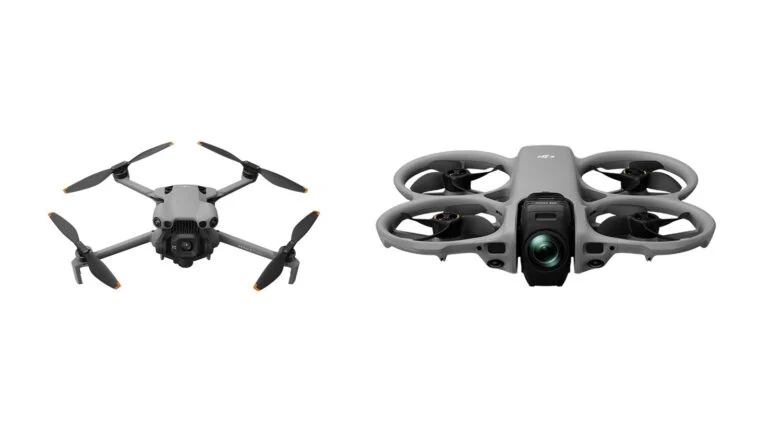
For hiking and bad weather, the OM System OM-5 Mark II with IP53 sealing at 418 g. If you want a zoom in your pocket, the Panasonic Lumix TZ300 (24–360 mm, 337 g), and for full frame, the Canon EOS R8 Mark II at 546 g. For shots from above, a camera won’t replace a drone; we’ve rounded up the best camera drones.
How many shots does a camera battery last?
Under the CIPA standard, from 220–240 shots with the viewfinder on the Nikon Z50II and Canon EOS R8 Mark II to 750 shots with the screen on the Sony α7 V. Real-world numbers can differ a lot: video, flash, cold weather and frequent image review all cut them down.



Leave a Reply