
You may already know how to meditate, but do you know how to practice transcendental meditation?
Meditation was first developed in India many years ago (around 5000–3500 BCE). It took some time to become popular in the Western world, but today it is known as a therapeutic tool for relieving stress, anxiety, depression, and harmful habits. In recent years it has been recognized as improving mental performance, and it has therefore grown into a business worth billions of dollars.
When we think of meditation, we usually picture “mindfulness meditation,” but there are seven different types of meditation practiced around the world:
- Loving-kindness meditation
- Body scan or progressive relaxation
- Mindfulness meditation
- Breath awareness meditation
- Kundalini yoga
- Zen meditation
- Transcendental meditation
Over the past decade, transcendental meditation (also known as TM or TM Meditation) has become extremely popular, with a staggering 5 million people practicing it every day. You may have heard about the benefits of TM and wondered what it is all about.
TM is a form of mantra meditation that Maharishi Mahesh Yogi began spreading in the West in the late 1950s. He taught this practice around the world for 40 years, spreading the movement and drawing in everyone from politicians to The Beatles.
Today, many celebrities, including Jerry Seinfeld, Hugh Jackman, Ellen DeGeneres, and Howard Stern, have publicly said that TM changed their lives. The popular film director David Lynch even created a foundation to spread transcendental meditation around the world.
These high-profile names have certainly helped the practice succeed, alongside a large body of research showing its benefits. But the main reason for TM’s popularity is its simplicity.
If you have tried to meditate in the past but could not stick with it long enough to feel its benefits, keep reading.
In this article, I will outline the main differences between mindfulness meditation and transcendental meditation, and explain why some people prefer one type over the other. I will cover how the TM organization teaches its students, and give you a step-by-step guide to practicing TM on your own.
Transcendental Meditation vs. Mindfulness Meditation
To understand what makes Transcendental Meditation (TM) unique, we need to go back and look at the basics of mindfulness meditation. All other forms of meditation use a similar mechanism of attention, with the exception of TM. For simplicity, let’s focus on the differences between these two approaches.
In modern culture, mindfulness meditation encourages the development of nonjudgmental attention to the present moment, both during practice and in everyday life.
We all get distracted from time to time by thoughts that keep us from focusing on the present moment. It might be a to-do list or memories triggered by music. Either way, we often spend more time in our thoughts than in the here and now.
Mindfulness meditation helps bring our attention back to the present moment, for example by focusing on the breath or on parts of the body, which allows us to observe our anxious or depressive thoughts.
Put simply, it means noticing our thoughts and learning to let them go, shifting our attention from a thought to something concrete, such as the breath.
Actively observing thoughts without judgment and trying to release them while focusing on the body works as an exercise for training the brain. The better we do this in meditation and in daily life, the more we are able to make conscious choices rather than react automatically to negative thoughts.
To better understand this concept, picture your mind as an ocean. On the surface, different thoughts churn, but deep down there is calm and stillness. Your thoughts are the waves.
In everyday life, you swim among the waves of your thoughts, trying to face them head-on. Sometimes you manage to swim through them, and sometimes you feel overwhelmed by their force.
Mindfulness meditation is like a surfboard that helps you ride the waves with ease. The more you practice, the better you master the technique and the easier it becomes to manage your thoughts.
Sometimes, as they move through this process, people can finally reach a state of complete inner peace, which is called the “second state of meditation,” or transcendence.
It is important to note that the goal of mindfulness meditation is not limited to reaching this state. Its goal is to actively train the mind, helping you let go of thoughts and develop the ability to make conscious choices in everyday life.
I have personally spent thousands of hours practicing mindfulness meditation and teaching it to my clients, with impressive results. However, I have noticed that some people find it hard to stick with this approach and to enjoy the brain training.
These people often have a very active, noisy mind, and a mindfulness technique that requires you to “close your thoughts” can seem challenging to them. For such people, transcendental meditation often turns out to be a better fit, since it takes a completely different approach to reaching a state of calm.
How Is Transcendental Meditation Different?
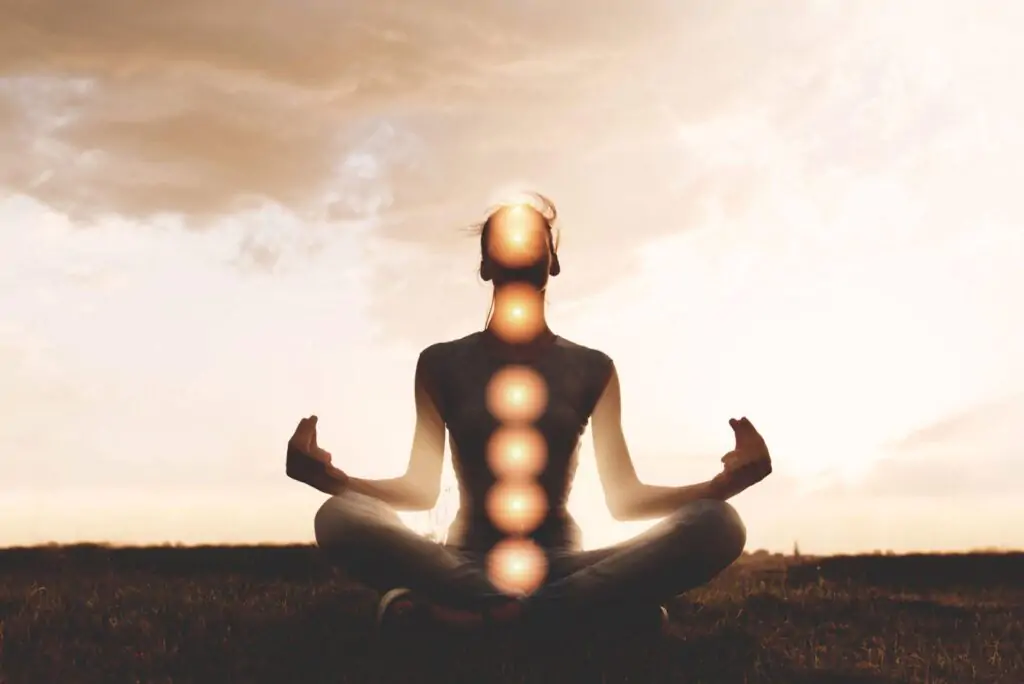
Returning to the ocean example, imagine that your mind is like a submarine diving into the deepest depths of your consciousness, where peace and tranquility reign.
Now let’s look at how transcendental meditation works. If the goal of mindfulness meditation is to train the mind in aware attention, the goal of TM is to go beyond the thinking process. A properly practiced TM session can be a natural continuation of the flow of mindfulness meditation, where the means of reaching this state is a mantra. (I will explain in detail how this works later.)
Also read: tea for sleep recipe
Using a mantra, much like a submarine diving into the ocean, we slowly reach depths where silence and calm prevail.
This state of conscious calm allows us to connect with a source of energy, thought, and creative ability (Carl Jung also called it the collective unconscious). When we reach these depths, we experience deep peace and are freed even from the deepest stress.
The positive effects of TM appear spontaneously when we are able to reach the state of transcendence. People who practice TM regularly report better attentiveness and a significant drop in stress levels.
TM teachers stress that the mind naturally tends toward this state of calm. However, the mind is also always inclined to stay interested in the world around us. This is the challenge of mindfulness meditation, which focuses on actively observing thoughts and makes it harder to reach deep calm.
Now the question arises: “How do you reach the state of transcendence?” The answer is much simpler than you might think:
Simply repeat the mantra.
What Doing TM Looks Like
To practice transcendental meditation (TM), you simply need to sit with your eyes closed — that’s all. No special posture or place is required. Although it’s best to start in a quiet setting on a comfortable chair, once you are familiar with the practice you can meditate anywhere, even at a desk or on a bus.
The basic elements of TM practice include sitting with your eyes closed and quietly repeating a mantra. It is recommended to repeat the mantra silently for 20 minutes twice a day. This is partly related to the body’s circadian rhythm and helps make meditation a natural part of your schedule.
However, there are no strict rules about the frequency or length of TM sessions. It depends on your preferences and schedule. The main thing is to do it regularly and whenever you can.
Now let’s move on to discussing mantras and their role in TM practice.
What Is a Mantra?
A mantra in transcendental meditation is simply a meaningless sound. There is no special secret behind it, except that it should be free of meaning and pleasant to say.
People often focus too much on choosing the right mantra. I interviewed experienced TM teachers, and all of them confirmed that “the less we know about our mantra, the better.”
This is because our minds constantly form associations. If we choose a word that is too similar to something familiar, we start linking it with images, sounds, smells, and memories. With a meaningless mantra, it is easier to let the mind enter a state of deep calm.
You can think of a mantra as a seed. When you plant a seed to grow a plant, you don’t need to search for the “perfect seed.” Just pick one, plant it, and watch it grow. Freeing yourself from the trap of “choosing the right mantra” will do you more good.
If you still want to know what mantras look and sound like, here are a few examples to repeat.
Examples of Personal Mantras
Hom is indeed one of the common mantras, although TM teachers usually avoid using it because of the complexity of its sound structure. In Hinduism, the sound “Hom” reflects all vibrations, both positive and negative.
However, in TM practice any other mantra can work well. For example:
- Kirim
- Shirim
- Inga
- Aema
Chanting a mantra might sound something like this:
- Kiiiiiririmmmm Kiiiiiririmmmm
- Shiiiiririiiiiiim Shiiiiririiiiiiim
- Iiiiiinggaaaa Iiiiiinggaaaa
- Aaaaaaaenmaaaa Aaaaaaaenmaaaa
It is important to vary the length and tone of each sound in the mantra as you repeat it, so that it is easier to reach a trance-like state in your mind. Again, exactly how you do this is not especially important; the main thing is that the mantra sounds positive and meaningless.
Should You Try Different Mantras?
Most TM teachers confirm that they and their students use the same mantra they were given at the first sessions for their entire lives. The goal is not to search for the perfect sound, but to build the habit of reducing stress in the mind through repeating a meaningless sound.
If you are trying to practice TM on your own and find that your chosen mantra resembles a real word, choose another one that is completely meaningless. For people who speak several languages this can be a bit harder than for those who speak only their native language, but it is still easy to find a suitable meaningless sound.
If you learn TM from a teacher, they will choose a mantra for you after you fill out a questionnaire at the first meeting. Then you will repeat the mantra together with the teacher and go on to your personal meditation practice. During practice, the teacher will give you feedback and help you understand the mechanics of TM. This will be followed by another meeting with the teacher and two group meditations.
This process provides a solid foundation for understanding and practicing TM under the guidance of an experienced teacher.
Can You Teach Yourself Transcendental Meditation?

If teachers openly say that you can practice TM on your own, the rules are simple: you just need to practice a little and follow them.
However, a TM course offers something more than self-study alone. It provides a teacher’s guidance and the support of a group of like-minded people.
Most people who decide to take a TM course are looking not only to learn the system but also for support on the path to healing from stress, insomnia, addictions, and relationship problems.
If you have already tried mindfulness and simply want to compare TM through your own experience, you can do without a course. A simple way to try it is to find a TM mantra on YouTube, listen to it, and repeat it the way it is shown in the video. Practice twice a day for about 20 minutes each time and notice how you feel. If TM brings you more satisfaction than mindfulness does, and you want to understand this method more deeply, then you might consider taking a full TM course.
So, Is TM the Right Fit for You?
No one can claim that TM is better than any other type of meditation. Everyone has their own experience, and it is important to discover something new before drawing conclusions.
If you already meditate, I strongly recommend trying TM on your own or with a teacher to broaden your horizons. The same goes for those who are just starting their meditation journey. In that case, starting with mindfulness meditation through an app such as Headspace may be a great option. TM can be a challenge for a beginner without proper guidance, and taking a course may also require a significant financial investment (from $250 to $1,000 or even more, depending on income).
Whichever type of meditation you decide to try, I recommend doing daily practice for at least 30 days. This will give you the chance to start noticing real benefits in your everyday life.
Exploring your consciousness is truly a wonderful experience. The more you study the mechanics of your mind, the more you can achieve personal growth and happiness.













Leave a Reply