
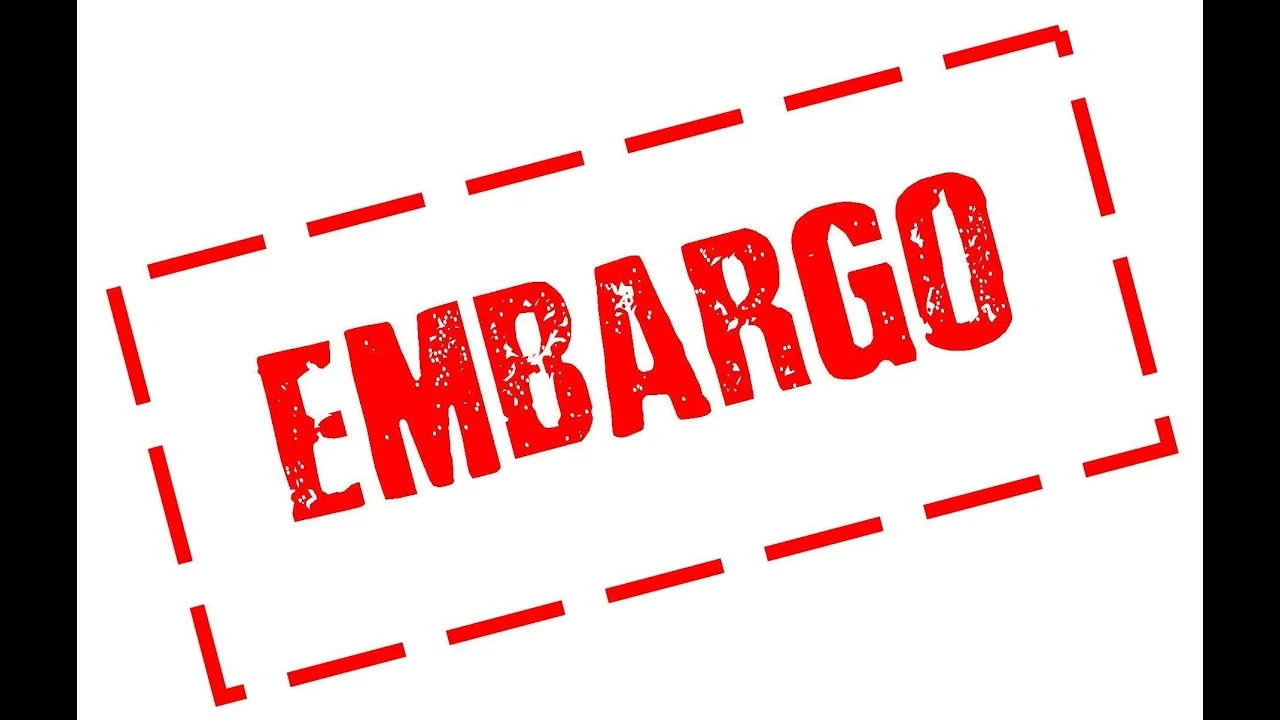
An embargo is a government order that restricts trade with a particular country or the exchange of certain goods. Embargoes are usually imposed as a result of unfavorable political or economic circumstances between countries. Their purpose is to isolate a country and create difficulties for its governing body, forcing it to act on the problem that led to the embargo.
KEY TAKEAWAYS
- An embargo restricts trade or the exchange of certain goods with a specific country, usually because of political or economic problems between countries.
- An embargo is meant to cause negative consequences for the economy of the affected country.
- Trade embargoes imposed by the United States are often based on mandates from the United Nations.
How an Embargo Works
An embargo is a powerful tool that can affect a country both economically and politically. The ability to trade goods freely around the world is key to a country’s maximum economic prosperity. When this becomes impossible, the consequences can be serious.
Decisions about trade embargoes and other economic sanctions made by the United States are often based on mandates from the United Nations (UN), an international organization created in 1945 to expand political and economic cooperation. Allied countries often join together, signing joint agreements to restrict trade with certain countries. This is often done in order to bring about humanitarian change or reduce perceived threats to international peace.
An embargo does not necessarily apply to all goods imported into and exported from a country. Sometimes only certain goods are covered by an embargo, such as military equipment or oil.
Types of Embargoes
There are several different types of embargoes. A trade embargo refers to a ban on exporting or importing to or from one or more countries. These can then be narrowed down more specifically. For example, strategic embargoes protect animals, people, and plants.
In particular, a military embargo prohibits the exchange of military goods with a country, while an oil embargo prohibits only trade in oil, and an embargo on endangered animals prevents the trade of such animals. An embargo can be political, economic, security-related, environmental, or health-related.
The term “embargo” is also used in the media industry. When information is published under embargo, it means that it cannot be published or shared until a set date. Companies often forbid the release of press releases .
Imposing an Embargo
The U.S. president has the authority to impose embargoes and other sanctions during wartime under the Trading with the Enemy Act.
Another law, the International Emergency Economic Powers Act, gives the president the right to impose trade restrictions during periods of national emergency.
In the U.S., the Office of Foreign Assets Control, a unit of the Treasury Department, manages economic trade embargoes. The office plays a central role in tracking and freezing the sources of funding for terrorist and drug-related organizations.
U.S. Trade Embargoes
The United States has imposed several long-running embargoes against other countries, including Cuba, North Korea, and Iran. In the 1980s, several countries, including the U.S., imposed a trade embargo against South Africa in opposition to apartheid.
American embargoes and economic sanctions against some countries specifically prohibit trade in certain types of goods, such as weapons or luxury items, but allow other forms of trade. By contrast, comprehensive embargoes are more punitive, since they prohibit any trade with a country.
After the September 11, 2001 attacks, U.S. embargoes were increasingly aimed at countries known to be linked to terrorist organizations that pose a threat to national security. More recently, U.S. embargoes have become more widespread, paving the way for a series of trade wars.
When Donald Trump began his first term in 2017, he promised to make it easier for consumers to buy American goods. He began imposing taxes on imports of certain goods into the country, which led some countries, such as China, to respond with their own punitive measures. In 2018, Trump imposed safeguard tariffs worth $8.5 billion on imports of solar panels and $1.8 billion on imports of washing machines. The intended target was China.
Several embargoes have targeted the United States in the past. For example, in the 1970s, the U.S. economy suffered from an oil embargo imposed by member countries of the Organization of the Petroleum Exporting Countries (OPEC). This particular embargo caused fuel shortages, rationing, and a sharp rise in gas prices.
The Impact of Embargoes
Effectiveness
Aiming to influence the actions and policies of another country, embargoes are usually ineffective. For example, the U.S. embargo against Cuba since the late 1950s has done little to change the country’s communist program and its treatment of its people.
Similarly, Russia’s political actions in the 21st century led many countries to impose sanctions on the country; however, these sanctions did little to deter Russia’s actions, such as its invasion and annexation of Crimea from Ukraine in 2014. Even after the annexation, the sanctions did little to stop Russia’s cyberwarfare and the buildup of its troops on the border with Ukraine.
In February 2022, Russia again invaded Ukraine. U.S. President Joe Biden announced sanctions against Russia on February 22, 2022, in response to military aggression against Ukraine, including the movement of Russian troops into two separatist regions in eastern Ukraine. The Biden administration said these were “the first tranche of sanctions that go well beyond 2014 and are being implemented in coordination with allies and partners in the European Union, the United Kingdom, Canada, Japan, and Australia.”
The sanctions are mostly economic in nature and include blocking two Russian state-owned financial institutions, Vnesheconombank and Promsvyazbank, and their subsidiaries, which finance the Russian military. Other sanctions included a ban on buying new Russian sovereign debt and a ban on American companies and individuals buying sovereign debt on the secondary market. Five members of the Russian elite and their families were also targeted.
Consequences
Embargoes generally harm the economies of economically weaker countries more than those of economically stronger ones, and they usually hurt the citizens of the country more than its leaders, especially in countries with autocratic rule, such as Iran. And often these embargoes do little to change the policies and actions of the country against which they are imposed.
Countries under an embargo typically see their citizens lose access only to essential goods and services. Businesses in the country imposing the embargo also miss out on trade and investment opportunities, damaging their profits and even their survival.
In addition, embargoes usually lead to an eye-for-an-eye response: the country under an embargo imposes a counter-embargo, which further harms trade, business, and citizens in both countries.
Special Considerations
A country’s ability to conduct global trade also suffers if it does not join the World Trade Organization (WTO), an international organization that oversees the rules of global trade between nations. The WTO promotes and manages free trade for its members. As a result, members often trade only with one another. The WTO now has more than 160 members. Twenty-five countries and territories have observer status, including Iran and Iraq.
Which countries does the United States impose embargoes on?
There are six countries subject to U.S. embargoes.
They are Russia, Sudan, Iran, North Korea, Cuba, and Syria.
What are the disadvantages of embargoes?
The disadvantages of embargoes include cutting off citizens of the affected country from essential goods and services, missed investment and trade opportunities for businesses in the country that imposes the embargo, and counter-embargoes that further harm trade and prosperity.
What are the types of embargoes?
An embargo can be economic, political, environmental, or strategic.
An embargo imposes specific trade restrictions between countries and is put in place for one or more of the reasons above.
How can a country respond to a trade embargo?
Countries can respond to trade embargoes by finding other trading partners, taking military action, imposing counter-embargoes, or filling the gap created by the embargo (self-sufficiency).











Leave a Reply