
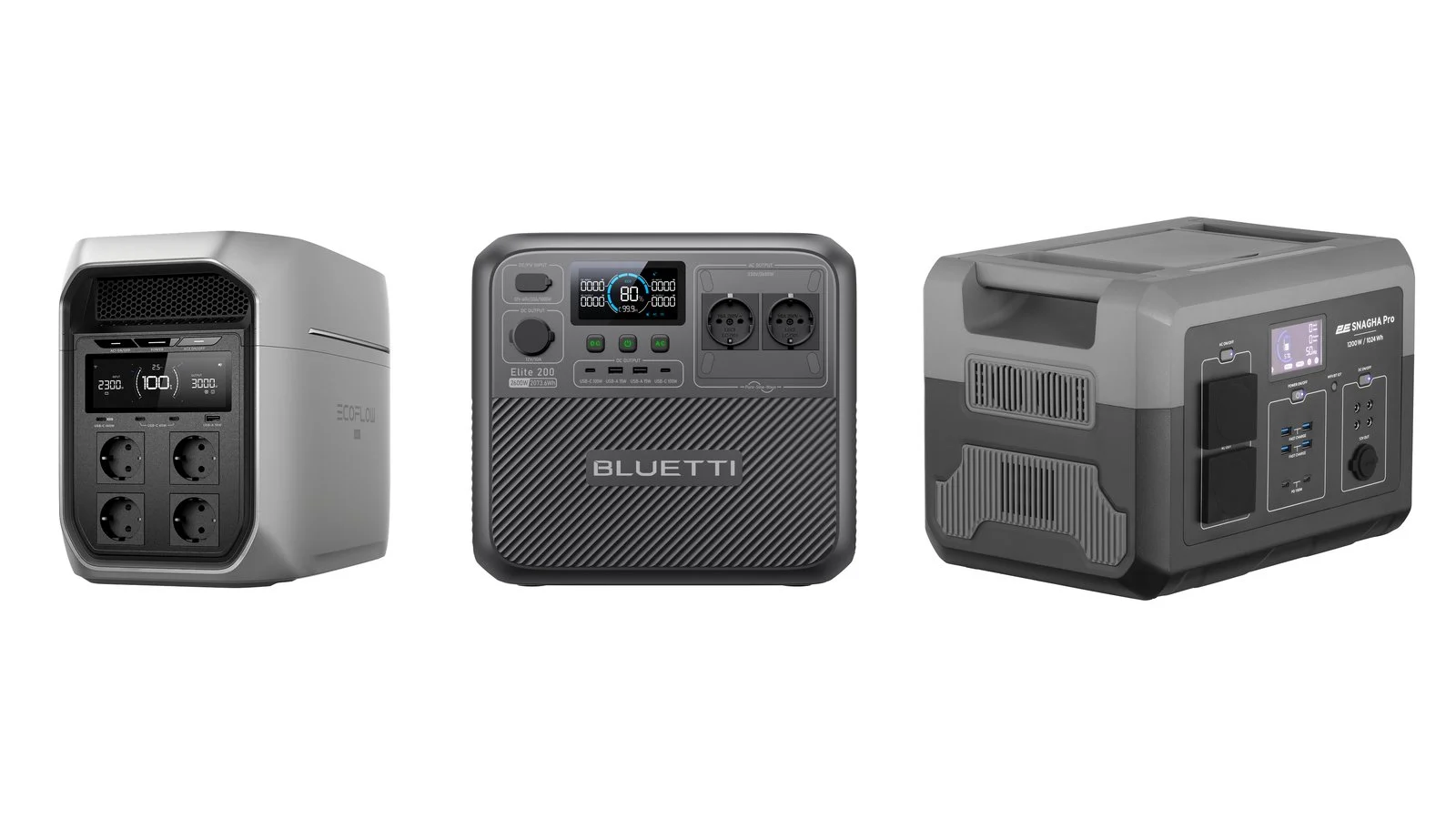
A portable power station for home is a LiFePO4 battery with an inverter and 230 V outlets: during a blackout it keeps a router, laptop, fridge and gas boiler running. The best all-rounder among current models is the EcoFlow DELTA 3 Max Plus with 2,048 Wh and 3,000 W, the 2E Snagha PRO gives you the cheapest kilowatt-hour at UAH 29,999, and the EcoFlow RIVER 3 UPS at UAH 15,999 is enough for a router.
This list covers six power stations on sale in Ukraine as of October 10, 2026, one per job: an all-round 2 kWh unit, a budget 1 kWh unit, a compact one for a router, a UPS-style station for a PC and boiler, an expandable system for a house and a model built around solar panels. Below you will find how to size the capacity with a worked example, how to choose between EcoFlow and Bluetti, and how to power a gas boiler and connect solar panels safely.
How we picked
- LiFePO4 and pure sine wave. All six stations use lithium iron phosphate batteries and a pure sine wave inverter, according to their makers.
- One job, one model. A whole apartment or house, a tight budget, a router and laptop, UPS mode for a PC and boiler, a day or more of backup, and solar panels.
- Manufacturer data. Specs come from EcoFlow, Bluetti and 2E websites and manuals; UPS transfer times are given as each maker states them.
- Prices as of October 10, 2026 from Foxtrot and MOYO, or 2E’s recommended price; the source is listed in the comparison table.
We did not test these power stations: the list is based on manufacturer data and store prices.
1. EcoFlow DELTA 3 Max Plus
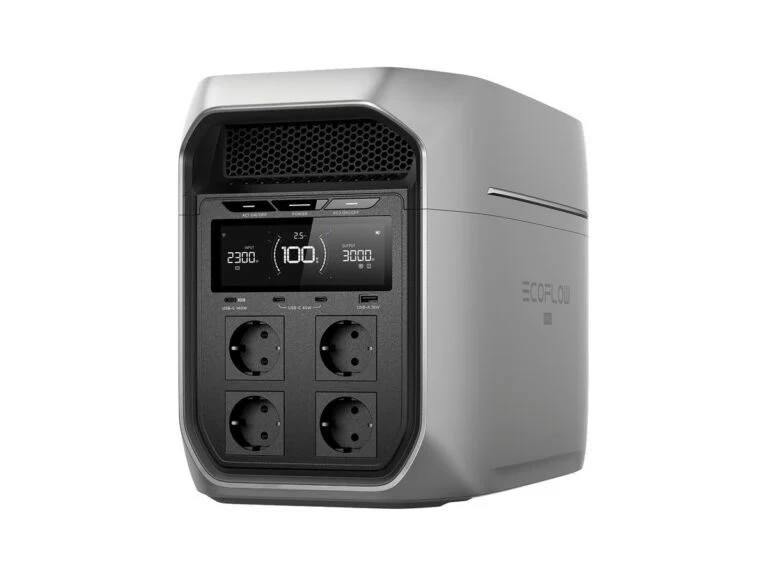
Best overall2 kWh power station
EcoFlow DELTA 3 Max Plus
- Capacity
- 2,048 Wh, LiFePO4
- AC output
- 3,000 W, 6,000 W surge, X-Boost up to 3,900 W
- Waveform
- pure sine wave
- Outlets
- 4 × 230 V
- USB
- USB-C 140 W with HID, 2 × USB-C up to 45 W combined, USB-A 18 W
- 12 V outputs
- car outlet 10 A and Anderson 30 A, up to 378 W total
- UPS mode
- 10 ms plus HID signal for a PC
- AC charging
- 2,300 W, 0–80% in 47 min
- Solar input
- up to 1,000 W
- Expansion
- up to 10 kWh with extra batteries
- App
- Wi-Fi and Bluetooth
- Noise
- up to 25 dB at 600 W
- Weight and size
- 22.1 kg, 494 × 242 × 305 mm
- Warranty
- 3 years plus 2 more after app registration
PriceUAH 87,999checked 10 October 2026
For an apartment or house that needs to run a fridge, boiler, router and computer for hours, with room to expand.
- 3,000 W and four 230 V outlets
- 10 ms UPS and HID for a PC
- Expands to 10 kWh
- Weighs 22.1 kg
- Costs more than the Bluetti Elite 200 V2 of the same capacity
The DELTA 3 Max Plus is the most versatile station here: 2,048 Wh lasts an evening with a fridge, boiler and router, and 3,000 W lets you switch on a kettle or microwave along the way. From the wall it charges to 80% in 47 minutes, so it can refill during a short window with power. In the app you can choose which outlets stay on when the battery runs low, such as the fridge and Wi-Fi.
If two kilowatt-hours turn out to be too little, you can add EcoFlow extra batteries for up to 10 kWh. Don’t confuse it with the simpler DELTA 3 Max without the Plus: that one has 2,400 W, no extra battery port and no HID signal. EcoFlow does not publish a cycle rating for this series and estimates its lifespan at about 10 years based on internal tests.
2. 2E Snagha PRO
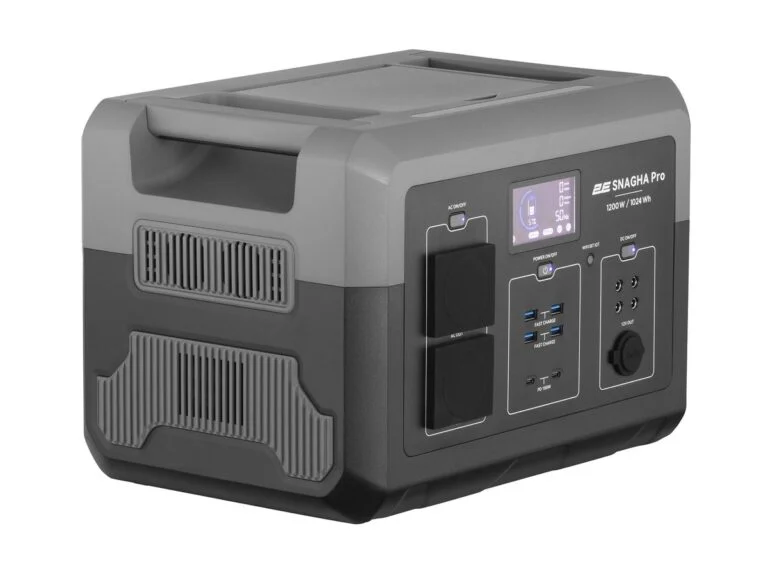
Budget pick1 kWh power station
2E Snagha PRO
- Capacity
- 1,024 Wh, LiFePO4 51.2 V
- Usable via AC outlets
- 945 Wh, per 2E
- AC output
- 1,200 W, 2,400 W peak, pure sine wave
- Outlets
- 2 grounded Schuko
- USB and DC
- 2 × USB-C PD 100 W, 4 × USB-A, 4 × DC5521, 12 V car outlet
- Cycle life
- 2,000 cycles
- AC charging
- 1,000 W, 0–80% in 50 min, 100% in 1 hour
- Solar input
- up to 500 W, 11–59 V, 12.5 A, MPPT
- UPS mode
- yes, 2E does not state the transfer time
- App
- Tuya Smart, Wi-Fi and Bluetooth
- Weight and size
- 16 kg, 374 × 265 × 263 mm
- Warranty
- 12 months
PriceUAH 29,999, recommended pricechecked 10 October 2026
An affordable kilowatt-hour with a pure sine wave: a router, laptop, lights and fridge for several hours.
- Cheapest 1 kWh in this list
- USB-C 100 W, USB-A and DC5521
- Solar input 11–59 V
- 2,000 cycles, fewer than rivals
- 12-month warranty
- UPS transfer time not stated
2E is a Ukrainian brand, and the Snagha PRO at UAH 29,999 (recommended price) is the most affordable way to get 1 kWh of LiFePO4 with a pure sine wave. 2E states plainly how much energy comes out of the outlets: 945 Wh out of 1,024, so about 8% is lost in the inverter. Two Schuko outlets and 1,200 W are enough to run a fridge, router and laptop at the same time; check your total wattage with the method below.
The savings show in the details: a 2,000-cycle rating (the Bluetti stations here start at 6,000), a 12-month warranty, and no published UPS transfer time. For a computer where every millisecond counts, pick a model with a stated 10 ms, such as the DELTA 3 Classic below.
3. EcoFlow RIVER 3 UPS
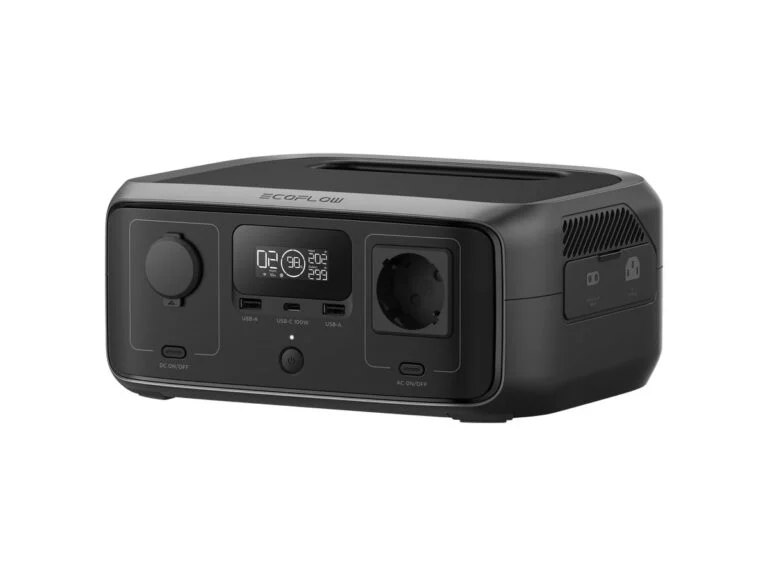
For a router and laptopCompact UPS power station
EcoFlow RIVER 3 UPS
- Capacity
- 245 Wh, LiFePO4
- Cycle life
- 3,000 cycles to 80% capacity
- AC output
- 300 W, X-Boost up to 600 W, pure sine wave
- Outlets
- 1 × 230 V
- USB and DC
- USB-C 100 W, 2 × USB-A 12 W, 126 W car outlet
- UPS mode
- under 10 ms
- AC charging
- 0–100% in 60 min
- Solar input
- up to 110 W, 11–30 V, 8 A
- Noise
- under 30 dB
- App
- Wi-Fi and Bluetooth
- Weight and size
- 3.55 kg, 255 × 212 × 113 mm
PriceUAH 15,999checked 10 October 2026
Keeps a router, fiber terminal and laptop running through outages: the station stays plugged into the wall all the time.
- Transfer in under 10 ms
- Quiet: under 30 dB
- Weighs 3.55 kg
- One 230 V outlet and 300 W
- Solar input of only 110 W
The regular RIVER 3 and the UPS version (part number EFRIVER3-UPS) look the same, but according to the EcoFlow manual the regular one switches to battery within 20 ms and should not be used with desktop PCs or NAS units, while the UPS version switches within 10 ms. For a 12 W router, 245 Wh lasts about 17 hours: 245 × 0.85 ÷ 12.
The station is nearly silent at under 30 dB, so you can keep it in a living room around the clock. If your router is overdue for replacement, see our list of the best budget Wi-Fi routers for 2026.
4. EcoFlow DELTA 3 Classic
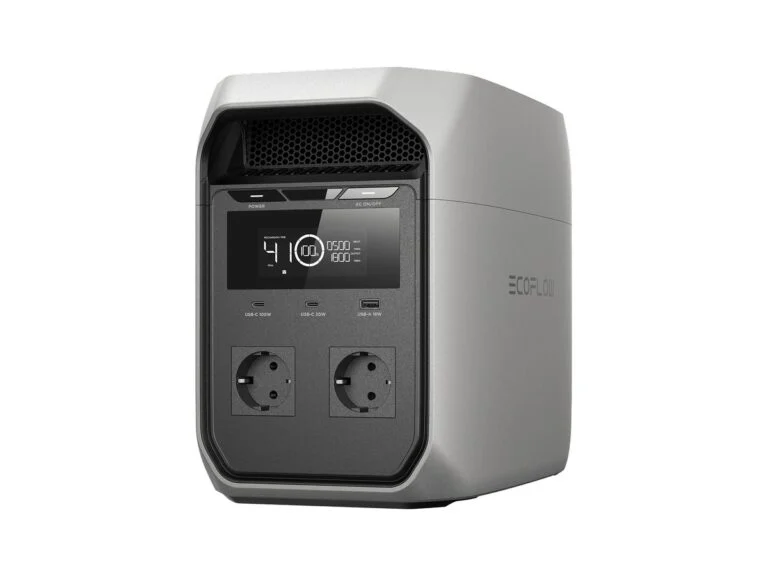
UPS for a PC, router and boiler1 kWh power station
EcoFlow DELTA 3 Classic
- Capacity
- 1,024 Wh, LiFePO4
- AC output
- 1,800 W, 3,600 W surge, X-Boost up to 2,400 W
- Waveform
- pure sine wave
- Outputs
- 5 in total, including USB-A 18 W and USB-C 100 W and 30 W; no 12 V output
- UPS mode
- 10 ms
- AC charging
- 1,400 W, 0–80% in 45 min
- Solar input
- up to 500 W
- Noise
- under 30 dB at 600 W, under 40 dB at 1,200 W
- App
- Wi-Fi and Bluetooth
- Weight and size
- about 12.5 kg, 398 × 200 × 283 mm
- Warranty
- 3 years plus 2 more after app registration
PriceUAH 37,999checked 10 October 2026
Switches a computer, router and gas boiler to battery in 10 ms without making noise in the room.
- 10 ms UPS and pure sine wave
- Under 30 dB at 600 W
- 1,800 W, plenty for a boiler and PC
- No 12 V output
- No extra battery port
- EcoFlow does not state a cycle rating
EcoFlow started selling the DELTA 3 Classic in Europe in March 2026 as a simplified DELTA 3: no 12 V output and no expansion port, but cheaper than the DELTA 3 Plus, at UAH 37,999 versus UAH 49,999 at Foxtrot. It has what matters for UPS duty: a 10 ms transfer, a pure sine wave and 1,800 W.
It can run a gas boiler with a maximum draw of 110 W for about 8 hours: 1,024 × 0.85 ÷ 110 ≈ 7.9 hours, and that estimate assumes maximum draw. It will not shut a computer down on its own: EcoFlow does not list an HID signal like a regular UPS has for this model, so save your work manually during a long outage.
5. Bluetti Apex 300
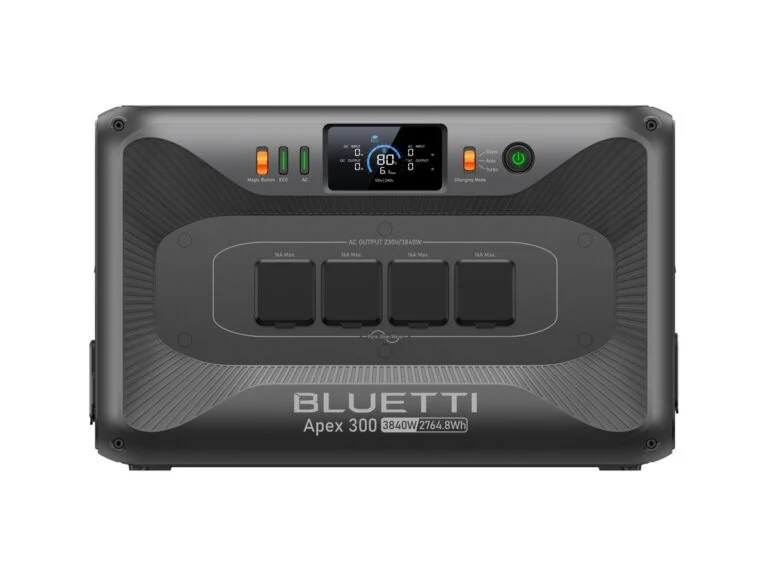
For a houseExpandable home power station
Bluetti Apex 300
- Capacity
- 2,764.8 Wh, LiFePO4 51.2 V
- Cycle life
- 6,000+ cycles to 80% capacity
- AC output
- 3,840 W, pure sine wave, Power Lifting up to 7,680 W
- USB and 12 V
- only via the Hub D1 module
- UPS mode
- 20 ms
- AC charging
- up to 2,300 W, up to 3,840 W with Hub A1
- Solar input
- 2 × 1,200 W, 12–60 V, 20 A
- Expansion
- up to 6 B300K batteries, 19,353.6 Wh per unit
- App
- Wi-Fi and Bluetooth
- Weight and size
- 38 kg, 525 × 327 × 320 mm
- Warranty
- 5 years
PriceUAH 109,000checked 10 October 2026
For a house that needs a day or more of backup: add batteries for more capacity, and the solar inputs take up to 2,400 W.
- Up to 19.4 kWh per unit
- 3,840 W and two solar inputs
- 6,000+ cycle rating
- Weighs 38 kg
- USB and 12 V only via Hub D1
- 20 ms UPS, not for a desktop PC
The Apex 300 is not a portable unit but the core of a home system: one unit takes up to six B300K batteries for 19,353.6 Wh, and a system of three units with 18 batteries reaches about 58 kWh, according to Bluetti. Two 1,200 W solar inputs are designed for a large set of panels in a yard or on a roof. Connecting it to your home’s breaker panel is a job for an electrician; see the gas boiler section for details.
Its UPS transfer time is 20 ms: Bluetti says that is enough for CPAP machines, but EcoFlow’s manual advises against powering desktop PCs and NAS units from its own stations with the same 20 ms. MOYO sells the Apex 300 for UAH 109,000, and Bluetti’s Ukrainian store lists it at €1,999.
6. Bluetti Elite 200 V2
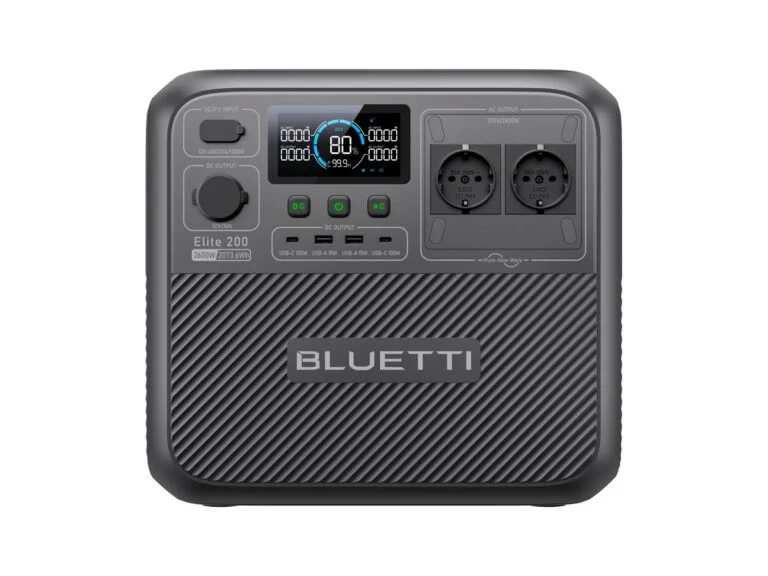
For solar panels2 kWh power station
Bluetti Elite 200 V2
- Capacity
- 2,073.6 Wh, LiFePO4
- Cycle life
- 6,000+ cycles to 80% capacity
- AC output
- 2,600 W, pure sine wave, Power Lifting up to 3,900 W
- Outlets
- 2 × 230 V
- USB and 12 V
- 2 × USB-C 100 W, 2 × USB-A 15 W, 10 A car outlet
- Solar input
- up to 1,000 W, 12–60 V, up to 20 A
- AC charging
- up to 2,300 W, 80% in 1 hour, 100% in 1.4 hours
- AC and solar combined
- up to 2,400 W
- UPS mode
- up to 15 ms
- Noise
- 16–50 dB
- App
- Wi-Fi and Bluetooth
- Weight and size
- 24.2 kg, 350 × 250 × 323.6 mm
- Warranty
- 5 years, per Bluetti
PriceUAH 71,999checked 10 October 2026
For a home with solar panels: the 1,000 W input also accepts third-party panels with MC4 connectors.
- 1,000 W solar input, 12–60 V
- 6,000+ cycle rating
- UAH 16,000 cheaper than the DELTA 3 Max Plus
- No battery expansion
- UPS up to 15 ms
- Only two 230 V outlets
According to the Bluetti manual, with a continuous 1,000 W from panels the Elite 200 V2 charges fully in about 2.4 hours. The panels’ open-circuit voltage (Voc) must stay within 12–60 V and the current within 20 A; third-party panels work if they have MC4 connectors, and Bluetti advises against mixing different panel models. An example from the same manual: two 200 W panels (20 V, 10 A) connected in series give 40 V and 10 A.
Without sun, it charges from the wall to 80% in an hour, and its rated cycle life is 6,000+ cycles to 80% capacity, more than any EcoFlow station in this list. Foxtrot sells the Elite 200 V2 for UAH 71,999, and Bluetti’s Ukrainian store lists it at €1,299.
Comparison
| Model | Best for | Capacity, Wh | AC output, W | UPS, ms | Price, UAH (source) |
|---|---|---|---|---|---|
| EcoFlow DELTA 3 Max Plus | Apartments and houses | 2,048 | 3,000 | 10 | 87,999 (Foxtrot) |
| 2E Snagha PRO | Tight budgets | 1,024 | 1,200 | not stated | 29,999 (2E price) |
| EcoFlow RIVER 3 UPS | A router and laptop | 245 | 300 | under 10 | 15,999 (Foxtrot) |
| EcoFlow DELTA 3 Classic | A PC, router, boiler | 1,024 | 1,800 | 10 | 37,999 (Foxtrot) |
| Bluetti Apex 300 | Houses | 2,764.8 | 3,840 | 20 | 109,000 (MOYO) |
| Bluetti Elite 200 V2 | Solar panels | 2,073.6 | 2,600 | up to 15 | 71,999 (Foxtrot) |
EcoFlow or Bluetti
There is no clear winner: both brands sell LiFePO4 stations with a pure sine wave and an app, and the differences come down to specific models. Here are the two 2 kWh stations from this list side by side.
| Criterion | EcoFlow DELTA 3 Max Plus | Bluetti Elite 200 V2 |
|---|---|---|
| Capacity | 2,048 Wh | 2,073.6 Wh |
| AC output | 3,000 W | 2,600 W |
| 230 V outlets | 4 | 2 |
| UPS transfer | 10 ms plus HID | up to 15 ms |
| Lifespan | about 10 years, per EcoFlow | 6,000+ cycles to 80% |
| AC charging to 80% | 47 min | 1 hour |
| Solar input | up to 1,000 W | up to 1,000 W, 12–60 V |
| Expansion | up to 10 kWh | none |
| Weight | 22.1 kg | 24.2 kg |
| Warranty | 3 years + 2 with the app | 5 years |
| Price at Foxtrot | UAH 87,999 | UAH 71,999 |
| Best for | An apartment with a PC and boiler, room to grow | A home with solar panels |
If a fast UPS for your computer and the option to add batteries matter most, get the EcoFlow DELTA 3 Max Plus. If you want a high rated cycle life for less money and plan to use solar panels, get the Bluetti Elite 200 V2. Overall, all three EcoFlow stations here switch over in 10 ms, while the Bluetti units take 15 and 20 ms; on the other hand, Bluetti publishes a cycle rating for every model.
How to choose a power station for home
How many watt-hours you need
Capacity in watt-hours (Wh) is how much energy the battery holds; power in watts (W) is how much the station can deliver at once. In the Elite 200 V2 manual, Bluetti calculates runtime as capacity × depth of discharge (95%) × inverter efficiency (over 90%) ÷ (load + the station’s own consumption, about 13 W). That works out to a factor of about 0.85, and EcoFlow puts conversion losses at 5–10%. So the capacity you need is the sum of “watts × hours” for all your devices, divided by 0.85.
Here is an example for 8 hours without power. The router, laptop and fridge figures are illustrative; take your own from the label, manual or energy label:
- Router: 12 W × 8 hours = 96 Wh.
- Laptop: 45 W × 4 hours of use = 180 Wh.
- A fridge rated at 250 kWh a year on its energy label: 250,000 ÷ 8,760 hours ≈ 29 W on average, or about 230 Wh over 8 hours.
- Gas boiler: the Bosch Condens 5700i W draws up to 110 W of electricity, so at maximum that is 110 × 8 = 880 Wh.
- The total is about 1,390 Wh, or 1,390 ÷ 0.85 ≈ 1,630 Wh with losses: you need a 2 kWh station such as the DELTA 3 Max Plus or Elite 200 V2. Without the boiler, 1 kWh is enough: (96 + 180 + 230) ÷ 0.85 ≈ 600 Wh.
Check the wattage too: the combined draw of everything running at once must stay below the station’s output. Bluetti warns that devices with motors or compressors can draw 2–4 times their rated power on startup, so fridges and pumps need headroom. A laptop lasts longer in a power-saving mode; we explain separately how to switch Windows power modes. Phones are easier to charge from a power bank, leaving the station for 230 V appliances; see our guide on how to choose a power bank by capacity and output.
LiFePO4 or NMC
All six stations in this list use lithium iron phosphate batteries (LiFePO4, LFP). One manufacturer shows the difference from NMC lithium-ion clearly: EcoFlow rates the NCM-based DELTA Max at 800 cycles to 80% capacity and the LFP-based DELTA 2 at 3,000 cycles. Bluetti rates the Elite 200 V2 and Apex 300 at 6,000+ cycles to 80%, and 2E rates the Snagha PRO at 2,000 cycles.
Even with daily charging, 3,000 cycles is more than eight years. NMC stations still turn up in stores and on the used market, so look for “LiFePO4” or “LFP” in the specs before you buy.
UPS mode: what it can and cannot do
In UPS mode, the station passes grid power through to your devices and switches to battery when the power goes out. The switch is not instant: up to 10 ms on the EcoFlow DELTA 3 Max Plus, DELTA 3 Classic and RIVER 3 UPS, up to 15 ms on the Bluetti Elite 200 V2 and 20 ms on the Apex 300. EcoFlow’s RIVER 3 manual says models with transfer times of up to 20 ms should not be connected to desktop PCs, NAS units or servers, and Bluetti says its unstable-grid adaptation mode is not suitable for servers and workstations.
There are other limits as well. In UPS mode, grid power is shared between your devices and battery charging: on the Elite 200 V2, the two together are capped at 2,300 W. EcoFlow’s X-Boost does not work in bypass mode. And EcoFlow outlets turn off on a timer when nothing draws power from them for a while, so for a fridge the maker advises switching that timer off in the app; otherwise the station may cut power during a pause in the compressor cycle.
A power station usually cannot shut down a computer by itself: in this list, only the DELTA 3 Max Plus has a USB HID signal like a regular UPS. If you only need a couple of minutes to save your files, a regular UPS is cheaper; see our guide to the best UPS for PCs, routers and boilers.
How to power a gas boiler
A gas boiler needs electricity for its controls, ignition and circulation pump, and its power draw is listed in the manual: the Bosch Condens 5700i W, for example, draws up to 110 W. Every station in this list delivers a pure sine wave, the same waveform as the grid.
The simplest option is to plug the boiler into the station’s outlet, as you would with a regular UPS, and keep the station in UPS mode. If the boiler is hardwired without a plug, or you want the station to feed a circuit in your breaker panel, that is a job for an electrician. Ukraine’s State Energy Supervision Inspectorate (Derzhenergonahliad), in its advice on connecting backup power to a house, requires disconnecting the home wiring from the grid and, for frequent outages, recommends a manual transfer switch or an automatic transfer switch installed after the meter and the main breaker. Otherwise, when power comes back, a short circuit, equipment damage or a fire is possible.
If the boiler will not start on the station or throws an error, do not rewire anything yourself; call the boiler’s service engineer.
Solar panels
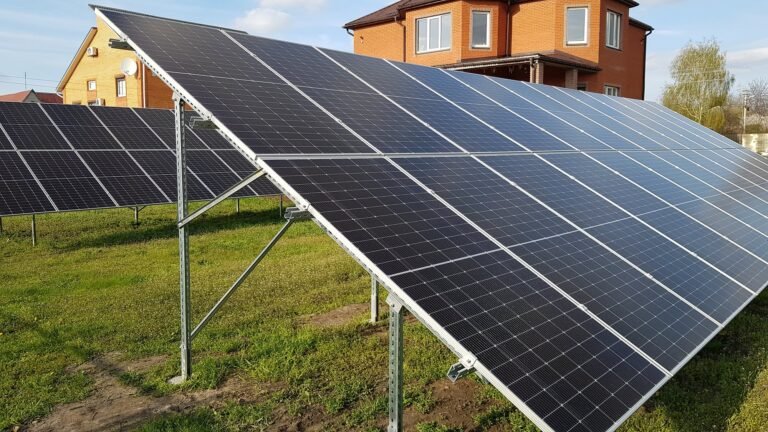
A station’s solar input has three limits: power, voltage and current. On the Elite 200 V2 they are 1,000 W, 12–60 V and 20 A; on the 2E Snagha PRO, 500 W, 11–59 V and 12.5 A; on the RIVER 3 UPS, 110 W, 11–30 V and 8 A. Bluetti explicitly prohibits panels with an open-circuit voltage (Voc) above 60 V.
Panels wired in series add up their voltages; panels wired in parallel add up their currents. So find the Voc on each panel’s label first and add it up for your layout. Manufacturers quote solar charging times for ideal conditions: 2.4 hours at a continuous 1,000 W for the Elite 200 V2, and 0–80% in 96 minutes for the DELTA 3 Max Plus. On cloudy days and in winter, panels deliver less than their rating, so expect longer charging.
Safety
- Charge the station in a well-ventilated place and do not block its vents; both the Bluetti and EcoFlow manuals require this.
- Keep it away from heaters and stoves, and do not use it in the rain or in damp rooms.
- Charging is allowed at 0–40 °C (Bluetti, 2E) or 0–45 °C (EcoFlow), so do not charge the station on a freezing balcony.
- For storage, Bluetti recommends a 40–60% charge and a full cycle every 3–6 months; 2E says not to store the station discharged.
- Charging from a generator is fine, and EcoFlow and Bluetti explicitly allow it. Bluetti requires the generator to deliver a pure sine wave at the right voltage and frequency and to have more power than the station draws while charging; if it falls short, lower the charging current in the app.
- Connect the station to your home wiring only with the main breakers off or through a transfer switch, as described above for the boiler.
Sources and methodology
Analysis of public sourcesChecked 10 October 2026
- EcoFlow — DELTA 3 Max and DELTA 3 Max Plus specs eu.ecoflow.com
- BLUETTI — Elite 200 V2 user manual: UPS, solar input, runtime calculation cdn.shopify.com
- 2E — Snagha PRO specs 2e-world.com
- Derzhenergonahliad — how to connect a power station to a house kmu.gov.ua
- Bosch — Condens 5700i W boiler technical data bosch-homecomfort.com
FAQ
Which power station should I choose for an apartment?
Work out what needs to run without power and for how many hours: a router alone needs 250–300 Wh, while a fridge and boiler call for 1–2 kWh. The all-round option is a 2 kWh LiFePO4 station with a pure sine wave and UPS mode, such as the EcoFlow DELTA 3 Max Plus.
How long will a 1 kWh power station last?
Roughly capacity × 0.85 ÷ load: about 72 hours for a 12 W router, about 8 hours for a boiler drawing 110 W, and about 30 hours for a fridge averaging 29 W. Real runtime depends on how much the device actually draws.
Can I run a gas boiler from a power station?
Yes, if the station delivers a pure sine wave and has enough power: plug the boiler into the station’s outlet as you would with a UPS. Connecting the station to your wiring or breaker panel is a job for an electrician, using a manual or automatic transfer switch.
Which is better: a power station or a UPS?
A regular UPS keeps a computer running for a few minutes so you can save your work, and it costs less. If outages last for hours, you need a LiFePO4 power station or a UPS with external batteries.
EcoFlow or Bluetti: which is better?
It depends on the model. In this list, EcoFlow has faster UPS switching (10 ms) and the DELTA 3 Max Plus can be expanded, while Bluetti offers a higher rated cycle life (6,000+ cycles) and a cheaper 2 kWh station: the Elite 200 V2 costs UAH 71,999 versus UAH 87,999 for the DELTA 3 Max Plus at Foxtrot.





Leave a Reply