
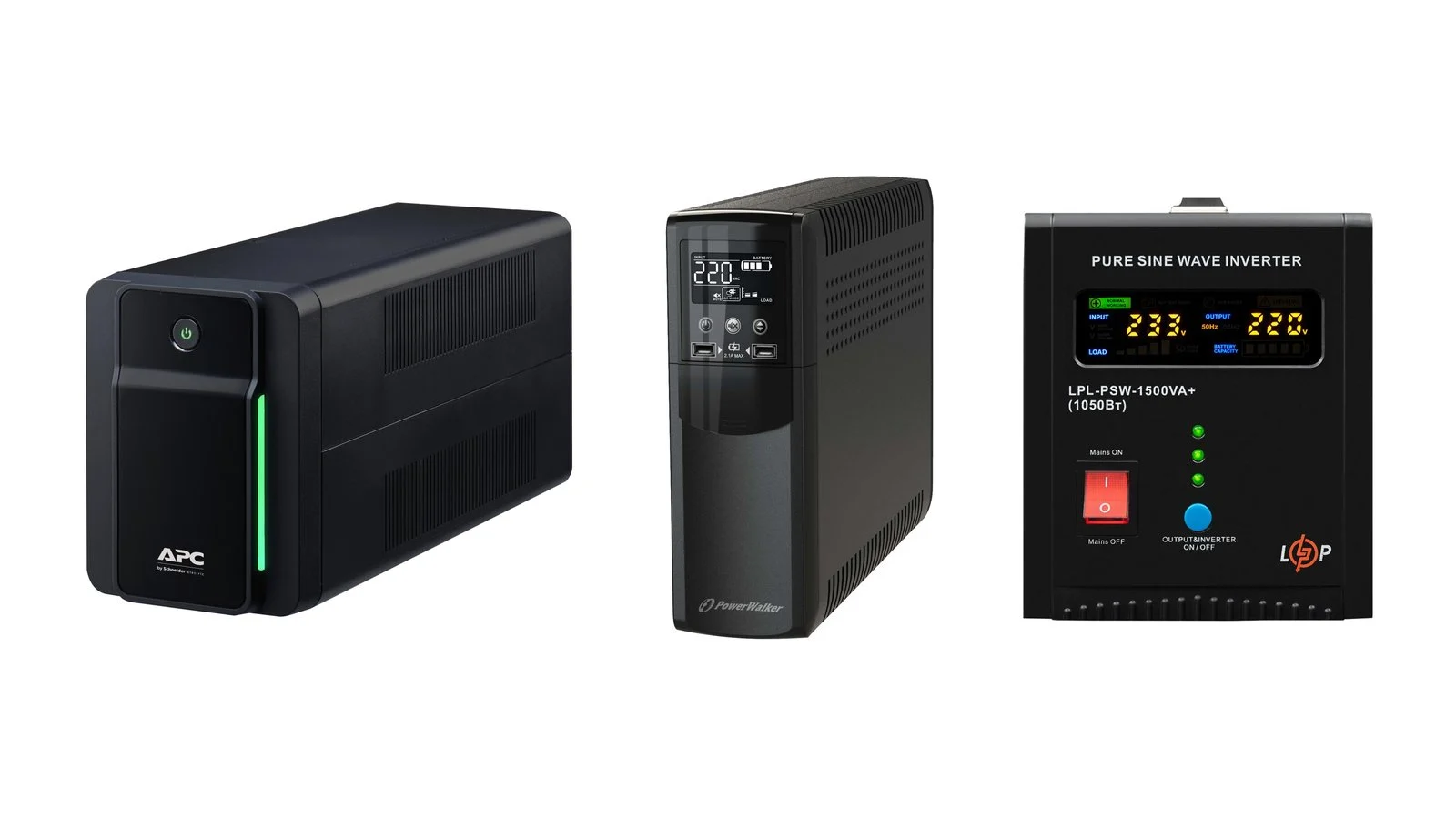
The best UPS in 2026 depends on what it has to power. An office computer will do fine with the line-interactive APC Back-UPS BX950MI-GR at UAH 8,299, a gaming PC with a powerful power supply needs a pure sine wave UPS such as the PowerWalker VI 1500 CSW, a router needs a DC mini UPS such as the 2E Mini DC 36W LFP, and a gas boiler needs the LogicPower LPL-PSW-500VA+ with an external battery.
This roundup covers 7 models on sale in Ukraine as of October 1, 2026, one per job, from a router backup to an online UPS for unstable mains. For each one you get the specs from the manufacturer’s site, the price and, where the maker publishes it, the runtime. Below, you’ll find how to work out the load and runtime yourself and when a portable power station makes more sense than a UPS.
How we picked
- Current models only. All 7 UPS units are listed on the makers’ websites and sold in Ukraine; none of the models from the 2020 version of this article made the cut.
- One job, one model. Office PC, gaming PC, router, gas boiler, an apartment for several hours, NAS and unstable mains.
- Manufacturer data. Specs come from the websites and datasheets of APC, PowerWalker, 2E, LogicPower and Eaton; runtimes come only from the makers’ charts and tables.
- Prices as of October 1, 2026 — at MOYO, KTC and Brain, in LogicPower’s own store, or 2E’s recommended retail price; the source is listed in the comparison table.
We did not test these UPS units: the roundup relies on manufacturer data and store prices.
1. APC Back-UPS BX950MI-GR
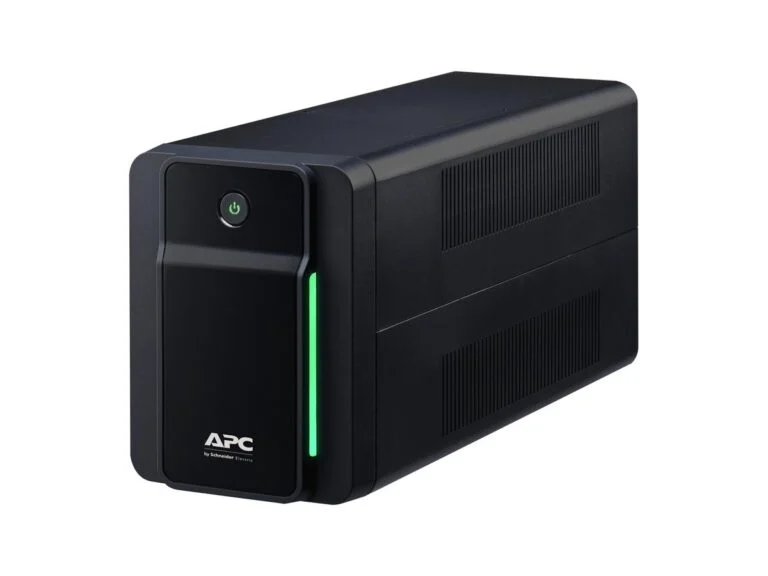
For an office PCLine-interactive UPS
APC Back-UPS BX950MI-GR
- Capacity
- 950 VA / 520 W
- Topology
- line-interactive, AVR
- Waveform on battery
- stepped approximation of a sine wave
- Outlets
- 4 Schuko with battery backup
- Transfer time
- 6 ms, 10 ms max
- Runs on mains with AVR
- 140–300 V
- Battery
- lead-acid, 12 V, 9 Ah
- Runtime per APC
- 6.5 min at 240 W, 1 min at 480 W
- Connectivity
- USB for PowerChute Personal Edition
- Noise
- 40 dBA
- Weight
- 6.1 kg
PriceUAH 8,299checked 1 October 2026
For an office or home PC with a monitor and router: enough time to save your work and shut the computer down properly.
- Four Schuko outlets, no adapters needed
- AVR corrects voltage without draining the battery
- USB port for automatic PC shutdown
- Stepped sine wave: not for boilers or pumps
- Battery replaced only at a service center
- To be discontinued in August 2027
The BX950MI-GR is a classic desk UPS: its four Schuko outlets take the plugs of a computer, monitor and router without adapters. Between 140 and 300 V it runs on mains and corrects the voltage without touching the battery, and when the power goes out it holds a 240 W load for about 6.5 minutes, according to APC — enough to save your files.
With USB and PowerChute Personal Edition, the computer shuts down on its own. Keep in mind that Schneider Electric plans to discontinue the model on August 13, 2027, and that, per APC’s manual, the battery is replaced at a service center. If you are also choosing the computer itself, see our best business desktops of 2026.
2. PowerWalker VI 1500 CSW
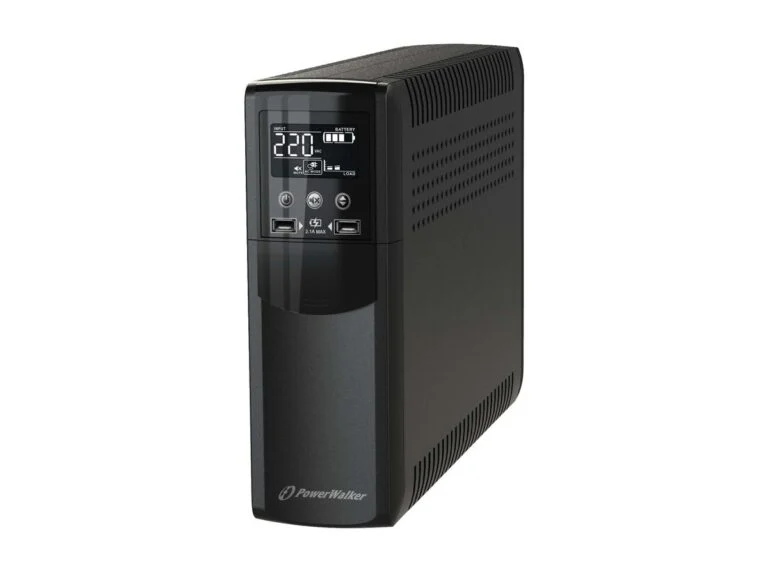
For a gaming PCLine-interactive pure sine wave UPS
PowerWalker VI 1500 CSW
- Capacity
- 1,500 VA / 900 W
- Waveform
- pure sine wave
- Outlets
- 2 Schuko with battery backup and 2 Schuko surge-only
- Transfer time
- 6 ms, 10 ms max
- Input voltage
- 162–290 V
- Batteries
- 2 × 12 V, 9 Ah, hot-swappable
- Runtime per PowerWalker
- 10 min at half load, 3.5 min at full load
- Efficiency
- 98.4% on mains, 82% on battery
- Connectivity
- USB HID, ViewPower software, 2 USB-A charging ports, 2.1 A
- Noise
- up to 45 dB, fan off on mains without AVR
- Dimensions and weight
- 410 × 99 × 280 mm, 13.1 kg
PriceUAH 13,339checked 1 October 2026
For a gaming PC or workstation with a powerful power supply: pure sine wave output and 900 W.
- Pure sine wave and 900 W
- Fan stays off when mains power is normal
- Front-access batteries swap without powering down
- Only two of four outlets have battery backup
- Weighs 13.1 kg
Powerful power supplies with active power factor correction (APFC) are best fed a pure sine wave: CyberPower states outright that a sine wave protects systems with such PSUs, and APC’s Back-UPS manual lists equipment that “does not accept” the stepped waveform among the causes of problems.
The VI 1500 CSW (Schuko version, SKU 10121114) delivers a sine wave and 900 W. Whether that is enough, work out with the method below: check your graphics card’s power draw in its specs and in our best graphics cards of 2026. While mains voltage is normal, the fan stays off, and the batteries swap through the front panel without cutting power to the load.
3. 2E Mini DC 36W LFP
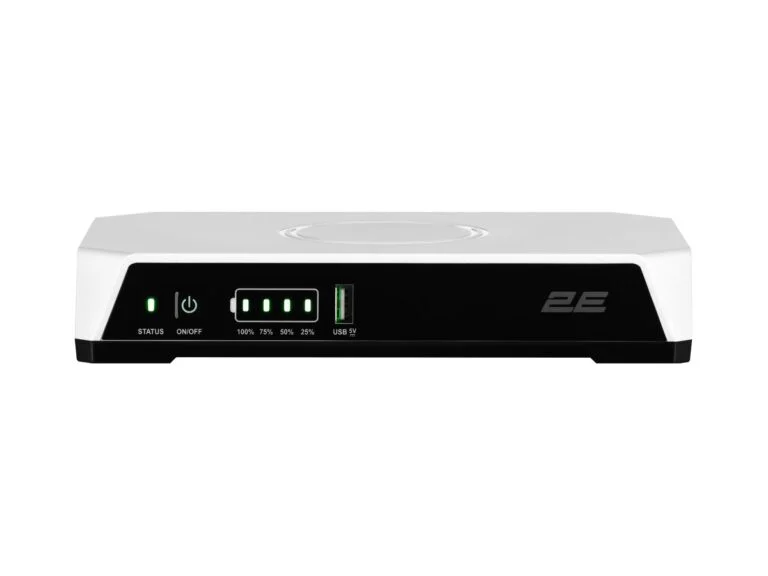
For a router and ONTDC mini UPS
2E Mini DC 36W LFP
- Type
- standby (off-line), DC output
- Power
- up to 36 W
- DC outputs
- 12 V / 3 A, 9 V / 3 A, 5 V / 3 A
- USB
- 5 V / 3 A
- PoE
- 24 V / 1 A or 48 V / 0.5 A, switchable
- Battery
- LiFePO4, 20,000 mAh
- Input
- 100–240 V
- Indicators
- charge LEDs 25/50/75/100%
- Dimensions and weight
- 40 × 210 × 130 mm, 0.73 kg
- Warranty
- 1 year
PriceUAH 2,760checked 1 October 2026
Keeps a router and fiber terminal running during outages: the mini UPS supplies DC power without a 230 V inverter.
- LiFePO4 battery
- Three DC voltages, USB and 24/48 V PoE
- Compact and quiet: no 230 V inverter
- Cannot power a computer or 230 V devices
- Capacity listed in mAh, not watt-hours
A router and a fiber terminal (ONT) run on DC adapters, so they don’t need an inverter: a mini UPS supplies DC directly and wastes no energy on double conversion. Before buying, check the voltage and current on your adapter’s label — the 2E Mini DC has 5, 9 and 12 V outputs at 3 A each, USB, and 24 or 48 V PoE for an IP camera or access point.
2E lists the LiFePO4 battery capacity in mAh without watt-hours, so you can’t calculate the exact runtime with your router from the spec sheet. If your wired internet also drops during outages, you need a backup channel — a mobile 4G router with its own battery, such as the Huawei E5785.
4. LogicPower LPL-PSW-500VA+
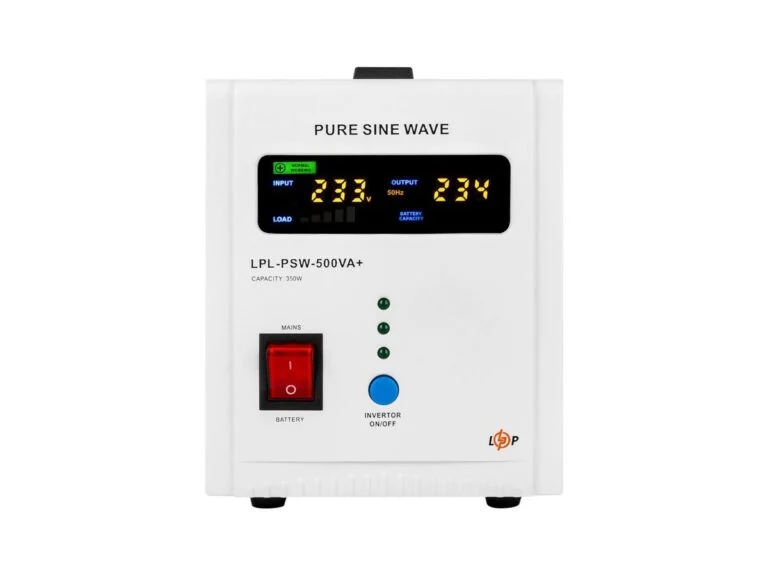
For a gas boilerPure sine wave UPS for an external battery
LogicPower LPL-PSW-500VA+
- Capacity
- 500 VA / 350 W
- Waveform
- pure sine wave
- Topology
- line-interactive, AVR
- Input voltage
- 150–270 V
- Output voltage
- 230 V ±5%
- Transfer time
- 4–6 ms
- Outlets
- 2 Schuko
- Battery
- external, 12 V, terminal connection, not included
- Charging current
- 5 or 15 A
- Battery types
- AGM, multigel, gel, LiFePO4
- Display
- LCD, metal case
- Dimensions and weight
- 145 × 240 × 180 mm, 4.2 kg
- Warranty
- 24 months
PriceUAH 5,518checked 1 October 2026
For a gas boiler with a circulation pump: pure sine wave, a pass-through neutral for phase-sensitive controls and a battery of the capacity you need.
- Pass-through neutral for phase-sensitive boilers
- 5 or 15 A charging for different battery sizes
- Supports LiFePO4
- Battery sold separately
- 350 W and two outlets: the boiler and small loads only
A boiler needs a pure sine wave: APC’s Back-UPS manual says plainly that its stepped waveform is not intended for motor-driven equipment, and a boiler has a circulation pump and, in fan-assisted models, a fan. The LPL-PSW-500VA+ delivers a sine wave and, according to LogicPower, has a pass-through neutral for phase-sensitive controls.
The battery connects externally, so the runtime depends on its capacity; choose the 5 or 15 A charging current to match the battery, as the manual specifies. Take the power draw of your boiler and pump from the boiler’s manual, multiply it by 1.2 and compare the result with the UPS’s 350 W.
5. LogicPower LPL-PSW-1500VA+
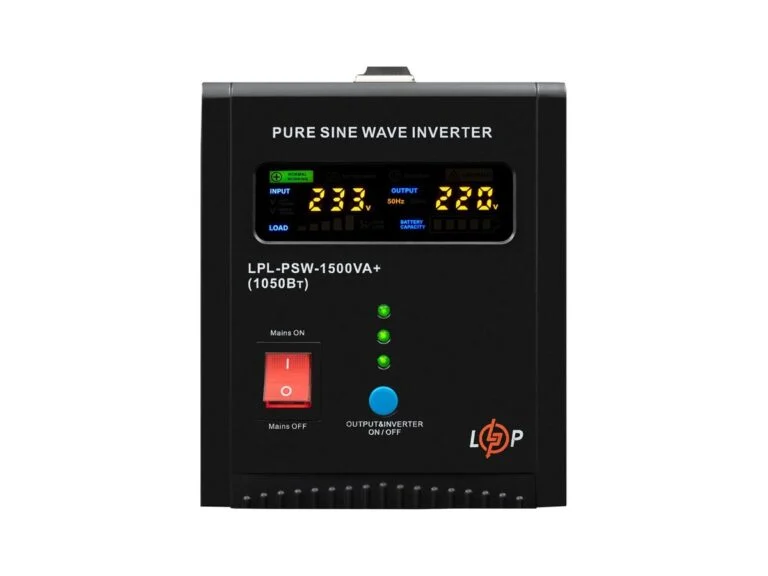
For an apartmentPure sine wave UPS for external batteries
LogicPower LPL-PSW-1500VA+
- Capacity
- 1,500 VA / 1,050 W
- Waveform
- pure sine wave
- Topology
- line-interactive, AVR
- Input voltage
- 150–270 V
- Output voltage
- 230 V ±5%
- Transfer time
- 4–6 ms
- Outlets
- 2 Schuko
- Batteries
- external, 24 V (two 12 V in series), not included
- Charging current
- 10 or 20 A
- Battery types
- AGM, gel, multigel, LiFePO4
- Dimensions and weight
- 345 × 145 × 180 mm, 7.7 kg
- Warranty
- 24 months
PriceUAH 8,449checked 1 October 2026
Powers a router, lights, TV, laptop and pump for hours: you set the runtime by choosing the batteries.
- 1,050 W of pure sine wave
- Up to 20 A charging for large batteries
- Runtime limited only by the batteries
- Batteries sold separately
- Lead-acid batteries need a ventilated spot
If you need to keep not just the boiler but also lights, a router, a TV and a laptop going for several hours, the usual choice is an inverter UPS with external batteries. The LPL-PSW-1500VA+ runs on 24 V and delivers up to 1,050 W of pure sine wave, and you build up the capacity yourself. Connect a refrigerator only after checking its starting power in its manual: LogicPower advises sizing by that figure, not the rated one. Put lead-acid batteries in a ventilated spot — more on that in the safety section below.
6. Eaton Ellipse PRO 650 DIN
For NAS and networkingLine-interactive UPS
Eaton Ellipse PRO 650 DIN
- Capacity
- 650 VA / 400 W
- Topology
- line-interactive
- Outlets
- 3 Schuko with battery backup and 1 Schuko surge-only
- Input voltage
- 165–285 V, extendable to 150–285 V
- Battery
- 12 V, 7 Ah, user-replaceable
- Runtime per Eaton chart
- 71 min at 40 W, 31 min at 80 W
- Connectivity
- USB HID, Eaton UPS Companion software
- Noise
- under 25 dB at 1 m
- Dimensions and weight
- 285 × 260 × 82 mm, 6.6 kg
- Warranty
- 3 years
PriceUAH 10,903checked 1 October 2026
For a NAS, router and switch in a living space: nearly silent, and over USB it signals a shutdown when the battery runs low.
- Under 25 dB
- USB HID and automatic shutdown
- Rack and wall kits: ELRACK, ELWALL
- Only 400 W
- Eaton does not list the battery-mode waveform
A NAS, router and switch draw little power but run around the clock and often sit in a living room, so silence and a clean shutdown matter here. The Ellipse PRO 650 runs below 25 dB and, over USB HID, tells a computer or a UPS-aware NAS that the battery is running low. According to Eaton’s chart, it lasts about 71 minutes at a 40 W load and about 31 minutes at 80 W. For a rack or wall installation, Eaton offers the ELRACK and ELWALL kits.
7. 2E OD1000
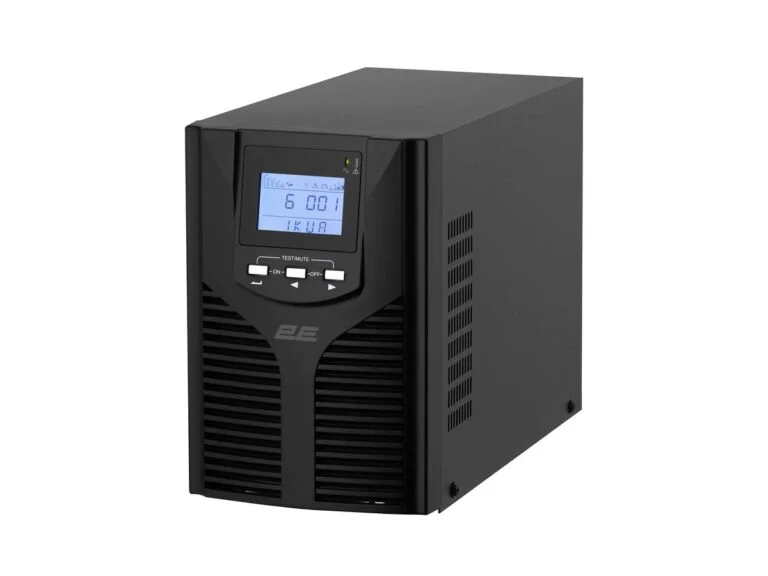
For unstable mainsOnline double-conversion UPS
2E OD1000
- Capacity
- 1,000 VA / 900 W
- Topology
- online, double conversion
- Outlets
- 2 Schuko
- Input without derating
- 176–280 V
- Input with derating
- 110–176 V
- Input frequency
- 40–70 Hz
- Efficiency
- 90% or more on mains, 95% or more in ECO mode
- Batteries
- 2 × 12 V, 9 Ah, charge to 90% in 3 hours
- Connectivity
- USB, RS-232, optional SNMP adapter
- Noise
- 50 dB
- Dimensions and weight
- 214 × 144 × 336 mm, 9.5 kg
PriceUAH 12,389, recommended pricechecked 1 October 2026
For equipment that suffers from voltage swings and even milliseconds of transfer time: an online UPS powers it from the inverter all the time.
- No transfer: the inverter runs constantly
- Input frequency 40–70 Hz
- Schuko outlets, not IEC
- 50 dB of noise
- Only two outlets
In a line-interactive UPS, the inverter kicks in only when mains power fails; in an online model, it runs constantly, so your equipment always gets freshly generated voltage and there is no transfer at all. That helps where the voltage jumps around or the house runs on a generator: the 2E OD1000 accepts 110–280 V (below 176 V with derating) and 40–70 Hz.
The trade-offs are 50 dB of noise and lower efficiency — 90% or more in normal mode. The model isn’t new, but it remains in 2E’s catalog at a recommended price of UAH 12,389; MOYO had it out of stock as of October 1.
Comparison
| Model | Best for | Key strength | Price, UAH (source) |
|---|---|---|---|
| APC Back-UPS BX950MI-GR | Office PC | 4 Schuko, AVR, USB | 8,299 (MOYO) |
| PowerWalker VI 1500 CSW | Gaming PC | Pure sine wave, 900 W | 13,339 (KTC) |
| 2E Mini DC 36W LFP | Router and ONT | LiFePO4, 24/48 V PoE | 2,760 (MOYO) |
| LogicPower LPL-PSW-500VA+ | Gas boiler | Sine wave, external 12 V battery | 5,518 (LogicPower) |
| LogicPower LPL-PSW-1500VA+ | Apartment, for hours | 1,050 W, 24 V batteries | 8,449 (LogicPower) |
| Eaton Ellipse PRO 650 DIN | NAS and networking | Under 25 dB, USB HID | 10,903 (Brain) |
| 2E OD1000 | Unstable mains | Online, no transfer | 12,389 (2E price) |
When a power station is the better choice
If outages last several hours, a regular UPS with a built-in battery won’t help: even per its datasheet, the APC BX950MI-GR holds 240 W for about 6.5 minutes. A portable power station is a large LiFePO4 battery with an inverter, outlets and USB in one box: the EcoFlow RIVER 3 Plus has 286 Wh, the Anker SOLIX C1000 has 1,056 Wh. You can carry it to another room and recharge it between outages.
Many stations can work as a UPS, but their transfer times differ: EcoFlow claims under 10 ms for the RIVER 3 Plus, Anker under 20 ms for the SOLIX C1000. The line-interactive UPS units in this roundup take 4–10 ms, and an online UPS has no transfer at all. For a desktop PC or NAS, pick a station that switches in 10 ms or less and can warn about a low battery: the RIVER 3 Plus connects to a PC or NAS over USB-B, and the Power Manager software reports low charge.
The LiFePO4 battery in stations is rated for thousands of cycles — 3,000 cycles to 80% capacity for the Anker SOLIX C1000. An inverter UPS with external batteries, such as the LogicPower LPL-PSW-1500VA+, lets you size the capacity to your load, but it needs space, cabling and, for lead-acid batteries, ventilation. A simple rule: for minutes, a UPS; for hours, a power station or a UPS with external batteries.
How to choose a UPS
How many watts you need
A UPS has two power ratings: apparent power in volt-amperes (VA) and real power in watts (W). Go by watts: the APC BX950MI-GR is rated at 950 VA but only 520 W. Add up the power draw of all your devices from their specs and add headroom — LogicPower recommends multiplying the total by 1.2. An example with illustrative numbers:
- A PC under load draws 150 W, a monitor 30 W, a router 10 W: 190 W in total.
- With headroom: 190 × 1.2 ≈ 230 W.
- Any UPS rated above 230 W will do: the 520 W APC BX950MI-GR handles this load with room to spare, and so does the 400 W Eaton Ellipse PRO 650 DIN.
How long it will run
The most accurate answer is the manufacturer’s runtime chart: APC, Eaton and PowerWalker publish runtimes at different loads. If there is no chart, estimate it yourself. A battery’s energy in watt-hours equals its voltage times its capacity: a 12 V, 100 Ah lead-acid battery stores 1,200 Wh, and a 12.8 V, 100 Ah LiFePO4 battery stores 1,280 Wh.
Next, multiply the energy by the inverter efficiency and divide by the load. For the PowerWalker VI 1500 CSW, the maker lists 82% efficiency on battery; we’ll use 80% as an example. Say a boiler with its pump draws 100 W — take your own figure from the boiler’s manual. With a 1,280 Wh LiFePO4 battery: 1,280 × 0.8 / 100 ≈ 10 hours. That is an upper estimate: lead-acid batteries deliver less in the cold and at high current, and every battery loses capacity as it ages.
When you need a pure sine wave
A stepped approximation of a sine wave, per APC’s manual, is meant for computers and peripherals, not motor-driven equipment. That is why a gas boiler with a pump, a water pump and a refrigerator need a pure sine wave UPS. It is also the right choice for a computer with a powerful active-PFC power supply: CyberPower states directly that a sine wave protects such systems.
Line-interactive or online
A line-interactive UPS corrects the voltage with its regulator (AVR) without draining the battery and switches to battery within 4–10 ms when the power goes out — most models in this roundup work this way. An online UPS powers the load from the inverter all the time: there is no transfer and it accepts a wider input voltage range, but it is louder and uses more energy. The 2E OD1000 is 90% or more efficient on mains, versus 98.4% for the line-interactive PowerWalker VI 1500 CSW.
Batteries: AGM or LiFePO4
Built-in UPS batteries are usually sealed lead-acid; APC estimates their life at 3–5 years. For external batteries, LogicPower lists up to 400 cycles for AGM, up to 800 for multigel, up to 1,200 for gel and up to 7,000 for LiFePO4. Heat ages any battery: lead-acid battery maker CSB halves its warranty period for every 10 °C above 25 °C.
External battery safety
Lead-acid batteries can release hydrogen when overcharged, so CSB prohibits charging or storing them in a sealed box, requires ventilation and recommends leaving 5–10 mm between batteries. Don’t put the battery in a closed cabinet or near heat sources, and connect it with the correct polarity, using cables of the gauge given in the UPS manual. If a powerful UPS gets its own circuit, the breaker is sized to the wire gauge — see our guide on choosing a circuit breaker.
Sources and methodology
Analysis of public sourcesChecked 1 October 2026
- Schneider Electric — APC Back-UPS BX Series 500–2200 VA user manual se.com
- Eaton — Ellipse PRO 650 DIN runtime chart eg.eaton.com
- LogicPower — pure sine wave UPS: battery types and load sizing logicpower.ua
- CSB — VRLA battery operation and handling manual csb-battery.com
- EcoFlow — RIVER 3 Plus, UPS mode ecoflow.com
FAQ
Which UPS is best for a computer?
For an office or home PC, a line-interactive model with AVR and enough watts, such as the 520 W APC Back-UPS BX950MI-GR. For a gaming PC with a powerful active-PFC power supply, a pure sine wave model such as the 900 W PowerWalker VI 1500 CSW.
How long will a UPS run during a power outage?
A built-in battery lasts minutes: according to APC, the BX950MI-GR holds 240 W for about 6.5 minutes, and the Eaton Ellipse PRO 650 DIN runs for about 71 minutes at 40 W. To last for hours, you need a UPS with external batteries or a power station.
Will the APC BE600M1 work in Ukraine?
No. The Back-UPS BE600M1 is designed for the 120 V US grid and NEMA 5-15 outlets, while Ukraine uses 230 V and Schuko outlets. Choose a 230 V model instead, such as the APC Back-UPS BX950MI-GR with four Schuko outlets.
What UPS does a gas boiler need?
One with a pure sine wave and an external battery connection: the boiler’s pump is an electric motor, and a stepped waveform isn’t meant for such loads. A phase-sensitive boiler needs a UPS with a pass-through neutral, such as the LogicPower LPL-PSW-500VA+.
How is a UPS different from a power station?
A UPS is built for minutes and switches over in 4–10 ms, while online models don’t switch at all. A LiFePO4 power station stores hundreds or thousands of watt-hours for hours of runtime, and UPS-mode transfer times vary by model: EcoFlow claims under 10 ms for the RIVER 3 Plus, Anker under 20 ms for the SOLIX C1000.







Leave a Reply