
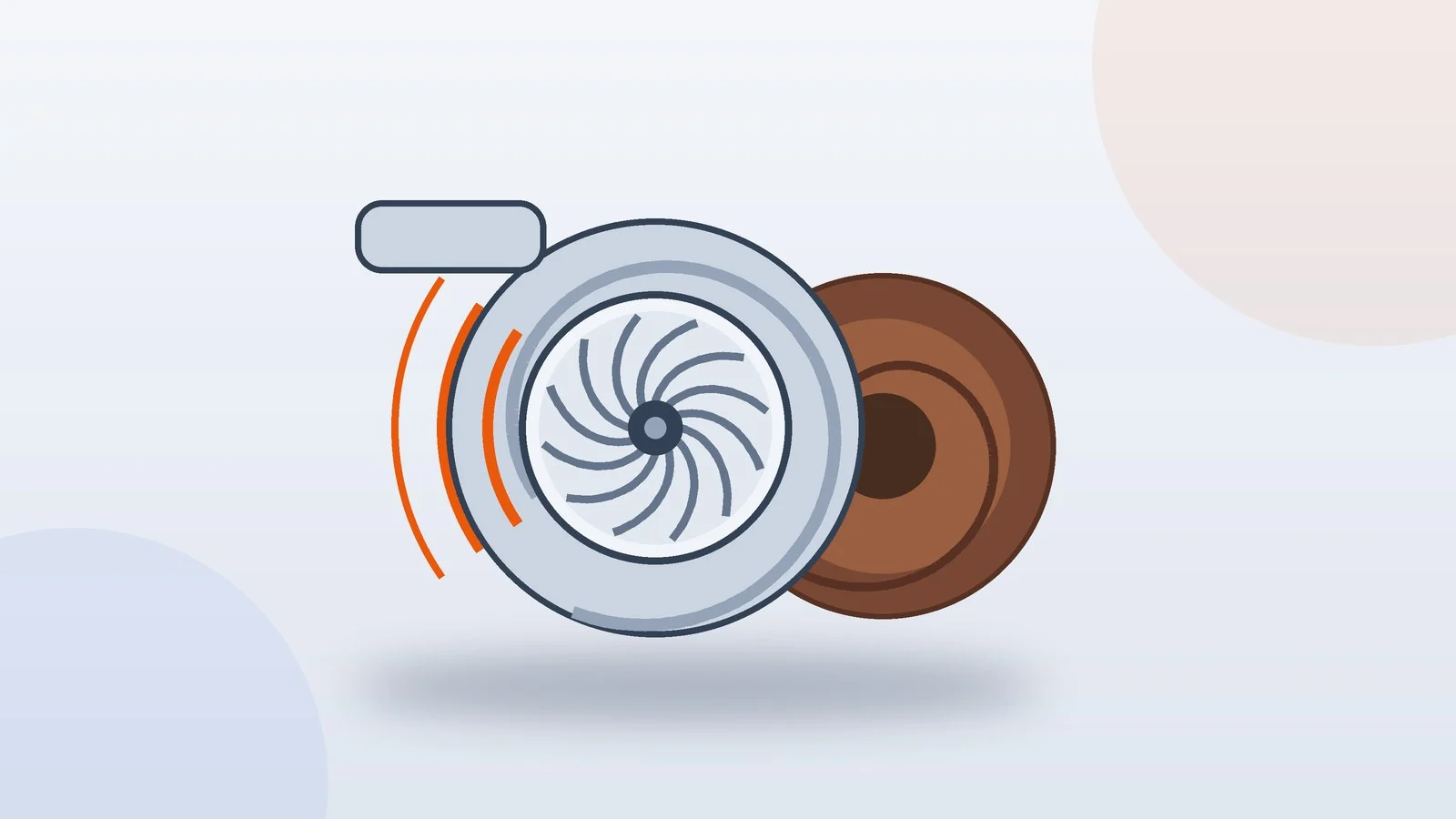
A light whistle from the turbo when you accelerate is normal: it’s the sound of air being pushed into the engine by a compressor wheel spinning at hundreds of thousands of rpm. The warning signs are a new or noticeably louder whistle, a siren-like howl, or a whistle that comes with power loss, exhaust smoke or oil consumption.
Below: normal and worrying sounds, the common causes of turbo whistle, what you can check yourself, what to leave to a shop, and how to make a turbo last. The facts come from technical materials by turbocharger makers Garrett, BorgWarner, IHI, Mitsubishi Heavy Industries and MAHLE.
up to 300,000 rpm
Turbo shaft speed
IHI, BorgWarner
950 °C and up
Exhaust temperature at the turbo
gasoline engines, IHI
over 90%
Share of turbo failures linked to oil
Garrett
2–3 min
Bearing heat peaks after shutdown
Garrett
Source: Garrett, BorgWarner, IHI · data as of 25 September 2026
Should a turbo whistle?
Yes, but quietly. A turbocharger is an air pump driven by exhaust gas: the exhaust spins the turbine wheel, which drives the compressor wheel on a shared shaft to compress air for the engine. According to IHI, the shaft of a gasoline turbo spins at up to 300,000 rpm; for Mitsubishi’s small TD02 turbos, the limit is 260,000 rpm. At those speeds, some airflow noise is unavoidable.
MAHLE, which makes replacement turbochargers, points out that the intake pipes and the air filter housing are designed so the driver hears almost nothing from the turbo. So the normal sound is a soft, even whistle that rises with rpm as you accelerate and fades when you lift off the gas.
What matters most is not the volume itself but a change. If the car has sounded the same for years and now whistles louder, at a higher pitch or in new situations, it’s worth investigating; below is what that sound can mean.
A common myth is that a new turbo whistles for a while and then “beds in.” MAHLE says the opposite: if a turbo draws attention right after replacement with whistling, rattling or rasping, the fault is usually found around it. A typical example is old sealing rings in the pipe joints: once disturbed, they no longer hold pressure, and air escapes with a whistle and a hiss.
Whistle and “pssh” when you lift off
When you lift off the gas sharply, the throttle plate of a gasoline engine closes while the turbo keeps spinning and pumping air. Pressure gets trapped in the pipes and intercooler, and, as Garrett explains, the air starts forcing its way back through the compressor. That’s compressor surge. To prevent it, the intake has a blow-off (bypass) valve that vents the excess pressure as soon as the throttle closes.
These valves come in two types. Some vent to the atmosphere and make the loud “pssh.” Recirculating valves route the air back to the compressor inlet and sound quieter; for engines with a mass airflow (MAF) sensor, Garrett recommends this type. A short “pssh” or rustle when you lift off is simply the valve doing its job.
What isn’t normal is a rapid fluttering “chu-chu-chu” on lift-off in a car that didn’t make it before. Garrett calls these rapid pressure swings the audible evidence of surge: surge loads the shaft and bearings and can eventually cause thrust bearing failure. In that case, check the blow-off valve, its hoses and its connector; these valves can be pneumatic or electric.
When a turbo whistle means trouble
Be on alert if:
- the whistle appeared suddenly or changed: it got louder or higher, or turned into a howl or a screech. Garrett links a high-pitched whistle or screech, especially under acceleration, to a damaged compressor wheel;
- the whistle came with a loss of power. Boost is escaping through a leak, or a damaged wheel can’t build it, and if boost strays far from the target, MAHLE says the engine control unit switches to limp mode and cuts power;
- there’s blue smoke from the tailpipe. That’s oil getting past the seals of a worn turbo and burning. Cars with a particulate filter may show no smoke: Garrett notes it’s noticeable in vehicles without one;
- there’s black smoke under load, meaning the mixture is too rich. BorgWarner’s list of causes includes a dirty air filter, leaking pipes, damaged turbo wheels and a faulty fuel system;
- you’re topping up oil more often, and there’s oil in the intercooler pipes. When the bearings wear, Garrett says, oil can get past the compressor-side seal and be blown straight into the pipes and intercooler. Clogged crankcase ventilation can cause this too, so it calls for a diagnosis, not a death sentence for the turbo;
- you hear grinding or metallic ringing. MAHLE describes cases where the shaft shifts and the compressor wheel starts rubbing the housing, a noise that, in their words, you can’t fail to hear.
| Sound | When you hear it | What it usually means | What to do |
|---|---|---|---|
| Soft, even whistle | Accelerating, rises with rpm | Normal turbo operation | Nothing |
| Short “pssh” | Sharp lift-off | Blow-off valve venting | Nothing |
| Fluttering “chu-chu” | Lift-off | Compressor surge | Check the blow-off valve |
| Loud whistle or hiss | Under load, power drops | Boost leak | Inspect pipes, go to a shop |
| Howl, screech, “siren” | Rises with rpm | Compressor wheel or bearings | Drive gently to a shop |
| Hiss near the manifold | Under load | Exhaust leak | Go to a shop |
| Grinding, metallic ringing | Any condition | Wheel rubbing the housing | Shut off, call a tow truck |
Why a turbo whistles: common causes
Often it’s not the turbo itself that whistles but something around it. BorgWarner warns that working turbos are often replaced for nothing when the fault lies with the engine.
Boost leak: pipes, clamps, intercooler
Compressed air from the turbo travels to the engine through pipes and the intercooler (charge air cooler). If a clamp has loosened, a pipe has cracked or a stone has punctured the intercooler, pressurized air escapes with a loud whistle or hiss that gets louder as you press the gas. MAHLE calls leaks “fault source #1” and notes that a boost leak also costs power.
Dirty air filter and restricted intake
A turbo needs to breathe freely. When the air filter is clogged or the pipe in front of the turbo has collapsed, intake resistance rises and the turbo gets noisy; both Garrett and MAHLE list this cause. In the worst case, MAHLE says, the shaft shifts axially and the compressor wheel rubs the housing. A dirty filter also keeps the turbo from building full boost.
Damaged compressor wheel
Compressor wheels are made of aluminum (IHI’s are, for example), and their thin blades spin at enormous speed. If a nut or a broken piece of a part gets into the intake, the blades bend or break off. Garrett describes the symptoms as a high-pitched whistle or screech under acceleration and a drop in boost and power. MAHLE adds that even slightly bent blades cause noticeable flow noise.
A damaged wheel loses its balance, vibration wrecks the bearings and seals, oil starts leaking, and it can end in total turbo failure (Garrett). If a foreign object damaged the wheel, MAHLE advises replacing the intercooler as well, because fragments can’t be fully removed from it.
Bearing wear and oil starvation
The turbo shaft rides on a film of oil, and the same oil carries heat away from the bearings on the hot turbine side. Garrett ties more than 90% of turbo failures to oil, whether starvation or contamination, while manufacturing defects account for less than 1%. Fine carbon particles in the oil act as an abrasive: bearing clearances grow until the oil can no longer control the shaft.
Garrett says this is usually accompanied by a sharp increase in noise, oil leaking past the seals and smoke. Once metal-to-metal contact begins, the turbo doesn’t have long to live.
Exhaust leaks before and after the turbo
The exhaust side can be noisy too. BorgWarner lists exhaust leaks before and after the turbo and excessive exhaust flow resistance among the causes of noise, and Garrett names a cracked manifold and a burned or loose gasket. Exhaust leaves the engine at several bar of pressure, so such a gap sounds like a sharp hiss, and some exhaust bypasses the turbo, cutting boost and power (MAHLE).
Boost control faults
Boost is controlled by the wastegate, a valve that lets some exhaust bypass the turbine, and on many turbos, especially diesels, by a variable geometry mechanism with movable vanes. If the valve won’t close or sticks, the mechanism is coked up, or hoses or actuators are damaged, Garrett’s troubleshooting chart lists both noise and power loss among the effects. MAHLE adds that such faults usually leave codes in the ECU’s memory.
Finally, not every case of low power with smoke comes from the turbo. Garrett points out that power loss, noise, smoke and oil consumption can also stem from a faulty fuel injection system, clogged filters, a damaged exhaust or a lubrication problem, and that turbo damage is often just a symptom of another fault. On a diesel, that could be worn injectors or a failing high-pressure fuel pump.
Turbo whistle on a diesel
Should a turbo whistle on a diesel? The rules are the same as for a gasoline engine: a quiet whistle under acceleration is normal; a new loud whistle, a howl, or a whistle with smoke and power loss is not. A modern diesel can’t do without a turbo: IHI notes that turbocharging helps fight soot and that without it a diesel can’t meet current emission regulations.
A loud “pssh” on lift-off is mostly a gasoline-engine thing. A diesel has no throttle plate to control power, and IHI names this as one reason diesels pair so well with turbochargers.
Diesels have their own weak spots, though. Variable geometry vanes clog with soot and carbon over time, and then, per MAHLE, power drops mainly at low rpm. MAHLE also says the most common cause of a restricted exhaust on a diesel is a clogged diesel particulate filter (DPF): exhaust struggles to pass through the turbo, and power falls. A shop then checks the pressure downstream of the turbo and how loaded the DPF is.
What you can check yourself
Without tools, you can do the following:
- Note when the sound appears: cold or hot engine, under acceleration, under load, when lifting off. Record it on your phone; it makes the mechanic’s job easier.
- Look at the dashboard: is the check engine light on, and has the car become slower to accelerate?
- Find out when the air filter was last replaced and inspect it: a dirty filter is one of the causes of noise in Garrett’s troubleshooting chart.
- Inspect the pipes you can reach, from the filter to the turbo and from the turbo through the intercooler to the engine: look for cracks, popped-off or loose clamps, oily traces at the joints, and dents or holes in the intercooler.
- Check the oil level on the dipstick and think about how often you’ve been topping up. If it’s more often than before, tell the shop.
- Watch the exhaust at startup and under acceleration: blue smoke means burning oil, black smoke means a too-rich mixture.
The internet tip of spraying soapy water on the joints and revving the engine in place doesn’t help much. At idle, the turbo spins slowly and there’s almost no boost, so a leak that whistles under load may not produce any bubbles on a parked car. Working next to a running engine with spinning belts and a hot exhaust isn’t safe, either.
If you’re buying a used car with a turbocharged engine, listen to it under acceleration and on lift-off, inspect the intercooler pipes, and ask how often the oil was changed.
What to leave to a shop
Anything that requires removing parts or running the engine under load is a job for a shop: Garrett reminds readers that only trained specialists should take a turbo apart, and BorgWarner says that, given the tight tolerances and speeds of up to 300,000 rpm, turbos should be inspected only by qualified technicians. Diagnosis usually goes from simple to complex.
Read fault codes and boost pressure
A scan tool shows trouble codes and compares target and actual boost pressure in different conditions; underboost is often logged as P0299. Garrett’s guide starts here too: read the engine control unit’s fault codes with the diagnostic equipment the carmaker recommends.
Result: You see in which conditions boost deviates from normal.
Pressure-test the intake and boost system
With the engine off, the system is pressurized with air or smoke to simulate the load at which the leak whistles, and the technician looks for where the pressure escapes. MAHLE advises replacing old sealing rings and gaskets rather than reusing them.
Result: A boost leak is found or ruled out.
Inspect the exhaust before and after the turbo
The technician looks for manifold cracks, burned gaskets and leaks at the turbo flanges, and checks whether the exhaust is restricted. Garrett says the manifold should be removed and inspected only with the engine cold and off.
Result: It’s clear whether exhaust is bypassing the turbo.
Inspect the wheel and check shaft play
With the intake pipe off, the technician checks the blades for nicks and signs of housing contact, then checks shaft play. Some play in a dry turbo isn’t a death sentence: Garrett says bearing clearances are often mistaken for “excessive play,” though the turbo needs them, and in operation an oil film fills them. So play is compared with the manufacturer’s tolerance, not judged by eye.
Result: It’s clear whether the turbo itself is intact.
Find the root cause before replacing
If the turbo is damaged after all, it’s important to understand why. MAHLE warns that if only the turbo is replaced, further repairs are usually needed soon. So technicians check the oil supply and drain, crankcase ventilation and air filter, change the oil and filter, and after debris damage, replace the intercooler too.
Result: A new turbo won’t fail the same way.
What comes next, whether that’s replacing pipes and seals or repairing or replacing the turbo, depends on the findings, and so does the cost of the repair.
How to make a turbo last
According to BorgWarner, a turbo is usually designed to last as long as the engine and needs no special maintenance. The condition is to strictly follow the carmaker’s service schedule: oil change intervals, oil filter maintenance, oil pressure checks and air filter maintenance. The rest depends on how you drive.
- Change the oil on time, and use the right oil. Replace it with the filter per the schedule: Garrett also lists the wrong oil as a cause of failure. Mazda, for example, doesn’t recommend oil additives in its turbo engine manual.
- Replace the air filter on schedule. When you do, make sure nothing falls into the intake; BorgWarner specifically warns about this.
- Don’t rev a cold engine. Per Garrett, hard acceleration right after a cold start doesn’t give the oil time to reach the bearings. Kia advises letting a cold engine idle for several seconds so lubrication reaches the turbo, and Mazda warns that revving right after startup can damage it.
- Let the turbo cool down. After the engine stops, oil stops flowing to the bearings while heat from the turbine side soaks into them: Garrett says the temperature there peaks about 2–3 minutes later, and leftover oil can coke. So after highway driving or a long climb, idle the engine before shutting it off: Kia recommends about a minute, Mazda at least 30 seconds. This applies specifically to heavy loads.
- Don’t idle for long periods. In Garrett’s troubleshooting chart, excessive idling is linked to oil consumption, blue smoke and oil at the turbine end.
- Don’t change the turbo’s factory settings. MAHLE notes that every turbo is calibrated at the factory and advises leaving those settings alone: if, for example, the wastegate starts opening too late, the turbo can exceed its maximum speed.
Sources and methodology
Analysis of public sourcesChecked 25 September 2026
- Garrett: Why do turbochargers fail? garrettmotion.com
- BorgWarner: Troubleshooting for turbochargers borgwarner.com
- MAHLE: The trouble with a whistling turbo workshop-heroes.mahle.com
- IHI: What is a turbocharger? ihi.co.jp
- Mitsubishi Heavy Industries: Turbocharger technical information mhi.com
FAQ
Should a turbo whistle?
Yes. A soft, even whistle that rises with rpm under acceleration and fades when you lift off is normal. A new, loud whistle or a howl is a warning sign, especially with power loss, smoke or oil consumption.
Why does my turbo whistle when I let off the gas?
A short “pssh” is the blow-off valve venting boost pressure, which is exactly what it should do. A rapid fluttering “chu-chu-chu” points to compressor surge, which wears the bearings: check the valve and its hoses.
Can I drive with a whistling turbo?
If the whistle is quiet and hasn’t changed, yes. If it’s new or loud, drive gently to a shop without heavy loads; if there’s grinding, smoke, a sudden loss of power or fast oil loss, shut off the engine and call a tow truck.
Why is my new turbo whistling?
Usually because of something around it: MAHLE names leaks as the main cause, such as old pipe sealing rings that were reused. Check the joints, the intercooler and the air filter.
How long should a turbo engine idle before shutdown?
Check your car’s manual. After highway driving or a long climb, Kia recommends about a minute at idle and Mazda at least 30 seconds; after gentle driving, their manuals don’t call for a pause.









Leave a Reply