
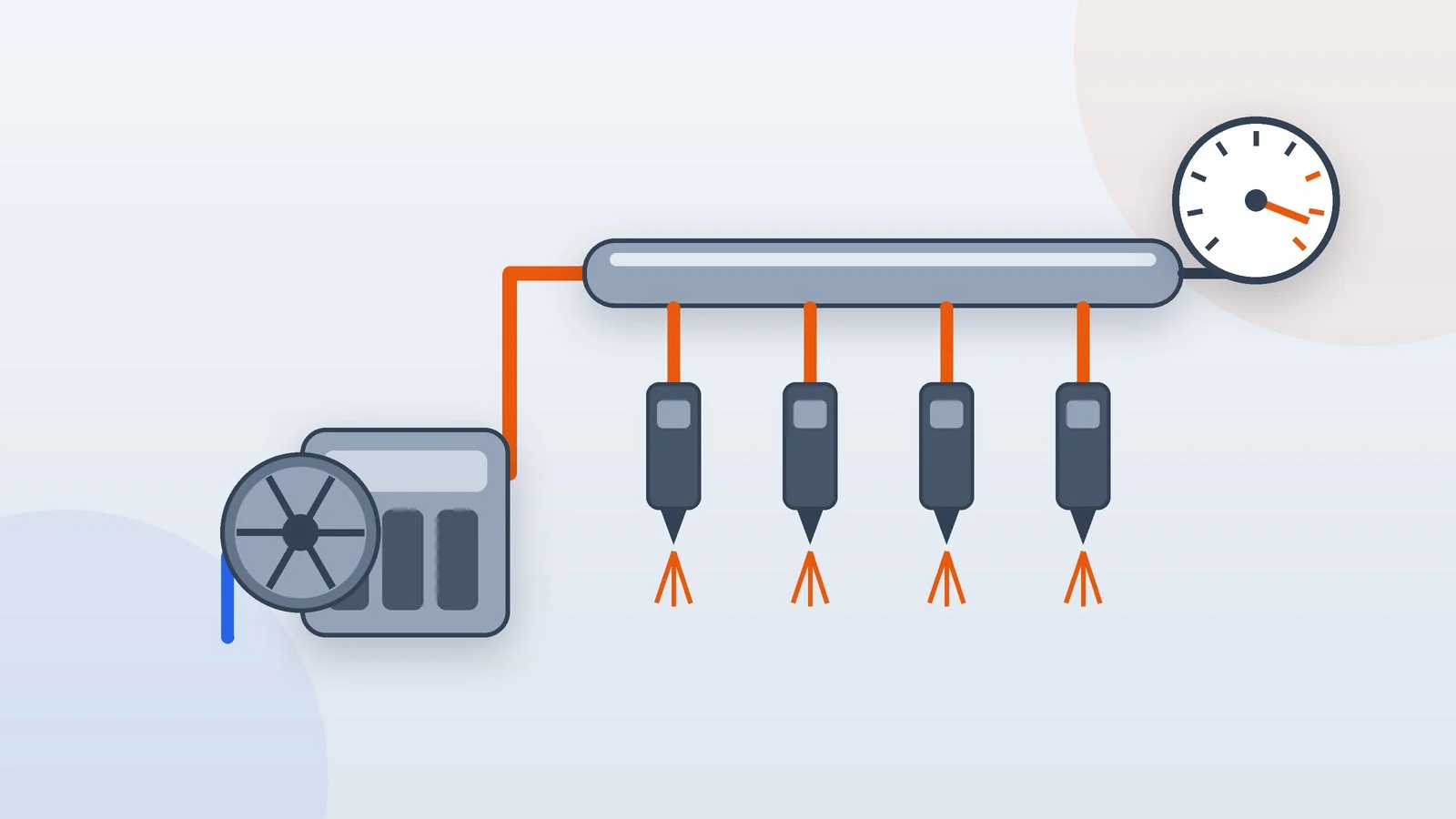
A diesel injection pump — the engine’s high-pressure fuel pump — squeezes diesel fuel to hundreds or thousands of bar so the injectors can spray it into the cylinders at the right moment, in the right amount and as a fine mist. Without that pressure a diesel won’t start: the fuel ignites from hot compressed air, and it has only a fraction of a second to mix with that air.
Below: how the pump works, how inline and distributor pumps differ from common rail and unit injectors, which symptoms point to a failing pump, what shortens its life and how a shop tests it. The figures come from fuel-injection makers Bosch, Denso and Delphi, diesel fuel standards and documents from the U.S. regulator NHTSA.
up to 2,700 bar
Common-rail pressure
Bosch CP4 pumps
up to 350 bar
Gasoline direct injection
Bosch systems
200 mg/kg
Water limit in diesel fuel
EN 590, DSTU 7688:2015
1927
Start of series production
Bosch inline injection pumps
Source: Bosch, EN 590, DSTU 7688:2015 · data as of 25 September 2026
What an injection pump is and why a diesel needs it
A diesel has no spark plugs. Air in the cylinder is compressed and gets very hot, so the fuel ignites on its own as soon as it enters. To atomize, mix with the air and burn without soot, the fuel has to arrive at a pressure far above that of the compressed air in the cylinder. The injection pump creates that pressure.
That is not its only job. On older diesels, a mechanical pump also meters the fuel to match the load and sets the injection timing for each cylinder. In common-rail systems, the pump only keeps the shared rail pressurized, while the engine control unit decides when and how much to inject through the injectors.
One important detail: the pump is lubricated by the fuel itself — Bosch describes its CP4 as a fuel-lubricated pump. So anything that degrades the fuel — water, dirt, gasoline, poor lubricity — directly shortens the pump’s life.
How a diesel injection pump works
In a modern common-rail diesel, fuel travels this route:
Tank and lift pump
supply fuel at low pressure
Filter
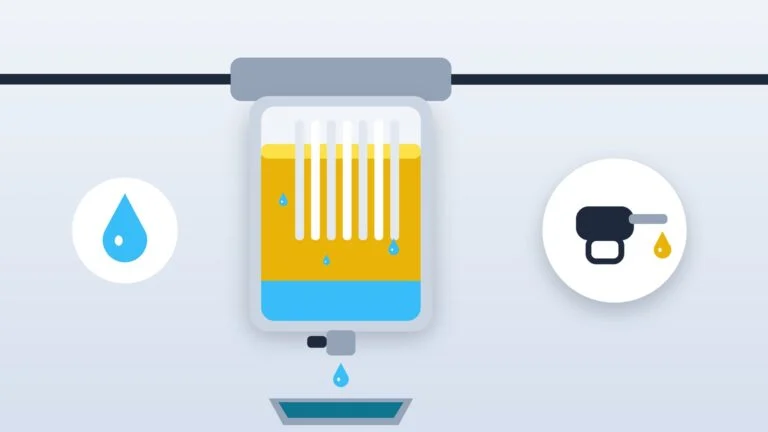
traps particles and separates water
High-pressure pump
compresses fuel to up to 2,700 bar
Rail
stores pressurized fuel for all injectors
Injectors
spray it in on command from the control unit
Every injection pump is built around a plunger and barrel: a steel plunger in a sleeve. The pump shaft is driven by the engine through a belt, chain or gears and moves the plunger via a cam or eccentric. On the downstroke, fuel fills the space above the plunger; on the upstroke, the inlet port closes, the fuel is compressed and leaves through the delivery valve for the injectors or the rail.
The plunger fits its barrel so precisely that no seal is needed between them — Bosch points this out for its inline pumps. The flip side of that precision is sensitivity to dirt: writing about common-rail injectors, Delphi compares their clearances to a fraction of the width of a human hair. An abrasive particle that gets into the plunger and barrel scratches them, and the pump gradually loses output.
Pumps control delivery in different ways. In an inline pump, the quantity changes as the plungers rotate: a control rack linked to the governor turns them and changes the effective stroke. In a common-rail system, a sensor measures rail pressure, and the control unit holds the target value with an inlet metering valve on the pump or a pressure control valve that spills excess fuel into the return line. A faulty sensor or valve causes the same symptoms as a worn pump.
Types of injection pumps and how they differ
There are four main designs, and they tell you a lot about an engine’s age and layout. The pressures in the table are the maximum for each pump family; a specific engine may run lower.
| Pump type | How it works | Max pressure, bar | Where you find it |
|---|---|---|---|
| Inline | A separate element per cylinder | 1,800 | Trucks, tractors, heavy machinery |
| Distributor | One unit feeds cylinders in turn | about 1,950 | Pre-common-rail cars, machinery |
| Common rail | Pump feeds a shared rail | 2,700 | Modern diesel cars and trucks |
| Unit injector | Pump and injector in one body | 2,200 | VW, Audi, Skoda, Seat; trucks |
Inline pump
The oldest design: this is the type Bosch put into series production in 1927 — first for trucks, while its pump for passenger cars reached the market in 1936. An inline pump looks like a small inline engine: each cylinder has its own pumping element with a plunger and barrel, and a common camshaft drives them all. Bosch fits these pumps to engines with 2 to 12 cylinders; today they are mostly found in trucks, farm and construction machinery and stationary engines.
Distributor pump
Here a single pumping unit builds pressure and hands fuel to each cylinder in turn. It is lighter, more compact and cheaper than an inline pump — Bosch calls it the key to “democratizing” the diesel. Bosch made its first distributor pumps in 1962, and the VE pump went into mass production in 1975: ten years later, distributor pump output was already about 2.8 million a year.
Electronically controlled pumps followed, such as the Bosch VP44 radial-piston pump (1996). On direct-injection diesels, distributor pumps reach about 1,950 bar, while older prechamber (indirect-injection) engines made do with up to 250 bar at the nozzle.
Common rail
Common rail, also known as an accumulator injection system, separates pressure generation from injection. The pump keeps feeding fuel into a shared rail where it is stored under pressure, and injectors with solenoid or piezo valves open on command from the control unit. That is why pressure is available even at low rpm and why one cycle can include up to ten injections — the engine runs quieter and smoother.
Denso was the first to bring such a system to market, in 1995, on Hino Ranger trucks at 1,200 bar. In 1997 Bosch launched common rail for passenger cars: the first were the Alfa Romeo 156 JTD and the Mercedes-Benz C 220 CDI, with the CP1 pump delivering up to 1,350 bar. Bosch’s current CP4 pump works at 1,800 to 2,700 bar, and Denso’s fourth-generation system is rated for 2,500 bar.
Several makers produce common-rail pumps: Bosch has the CP1, CP3 and CP4 series, Denso the HP2 through HP7, and PHINIA (the Delphi brand) the DFP. The part number on the pump body or a parts catalog will tell you which pump your engine has.
Unit injectors
This design has no separate pump: the pumping element is built into the injector above each cylinder and is driven by a lobe on the engine’s camshaft. The short fuel path allows high pressure — up to 2,200 bar for Bosch passenger-car unit injectors. Cars used them from 1998, mainly in Volkswagen, Audi, Skoda and Seat TDI diesels, but from 2007 common rail began to replace them to meet Euro 5.
Trucks and large engines use a related design, the unit pump: each cylinder has its own pump with a solenoid valve, connected to the injector by a separate high-pressure line. Bosch unit pump systems reach 1,800 bar.
Do gasoline engines have a high-pressure fuel pump
Yes, if the engine uses direct injection, with the injectors mounted right in the combustion chamber. The pump is driven by a lobe on the camshaft, and pressure in Bosch systems reaches 350 bar. A pump in the tank feeds it at up to 6 bar.
That is several times lower than in a diesel, where pressures run into the thousands of bar. Port-injection engines have no high-pressure pump at all — an electric pump in the tank is enough.
Signs of a failing injection pump
Pump wear usually builds up gradually, and the first signs are easy to confuse with other faults. Be on alert if:
- the engine is hard to start, or it cranks but won’t fire, because the pump can’t build starting pressure. For some 2.0 HDi engines, Delphi specifies at least 117 bar in the rail and at least 2.5 bar of feed pressure at the pump inlet;
- the check-engine light comes on, the engine goes into limp mode and a scan tool shows a rail pressure code such as P0087 (pressure too low);
- the engine loses pull under load, with hesitation and jerks when accelerating;
- fuel leaks from the pump, or it has become noticeably louder — FCA (Jeep, Ram) listed both signs in its recall report on vehicles with Bosch CP4.2 pumps;
- the engine stalls while driving — this happens when a failed pump fills the system with debris and fuel stops flowing;
- metal particles turn up in the fuel filter when it is changed — this is wear debris, and the pump should be checked first;
- the oil level rises and the oil smells of diesel: one possible cause is worn pump shaft seals, which, as Bosch notes, let fuel into the engine oil.
What shortens an injection pump’s life
The pump is built for enormous pressure but is vulnerable to whatever arrives with the fuel. In a joint statement back in 2009, fuel-injection equipment makers (Bosch, Delphi, Denso and others) pointed out that a diesel fuel standard guarantees quality only up to the gas station nozzle; from there on, protecting the fuel from water and dirt is the owner’s job.
- Water. It causes corrosion and reduces lubrication between parts — Delphi says plainly that water causes premature wear of both the injectors and the pump. Drain water from the filter as your owner’s manual requires, and don’t ignore the water-in-fuel warning light if your car has one.
- Dirt. Delphi warns that even the smallest particles can do serious damage, so filters must be replaced regularly — on the vehicle maker’s schedule, without stretching the intervals.
- Poor lubricity. The European EN 590 standard and Ukraine’s DSTU 7688:2015 require a wear scar of no more than 460 µm in the HFRR test. Fuel-injection makers warn that fuel worse than this limit shortens the life of every mechanical part in the system.
- Gasoline in a diesel tank. It washes away lubrication, and the pump runs almost dry. If you misfuel, don’t start the engine or even switch on the ignition: in many cars, the in-tank pump starts working with the ignition and pushes fuel through the system.
- Running the tank dry. Without fuel, the pump loses its lubrication, and air gets into the system.
- Biodiesel and oil instead of fuel. Fuel-injection makers approve no more than 7% fatty acid methyl esters (FAME) in diesel — the same limit EN 590 and DSTU 7688:2015 allow. Aged biodiesel develops acids and polymerization products that attack parts, clog filters and make moving parts stick. Equipment makers don’t approve straight vegetable oil as a fuel at all.
The story of Bosch CP4 pumps in the U.S. shows how much fuel matters. In 2022, FCA recalled 138,645 Jeep Grand Cherokee and Ram 1500 vehicles with the 3.0 diesel: a pump failure could fill the fuel system with debris and stall the engine while driving.
In 2023, the U.S. regulator NHTSA widened its investigation to about 490,000 Ram, Jeep and BMW vehicles, and BMW attributed its pump failures to an interaction between pump components and U.S. diesel fuel that led to particle-generating wear. Keep this in mind if you are buying a diesel imported from the U.S.
How an injection pump is tested
An accurate diagnosis takes a diesel specialist. Testing goes from simple to complex: everything cheaper than the pump is ruled out first.
Read fault codes and rail pressure
A scan tool shows the fault codes and compares the requested rail pressure with the actual value — when cranking, at idle and under load. Delphi starts diagnosis exactly here but warns that the pressure sensor can report wrong data without logging a fault code.
Result: You see whether pressure deviates and under which conditions.
Check the fuel supply to the pump
The shop checks the filter, looks for air leaks in the lines and measures feed pressure at the pump inlet. If the pump is starved of fuel, it cannot build high pressure even when it is healthy.
Result: The filter, air leaks and the lift pump are ruled out.
Check injectors, sensor and valves
Injectors get a back-leak test: a worn injector sends too much fuel to the return line, and rail pressure drops. The pressure sensor and control valves are checked separately.
Result: It is clear whether something other than the pump is “eating” the pressure.
Test the pump itself
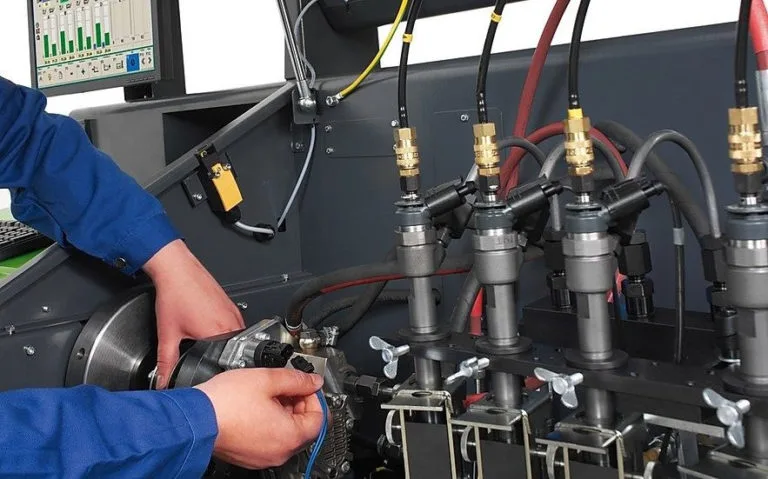
Pump output can be checked right on the vehicle: Delphi makes a sealed-rail kit for this that fits on the pump outlet. A bench test after removal is more accurate: the shop partly strips the pump and looks inside for metal debris, rust and water.
Result: It is clear whether to repair or replace the pump.
If you are buying a used diesel, ask a shop to at least read the fault codes and compare actual rail pressure with the requested value.
Repair, remanufactured or new pump
What comes next depends on what the diagnosis finds.
- A peripheral part is at fault. The filter, pressure sensor, metering valve or lift pump is replaced, and the high-pressure pump is left alone.
- Pump repair. A diesel shop with a test bench replaces seals, valves and worn parts, then checks output. If the housing is corroded or cracked, the pump is usually replaced as a whole rather than repaired.
- Remanufactured exchange pump. In the Bosch eXchange program, all wear parts are replaced with new ones, the pump goes through the same tests and gets the same warranty as a new one, and it costs up to 30% less than a comparable new part. The old pump is returned as a core.
- New pump. The most expensive option. Bosch positions exchange pumps as repairs matched to the vehicle’s age and value, so a new pump makes the most sense for newer cars.
Repair prices depend on the pump model and the scope of work, so there is no point quoting them before diagnosis. Ask the shop to show you the bench test results and itemize exactly what is being replaced.
Sources and methodology
Analysis of public sourcesChecked 25 September 2026
- Bosch: CP4 high-pressure pump for common rail bosch-mobility.com
- Bosch: inline and distributor pumps, unit injectors boschoffhighway.com
- Denso: fourth-generation common rail denso-am.eu
- Delphi: servicing common-rail injectors, water and dirt in fuel delphiautoparts.com
- NHTSA: recall 22V-406, Bosch CP4.2 pump failures static.nhtsa.gov
FAQ
What does a diesel injection pump do?
It compresses fuel to the pressure at which the injectors can spray it finely into the cylinders: up to 2,500–2,700 bar in modern common-rail systems. Mechanical pumps also meter the fuel and set injection timing. Without it, a diesel won’t start.
How is the injection pump different from the lift pump?
The lift pump, or low-pressure fuel pump, delivers fuel from the tank through the filter to the high-pressure pump at low pressure. The high-pressure pump raises it to hundreds or thousands of bar. A weak lift pump causes the same symptoms as a worn high-pressure pump, so it gets checked first during diagnosis.
Do gasoline engines have a high-pressure fuel pump?
Yes, if the engine uses direct injection into the cylinders. The pump is driven off the camshaft and produces up to 350 bar in Bosch systems. Port-injection engines don’t have one — an electric pump in the tank is enough.
Can you drive with a failing injection pump?
It’s not a good idea. A pump that is breaking up can fill the fuel system with debris, and the engine will stall right while you drive — that is how the maker of Jeep and Ram described CP4.2 pump failures. With hard starting, rail pressure codes or a leak at the pump, get it diagnosed.
What should you do if you put gasoline in a diesel?
Don’t start the engine or switch on the ignition; call a tow truck or a fuel-drain service. If the mix has already gone through the system, the damage can extend to replacing the pump, filters and injectors.








Leave a Reply