
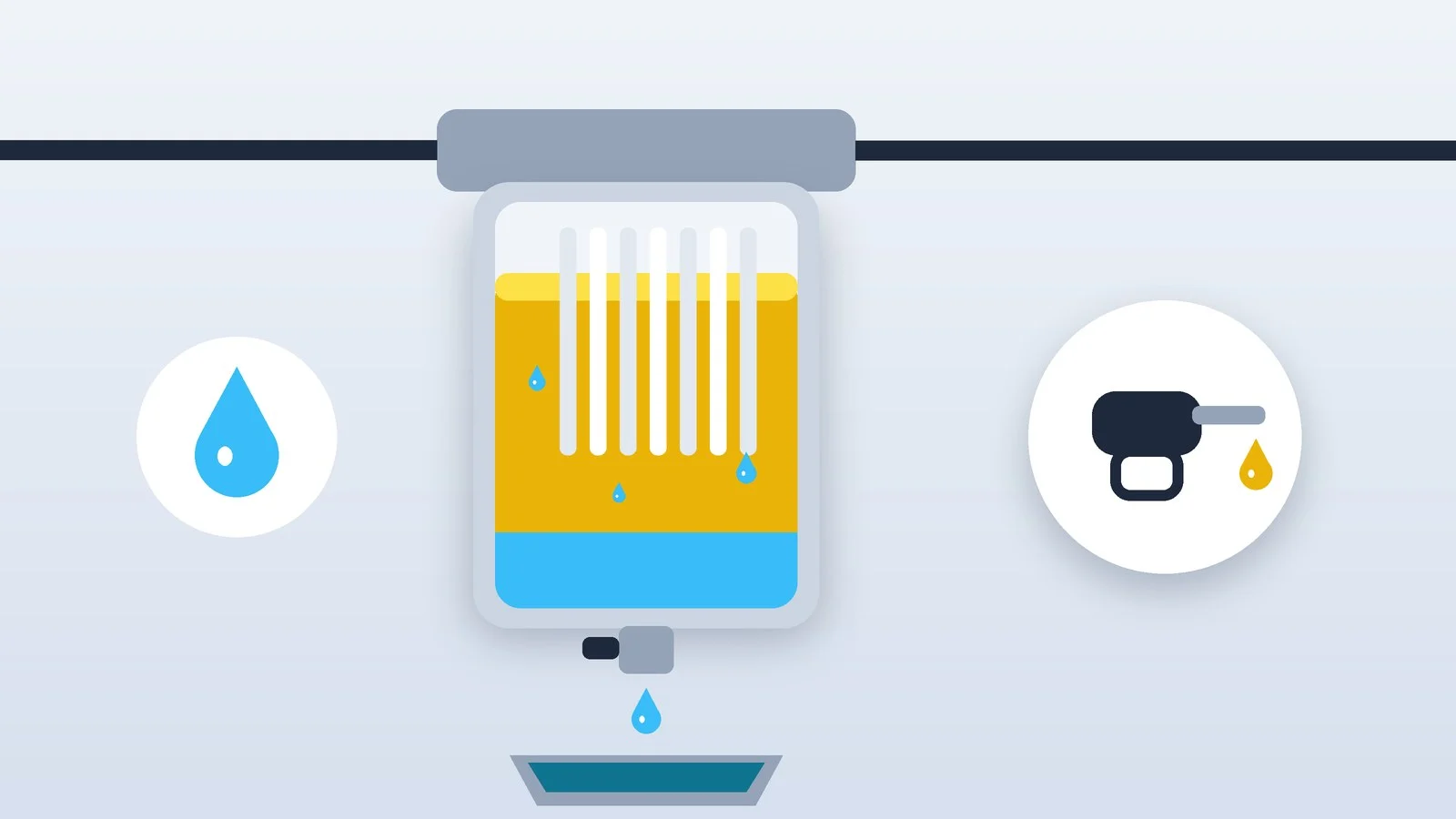
The main way to get water out of the diesel fuel in a car is to drain it from the fuel filter’s water separator. Water is heavier than diesel and collects in a water trap at the bottom of the filter: switch off the engine, loosen the drain plug, let the water run out until clean fuel appears, close the drain and bleed the air from the system the way your owner’s manual says.
Below: why water is dangerous for a common-rail diesel, where it comes from, how to spot it, how to drain it step by step and when you need a repair shop. The guide is based on owner’s manuals from Ford, Kia, Ram and Volkswagen, material from Bosch, Delphi, MANN+HUMMEL and MAHLE, a GM bulletin on additives and the diesel fuel standards EN 590 and DSTU 7688:2015.
Why water in a diesel fuel system is dangerous
In a diesel, fuel doesn’t just burn: it also lubricates the high-pressure fuel pump and the injectors. Delphi writes that water in fuel corrodes metal surfaces and reduces lubrication between moving parts, and together this leads to premature wear of both the injectors and the high-pressure pump. Bosch adds that, unlike diesel, water does not lubricate moving parts, and rust particles act as an abrasive.
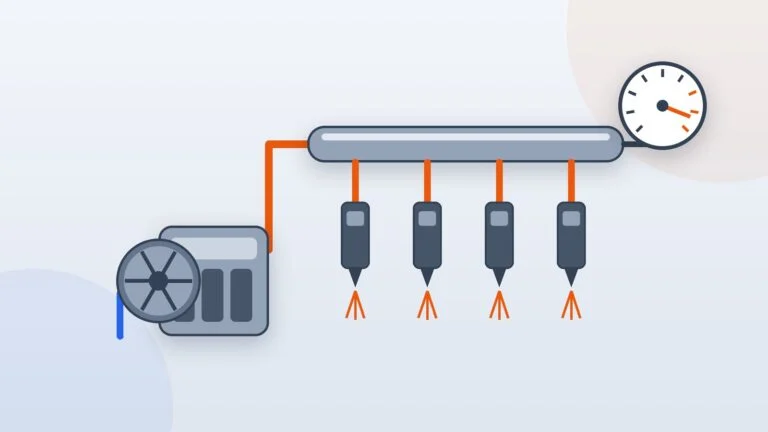
Common-rail systems are especially sensitive: pressures exceed 2,000 bar, and injector tolerances, as Delphi puts it, are a fraction of the width of a human hair. MANN+HUMMEL warns that water causes corrosion and cavitation in injectors, valves and the high-pressure pump and, in the worst case, failure of the whole system.
There are other consequences too. According to Bosch, water promotes the growth of microbes that form slime, acids from contaminated fuel corrode the tank and the fuel system, and diesel with water in it makes starting harder. In winter, free water freezes: ice crystals, as filter maker Donaldson writes, clog a filter just like hard particles and can shut the engine down without warning.
Where water in diesel comes from
Diesel fuel is almost never completely free of water — Ram’s manual says so directly. The European standard EN 590 (adopted in Ukraine as DSTU EN 590:2022) and Ukraine’s national DSTU 7688:2015 allow up to 200 mg of water per kilogram of fuel, or 0.02%. Fuel injection equipment makers call the absence of free water a key requirement: that is water that hasn’t dissolved in the fuel and settles as a separate layer.
According to MANN+HUMMEL, water gets into even high-quality fuel: with moist air through the tank vent and from condensation in the large storage tanks at gas stations. Modern diesel contains very little sulfur but more biofuel and additives, so water in it breaks up into tiny droplets that are harder to separate. Finally, water can come with poor-quality fuel straight from the pump.
Back in 2009, fuel injection equipment makers Bosch, Continental, Delphi, Denso and Stanadyne pointed out in a joint statement that fuel standards apply only up to the pump nozzle. From then on, protecting the fuel from free water and dirt is the owner’s job.
Signs of water in the fuel
Many diesels have a sensor in the filter’s water trap and a water-in-fuel warning light on the instrument panel; Kia calls it the fuel filter warning light. When you switch on the ignition, the light comes on as a self-check and goes out once the engine starts. If it stays on while driving, water has reached the set level: on the 2020 Ford Transit with the 2.0 EcoBlue engine, according to the US manual, that is about 200 ml.
Kia warns that when this light is on, engine power may drop, and if you keep driving, you can damage the injectors, the fuel rail and the high-pressure pump. Without a sensor, water gives itself away through hard starting, rough running, and jerking or hesitation when accelerating. But the same signs come from a clogged filter, an air leak, faulty glow plugs or a battery drained by the cold (how to choose a car battery).
Checking the fuel without a sensor is simple: drain a little from the filter’s water trap into a clear jar. Water is heavier than diesel and settles at the bottom as a separate layer.
| Sign | Likely cause | What to do |
|---|---|---|
| Water-in-fuel light while driving | Filter water trap is full | Stop and drain the water |
| Light right after refueling | Water came with the fuel | Stop the engine, call a shop |
| Won’t start or stalls in the cold | Ice or wax in the filter | Warm it up, replace the filter |
| Jerks and hesitation on acceleration | Water or a clogged filter | Drain the trap, check the filter |
| Hard starting after draining | Air in the fuel system | Bleed it per the manual |
| Light quickly comes back on | A lot of water in the tank | Drain tank at a shop, new filter |
How to drain water from a diesel fuel filter
The procedure depends on the design, so first open the fuel filter section of your car’s owner’s manual. On some models you just open the drain plug, on others you push the water out with a hand primer pump, and on others you bleed the air with ignition cycles after draining. If the manual sends you to an authorized service center — as Volkswagen does when the water-in-fuel light comes on — don’t unscrew anything yourself.
Find the filter and the drain plug
The fuel filter with a water separator sits in the engine bay or under the body; Ram 2500 and 3500 pickups have two of them, one on the engine and one in front of the rear axle. At the bottom of the housing is the water trap with a drain plug, tap or valve, sometimes with a fitting for a hose.
Check the manual: how the drain opens, whether you need the hand pump and how to bleed the air after draining.
Result: You know where the drain is and how to bleed the air afterward.
Switch off the engine and prepare the area
Ram says never to drain the separator while the engine is running, and Kia warns against smoking or using an open flame near the fuel system. Put a container under the drain and lay down rags: according to Ram, diesel fuel damages blacktop paving.
Put on gloves and glasses: under DSTU 7688:2015, diesel fuel irritates the skin and the eyes. If it gets on your skin, wipe it off with a rag and wash the spot with warm soapy water. If it gets in your eyes, rinse them with plenty of warm water and see a doctor.
Result: The engine is off, a container is under the drain and there’s no open flame nearby.
Loosen the drain plug
How far to open it depends on the vehicle. On the Ford Ranger with the 2.5 and 3.0 TDCi engines, the plug is loosened about one turn; on the Ford Transit with the 2.0 EcoBlue engine, it’s turned by hand until it stops; and the drain valve on the Ram’s engine-mounted filter opens just a quarter turn. If the drain has a fitting, attach a hose and lead it into the container.
Some filters have an air vent screw on top: DRiV, which owns the Champion brand, recommends opening it slightly so the liquid drains freely. Do this only if your car’s manual says so.
Result: Liquid starts flowing from the drain.
Drain until clean fuel comes out
If the filter has a hand primer pump, the water may not flow on its own: Kia says to press the hand pump slowly 6–7 times, Ford Ranger about seven times. On some vehicles, such as the Ram, an electric pump pushes the liquid through the drain while the ignition is on.
Keep the drain open until the water and dirt are out, and close it once clean fuel appears — that’s how Ram describes the procedure. Don’t drain more than you need: if a noticeable amount of fuel came out along with the water, Ram requires priming the system the same way as after running out of fuel.
Result: Clean diesel with no droplets or layer of water flows from the drain.
Close the drain and wipe up spills
Tighten the plug the way the manual says: Ford says by hand, without tools, until you feel strong resistance. Don’t overtighten: Ram warns that this can damage the seal and cause a leak, and then the whole water sensor has to be replaced. If you opened the air vent screw, close it as well.
Carefully wipe up everything you spilled: Kia notes that the mix of water and fuel can catch fire.
Result: The drain is closed and the filter housing is dry.
Bleed the air from the system
After draining, air can get into the filter, and then the engine starts poorly or runs unevenly. On the Ford Transit 2.0 EcoBlue, the air is purged like this: switch the ignition on for 30 seconds and then off, six times in a row. On Kia vehicles with a hand pump, you loosen the air vent plug and bleed the system with the pump.
If your manual says nothing about bleeding after draining, go straight to the next step.
Result: The air has been bled from the system the way the manual requires.
Start the engine and check the result
Start the engine and inspect the filter and the drain: there should be no leaks. On the Ford Ranger, the water-in-fuel light goes out about 2 seconds after the engine starts. If it doesn’t go out or soon comes back on, Kia advises having the vehicle checked by a workshop as soon as possible.
Don’t reuse the drained fuel, and don’t pour it into the sewer or household trash: Ford says to take it to an authorized waste disposal facility.
Result: The engine runs smoothly, there are no leaks and the water-in-fuel light is off.
When to replace the filter instead of just draining it
Draining removes water that has already separated, but the filter itself gets worse at holding it back over time. Bosch names the main reasons for poor water separation: an overdue replacement and low-quality filters. In MAHLE’s tests, the water separation efficiency of a conventional single-stage filter dropped from 93% to less than 20% on contaminated fuel.
Replace the filter on the carmaker’s schedule. Kia, for example, states that its schedule applies only to fuel meeting EN 590 or an equivalent, and with poorer fuel the filter must be replaced more often. If you notice fuel flow restriction, surging, loss of power or hard starting, Kia says to replace the filter right away, regardless of mileage, and see a workshop.
The filter also gets an unscheduled replacement if you find slime in the drained fuel: in that case, GM requires flushing the fuel system, replacing the filter and refilling with clean fuel. After a replacement, the system is primed: for the 2015 Transit with the 3.2 diesel, Ford specifies six ignition cycles of 30 seconds, then starting the engine and holding 1,500 rpm for 20 seconds.
When you need a repair shop
Draining the water trap is maintenance, not a repair. See a repair shop if:
- the water-in-fuel light quickly comes back on or water comes out every time you drain — that means there’s a lot of it in the tank, and the tank needs to be drained, sometimes removed and flushed;
- the light came on right after refueling — the water came with the fuel, and you shouldn’t keep driving;
- there’s slime in the drained fuel — a sign of microbes. GM warns that a biocide kills them, but the dead bacteria still clog the system, so it gets flushed, the filter is replaced and the tank is refilled with clean fuel;
- your manual sends you to a dealer when the water-in-fuel light comes on, as Volkswagen’s does;
- after draining and a new filter, the engine still starts hard, misfires, smokes or goes into limp mode, and a scan tool shows rail pressure codes — it’s time to check the injectors and the high-pressure pump.
How the high-pressure pump works and which signs point to a failing one is covered in our article on the diesel high-pressure fuel pump.
Additives: what the manufacturers say
The popular tip “add a pour-point depressant and it will bind the water” mixes up two different products. Pour-point depressants (anti-gel additives) keep wax from clogging the filter in the cold, but they don’t remove water. For water, stores sell so-called fuel dryers, and carmakers are cautious about them.
In service bulletin 03-06-04-017G, GM writes that diesel fuel additives are not required or recommended under normal conditions: the filter blocks water on its own. Additives deal with water in two ways. Demulsifiers make small droplets combine into larger ones, which the filter then separates. Emulsifiers, often alcohol-based, keep water suspended in the fuel: it gets past the water separator and, in most cases, damages other components.
That’s why GM allows only alcohol-free demulsifiers in its diesels, and winter additives must not contain alcohol, metals or emulsifiers. Ram says that with good-quality, season-appropriate fuel you don’t need additives at all, and it prohibits adding alcohol or gasoline to diesel: such blends can be unstable and explosive.
A product that, judging by the label, “dissolves” or “binds” water in the fuel most likely works as an emulsifier. And no additive replaces draining the water trap and changing the filter.
In winter: ice in the filter and winter diesel
Water freezes at 0 °C, before winter diesel starts to thicken. Donaldson advises removing free water before it turns into ice, so drain the water trap before the frosts set in. Some filters have a heater: in Bosch filters, for example, a bimetal valve routes warm fuel returning from the engine into the filter.
The second winter problem is wax. Under DSTU EN 590:2022, class C summer diesel must pass through a filter down to −5 °C, and class F winter diesel down to −20 °C. DSTU 7688:2015 divides fuel into summer (L), winter (Z) for air temperatures from +5 to −20 °C, and arctic (Ark) for frosts below −20 °C. For more on seasonal fuel and glow plugs, see our comparison of diesel and gasoline engines.
If the engine won’t start in the cold, tow the car to a heated garage or wait for a thaw. Never heat the filter or fuel lines with an open flame: diesel is a flammable liquid. Once the ice melts, drain the water trap and replace the filter if needed. If the tank had summer fuel, fill up with winter diesel.
How to keep water out of your fuel: checklist
- Fill up at high-volume gas stations: GM notes that the fuel there is more likely to be fresh and of good quality.
- Drain the water separator as often as your manual requires, and right away if the water-in-fuel light comes on.
- Replace the fuel filter on schedule, and more often if the fuel is questionable.
- Use filters with water separation that your carmaker approves: according to Bosch, low-quality filters separate water less effectively.
- Switch to winter diesel before the frosts and drain the water trap.
- Don’t add alcohol, gasoline or home remedies to the tank.
- Fill up at the end of the day while the engine is warm: Donaldson gives this advice to owners of diesel equipment — the less air above the fuel, the less condensation in the tank.
- Don’t drive with the water-in-fuel light on.
Troubleshooting
- Nothing comes out of the drain — push the water out with the hand primer pump or slightly open the air vent screw on top, if your manual allows it. In winter, ice can block the drain: warm the car up indoors.
- The engine won’t start or misfires after draining — air got into the system. Bleed it the way your manual says: with the hand pump or with ignition cycles.
- The drain plug leaks — tighten it until you feel resistance, but don’t overtighten. If the leak continues, the seal is damaged: a shop replaces it, and on the Ram it’s replaced together with the water sensor.
- The light stays on after draining — there may still be water, or the sensor may be faulty. In that case Kia advises seeing a workshop as soon as possible.
Sources and methodology
Analysis of public sourcesChecked 5 October 2026
- Delphi: water and dirt in fuel and servicing common-rail injectors delphiautoparts.com
- Bosch: diesel fuel filter design and water separation boschaftermarket.com
- Ford: draining the fuel filter water trap, Transit 2.0 EcoBlue fordservicecontent.com
- Kia: fuel filter warning light ownersmanual.kia.com
- GM: bulletin 03-06-04-017G on diesel fuel additives static.nhtsa.gov
FAQ
Can I keep driving with the water-in-fuel light on?
Only as far as a place where you can drain the water. Kia warns that driving on can damage the injectors, the fuel rail and the high-pressure pump. If your manual doesn’t let owners drain the filter, Volkswagen advises reducing your speed and driving carefully to a repair shop.
How much water should I drain from the fuel filter?
There’s no set amount: drain until clean diesel comes out instead of water. For reference, on the Ford Transit with the 2.0 EcoBlue engine, the water-in-fuel light comes on when there’s about 200 ml of water in the trap.
How often should I drain the water from a diesel fuel filter?
As often as your car’s manual requires, and right away when the water-in-fuel light comes on: there’s no single interval for every model. Draining it before the frosts is worth doing in any case, because frozen water clogs the filter.
Do water-removing diesel additives work?
Carmakers are cautious about them. GM considers additives unnecessary under normal conditions and allows only alcohol-free demulsifiers: products that keep water in the fuel let it get past the water separator, where it damages other components. No additive replaces draining the water trap.
What should I do if my diesel won’t start in the cold because of water?
Tow the car to a heated garage or wait for a thaw, and don’t heat the filter with an open flame. Once the ice melts, drain the water trap and replace the filter if needed. If the tank has summer fuel, fill up with winter diesel: class F fuel under EN 590 must pass through a filter down to −20 °C.







Leave a Reply