
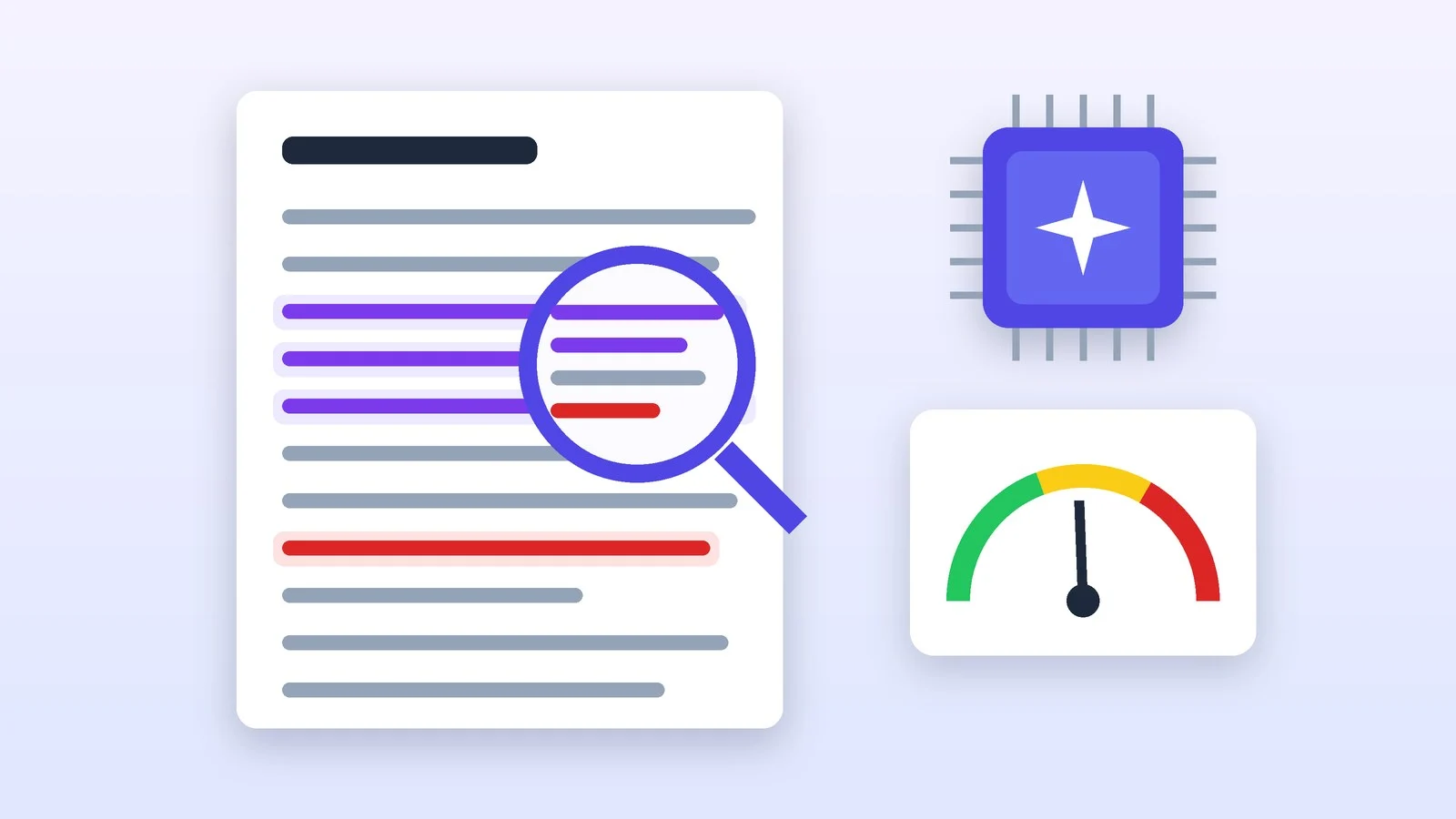
It is impossible to reliably prove that a text was written by AI: detectors give probabilities and make mistakes in both directions. The best approach is a combination: checking facts and links, looking for characteristic signs, comparing with the author’s earlier texts and drafts. A detector is just one signal.
Below are the signs described by Wikipedia editors and researchers, data on detector accuracy from primary sources (including a 2026 study), and a checking procedure. All links were checked on October 14, 2026.
Signs of AI-written text
Editors of the English-language Wikipedia maintain a list of signs of AI-written text. They stress that these are heuristics, not proof, and many of the signs also appear in human writing. Density matters most: a cluster of patterns in one text means more than a single word.
- Inflated significance. Phrases like “plays a key role” where there are no specifics.
- Promotional tone. Vivid adjectives and “rich heritage” instead of facts.
- Vague authorities. “Experts believe”, “researchers note”, with no names or links.
- Superficial conclusions. Trailing participial phrases: “…, highlighting the importance of the topic”.
- Formulaic constructions. “Not just X, but Y”, triplets of parallel items, and mandatory “Challenges and prospects” sections.
- Traces of a chatbot conversation. “Sure! Here’s…”, disclaimers about source availability, unfilled templates.
- Formatting. Excess bold, markdown symbols (asterisks, hash signs), emoji instead of bullets.
- Links. Broken addresses, nonexistent DOIs,
utm_sourcetags in URLs.
In Russian-language texts, the same patterns show up as stock phrases such as “in the modern world”, “it is worth noting” or “plays an important role”. But each of them could also have been written by a human.
Check facts, quotes and links
This is the most reliable check. In its help for webmasters, Google warns that generative models predict likely word sequences rather than retrieving facts, so answers can contain errors. Google’s guide to generative AI content explicitly says such text should be checked before publication.
- Open each link and make sure the page exists and actually says what is attributed to it.
- Check names, dates, figures and quotes against the primary source.
- Find the book or article mentioned: invented sources usually have no page numbers or issue numbers.
- If the facts can’t be checked, that is already a reason to doubt the text, whoever the author is.
What studies show about human experts
Untrained people often make mistakes. In a 2021 study (ACL), readers with no experience told GPT-3 text apart from human text at roughly chance level, about 50%. But experience changes the picture: in a 2025 paper, people who regularly write with AI help judged much better: the collective opinion of five experts was wrong in only 1 of 300 English-language articles. They paid attention to word choice, formality, originality and clarity, and paraphrasing or “humanizing” the text did not throw them off.
The practical conclusion: read carefully and thoughtfully, not one phrase at a time, and rely on several independent signs.
AI text detectors: what they show and where they go wrong
A detector assesses a text and outputs a probability or an AI percentage. This is not proof: the result depends on the length of the text, the language, edits and the trigger threshold. Data from primary sources:
| Source | What it showed |
|---|---|
| OpenAI, 2023 | Its own classifier correctly flagged 26% of AI texts and wrongly flagged 9% of human ones. Unreliable on short texts (under 1,000 characters) and worse in languages other than English. Shut down on July 20, 2023, because of low accuracy |
| Stanford, 2023 | Seven detectors flagged 61.22% of 91 TOEFL essays written by non-native English speakers as AI-generated; essays by American schoolchildren were assessed almost without errors. The authors link this to perplexity: detectors measure the “complexity” of writing, and non-native writers score lower |
| Turnitin, 2023 | The company claims fewer than 1% false positives, but admits that this is not zero and leaves the decision to the instructor |
| Vanderbilt University, 2023 | Disabled the Turnitin detector: at a claimed 1% on 75,000 papers a year, that is about 750 false positives. The university advises comparing a paper with the student’s earlier texts and checking sources |
| Sadasivan et al., 2023–2025 | Recursive paraphrasing noticeably reduces the share of AI texts detected, and watermarks can be forged |
The 2026 study: few false accusations, but AI text is often missed
In a paper in the International Journal for Educational Integrity (published June 29, 2026), researchers compared four detectors on 160 texts whose authors were known: 40 human, 40 fully AI-written, 40 mixed and 40 “humanized”. The four detectors correctly identified all the human texts. But with fully AI-written texts (written by GPT-4o Deep Research), the picture was worse: Turnitin detected none, GPTZero and Copyleaks missed 70% and 75%, and the best performer, Pangram, scored 65% on a strict count and 97.5% on a lenient one (counting partial matches).
On mixed texts, Pangram was again the best: Turnitin scored 60%, Copyleaks 30% and GPTZero 0%. On “humanized” texts (AI fragments rewritten with a special prompt), the results of Turnitin and Copyleaks dropped. The authors conclude that detectors provide a useful first signal but are not suitable as the only proof. There were few false positives, which is better than in earlier studies. A caveat: the dataset is synthetic, and the tools are updated regularly.
Watermarks and labels: what changes
An alternative to detectors is a mark that the model embeds in the text during generation. Google’s version is SynthID Text: a watermark that is checked probabilistically and returns “present”, “absent” or “unclear”. It withstands editing of a few words and light paraphrasing, but confidence drops after heavy rewriting or translation; the mark is weaker on factual answers. In the EU, Article 50 of the AI Act has applied since August 2, 2026, and the code of practice on transparency (June 2026) describes labeling and detection for providers, including text.
But a mark helps only if the provider added it and offered a way to check it; for text from another model or heavily rewritten text, it usually won’t help. We wrote separately about OpenAI’s watermark: what it can and can’t do.
How to check in practice
- Read the whole text and note the signs. One word isn’t enough: look at how densely they occur.
- Check facts, figures, quotes and links against primary sources.
- Compare it with the author’s style and drafts. Vanderbilt advises comparing the work with earlier texts and checking whether any sources were invented.
- If you need a detector, use several of them and a long passage: results on short texts are unreliable. Read the result as a hint.
- Talk to the author: ask them to explain the text and show the edit history. Vanderbilt notes that some students admit to using AI when the conversation is calm.
If you own a website, remember: according to Google’s help, AI-written text is not a violation in itself. The problem is mass-produced pages with no value (“scaled content” spam) and errors. We covered the overall picture of AI’s capabilities and limits in an article about artificial intelligence in 2026.
Sources and methodology
Analysis of public sourcesChecked 14 October 2026
- OpenAI — New AI classifier for indicating AI-written text openai.com
- International Journal for Educational Integrity — Who wrote this? (2026) link.springer.com
- Stanford HAI — AI detectors biased against non-native English writers hai.stanford.edu
- Wikipedia — Signs of AI writing en.wikipedia.org
- Google — Using generative AI content on your site developers.google.com
Frequently asked questions
Which AI detector is the most accurate?
There is no single leader. In the 2026 study of 160 texts, Pangram performed best, while Turnitin, GPTZero and Copyleaks missed AI texts. But the sample is small, the tools are updated, and we found no independent comparisons in Russian or Ukrainian.
Will Google penalize AI-written text?
Not for the fact of it. According to Google’s help, generative AI is allowed, but publishing large numbers of pages with no value, that is, “scaled content” spam, can be a violation. Texts should be checked for errors.
Can detectors mistake my text for AI?
Yes. In tests, OpenAI’s classifier wrongly flagged 9% of human texts, and seven detectors in the Stanford study took 61.22% of essays by non-native English speakers for AI. Turnitin acknowledges that false positives cannot be ruled out.
Can you prove that a text was written by AI?
No, only indirectly: through factual errors and invented links, a sudden change in style, the edit history, and a conversation with the author. A detector’s result is not considered proof.
Do detectors work in Russian and Ukrainian?
There is little data. OpenAI recommended its classifier only for English and warned that it works significantly worse in other languages. We found no independent tests in Russian or Ukrainian.




Leave a Reply