
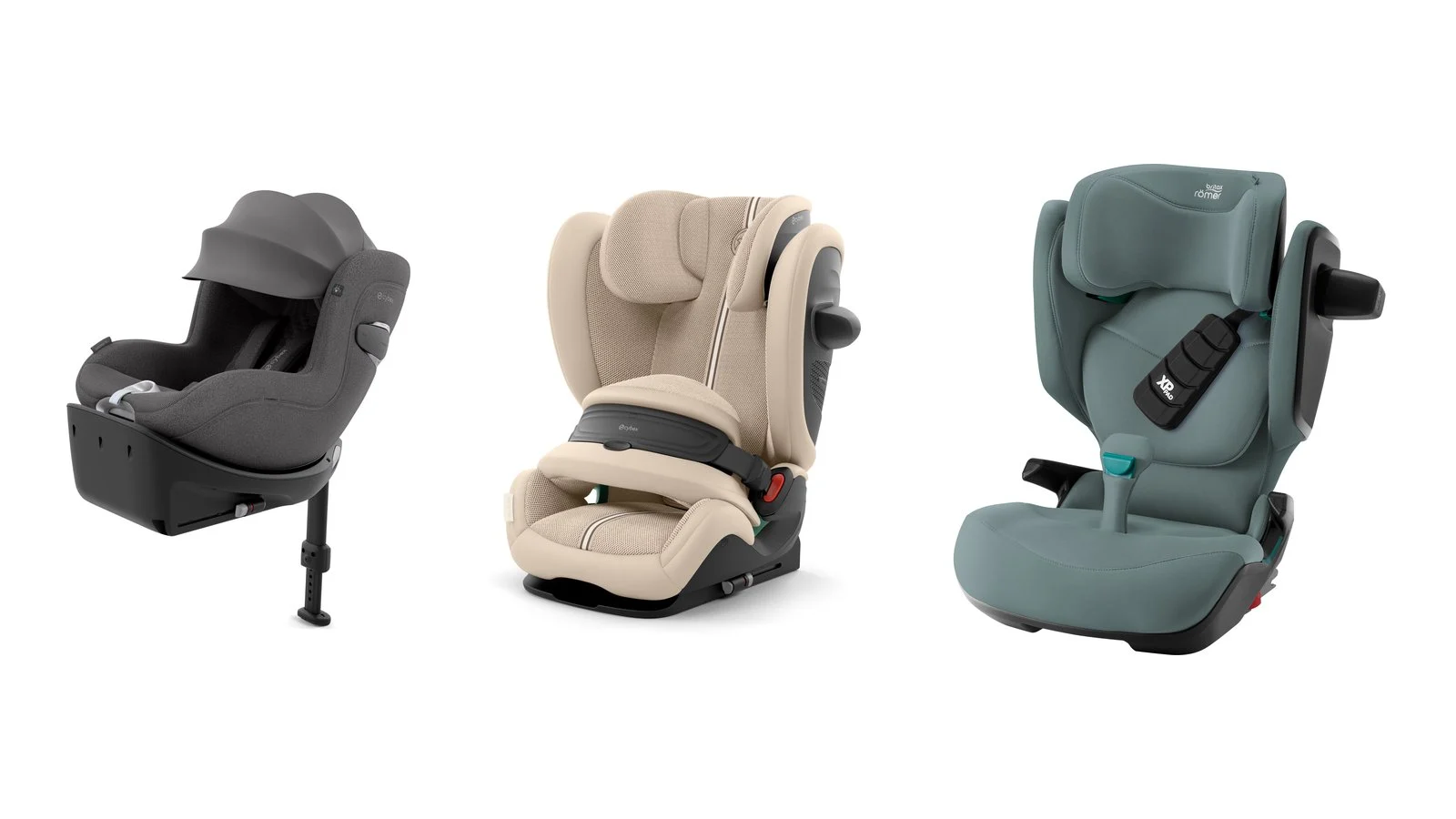
The best car seats of 2026 are UN R129 (i-Size) approved models that earned an overall “good” rating in ADAC’s 2025–2026 tests, which use a new, stricter crash-test protocol. This list covers seven of them, from an infant car seat for a newborn to a booster for school-age kids up to 150 cm tall: that is the height up to which Ukraine’s traffic rules require a child restraint system.
The top overall score in this list, 1.8, goes to the Maxi-Cosi Pebble S infant seat with the FamilyFix S base and to the Britax Römer Kidfix Pro booster. For each model you’ll find the ADAC test date and a separate safety score, the child height range and installation method according to the manufacturer, and the price in the brand’s official store as of September 30, 2026.
How we picked
- The seat is approved under UN R129 (i-Size) and is listed on the manufacturer’s website in September 2026.
- Its overall score in ADAC’s 2025–2026 Kindersitztest is “good.” ADAC has tested more strictly since 2025, so we don’t mix older results with the new ones.
- One or two models for each stage: infant car seat, rotating seat from birth to 4 years, seat from 15 months to 12 years, and booster for kids 100–150 cm tall. Models are ordered by the child’s age, and within each stage by ADAC’s overall score.
- Specs come from manufacturers’ websites and manuals. Prices are from the brands’ official online stores in Germany as of September 30, 2026; distributors in Ukraine charge different prices.
ADAC grades work like German school grades: the lower the number, the better. The overall score combines safety, ease of use, ergonomics and harmful substances, so we list the safety score separately — above all, it shows how well the seat protected the dummy in frontal and side impacts.
1. Maxi-Cosi Pebble S + FamilyFix S
ADAC score 1.8Infant car seat
Maxi-Cosi Pebble S + FamilyFix S
- Child height
- 40–83 cm, up to 13 kg (about 15 months)
- Installation
- rear-facing, on the FamilyFix S base (ISOFIX and support leg) or with the vehicle belt
- Weight
- 3.2 kg per Maxi-Cosi, 3.5 kg measured by ADAC; base 6.5 kg
- Standard
- UN R129/03 (i-Size)
- ADAC, May 2025
- 1.8 with base (safety 1.7), 2.7 without base
Price€329.98 with base, €179.99 withoutchecked 30 September 2026
For a newborn if your car has ISOFIX. With the base, it has the best score among infant seats in ADAC’s 2025–2026 tests, tied with the Joie Sprint.
- Very low injury risk in a frontal crash
- Light: 3.2 kg
- The base also takes the next-stage seat
- Without the base, the score drops to 2.7
- Lasts only to about 15 months
On the FamilyFix S base, ADAC rated the injury risk as very low in a frontal crash and low in a side crash. Without the base, safety is nearly the same (1.8), but the overall score drops to 2.7: the lap belt guides are narrow and hard to spot, which makes incorrect installation easy. The base stays in the car and later takes the next seat of the Maxi-Cosi system.
The Joie Sprint scored the same 1.8 in the spring 2025 test, but it only fits babies up to 75 cm, roughly one year old, and installs with ISOFIX only. The Pebble S can also be mounted on compatible strollers.
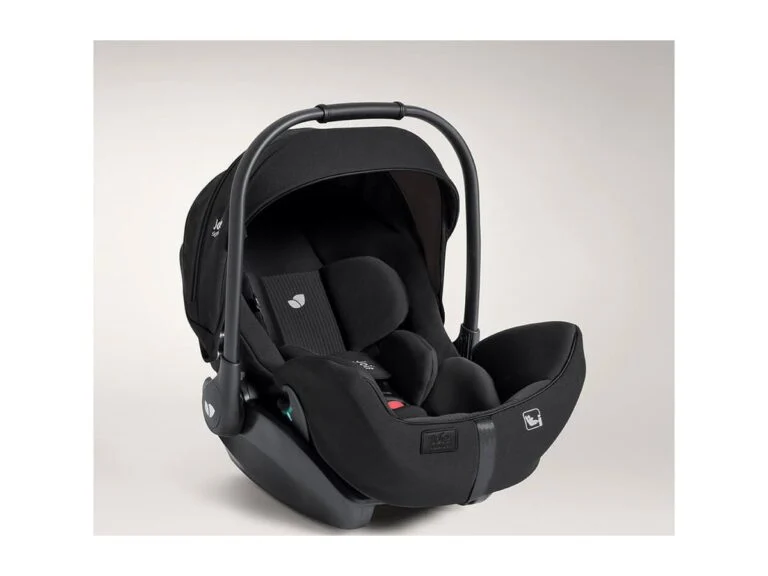
2. Joie i-Level Pro
No ISOFIX base neededInfant car seat
Joie i-Level Pro
- Child height
- 40–87 cm, up to 13 kg (about 15 months)
- Installation
- rear-facing, with the vehicle belt or on the i-Base Encore or i-Base LX 2 (sold separately)
- Weight
- 4.6 kg measured by ADAC; i-Base Encore base 7.0 kg
- Standard
- UN R129, i-Size with a base
- ADAC, October 2025
- 2.3 without base (safety 2.3) and 2.3 with i-Base Encore (safety 2.6)
For a car without ISOFIX or frequent switching between cars: even installed with the belt, it earned a “good” safety score from ADAC.
- Safety 2.3 with the belt, better than on the base
- Fits babies up to 87 cm
- Adjustable recline
- Average injury risk in a side crash
- Heavier than the Pebble S: 4.6 kg
This infant seat is actually safer without its base than with it. Installed with the vehicle belt, it scored 2.3 for safety from ADAC: low injury risk in a frontal crash and average in a side crash. The i-Base Encore makes installation easier (ease of use 1.9 vs. 2.4), but safety drops to 2.6; the overall score is 2.3 either way.
The seat lasts up to 87 cm — longer than the Pebble S — and, according to ADAC, is approved for use on some aircraft. On Joie’s website, it’s sold in the Signature line as the Signature i-Level Pro. We couldn’t verify a price in an official Joie store, so none is listed.
3. Joie i-Pivot 360
Birth to 4 yearsRotating car seat
Joie i-Pivot 360
- Child height
- 40–105 cm, up to 21 kg (about 4 years)
- Rear-facing
- 40–105 cm; forward-facing from 15 months and 76 cm
- Installation
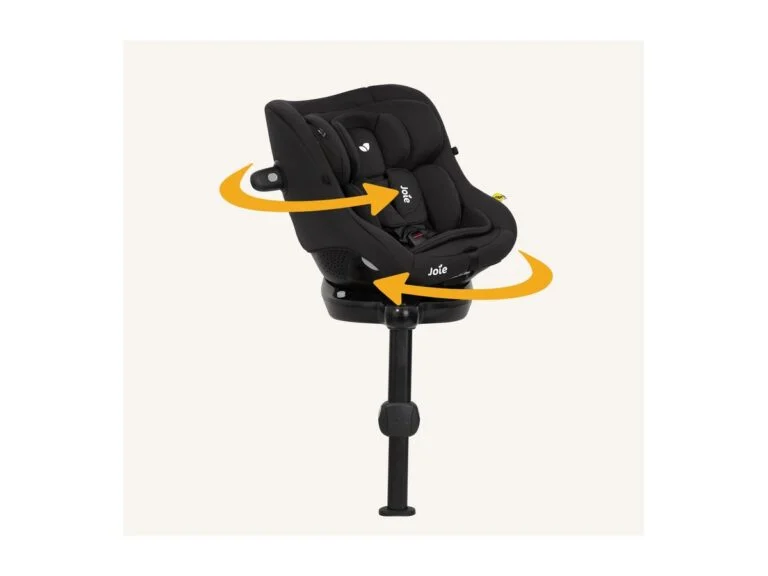
- ISOFIX with support leg only; the shell swivels toward the door
- Weight
- 11.3 kg measured by ADAC
- Standard
- UN R129/03 (i-Size)
- ADAC, May 2025
- 2.4 (safety 2.1)
For parents who want one seat from birth to about age four and to keep their child rear-facing up to 105 cm.
- Very low injury risk in a side crash
- Swiveling toward the door makes loading easier
- 2.2 kg lighter than the Cybex Sirona Ti
- Average injury risk in a frontal crash
- Heavy: 11.3 kg
- No belt installation, ISOFIX only
You install the seat once with ISOFIX and the support leg, then swivel the shell toward the door to put your child in and buckle them up. ADAC found a very low injury risk in a side crash and an average one in a frontal crash. Ease of use scored 2.8: buckling the child in takes a bit more effort, and there’s a slight risk of misuse.
Unlike an infant carrier, you can’t carry a newborn to the car in it: the seat stays in the vehicle. In return, one i-Pivot 360 lasts from birth to about age four, and your child can ride rear-facing the whole time.
4. Cybex Sirona Ti
Best toddler seat, ADAC 2026Rotating car seat
Cybex Sirona Ti
- Child height
- 40–105 cm, up to 19 kg (about 4 years)
- Rear-facing
- 40–105 cm; forward-facing: 76–105 cm, from 15 months
- Installation
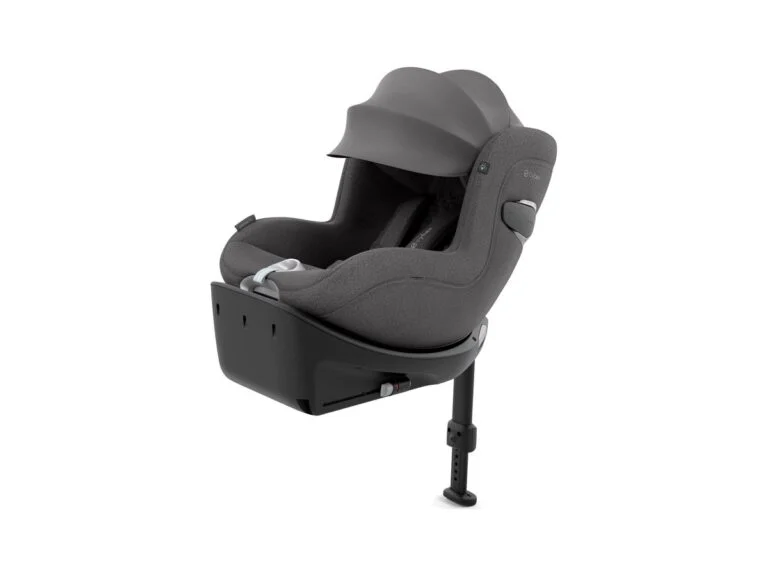
- ISOFIX with support leg only, built-in base with 360° rotation
- Weight
- 13.5 kg
- Standard
- UN R129/03 (i-Size)
- ADAC, May 2026
- 2.5 (safety 2.1)
Price€399.95 (special price)checked 30 September 2026
For parents who want a rotating seat from birth with the most recent ADAC result and don’t mind the weight and size.
- Very low injury risk in a side crash
- Best in its category in the spring 2026 test
- 360° rotation on the built-in base
- Very heavy: 13.5 kg
- Takes up a lot of space in the car
- Risk of turning it forward-facing too early
In the spring 2026 test, the Sirona Ti was the best seat for toddlers with an overall score of 2.5. ADAC notes a very low injury risk in a side crash and an average one in a frontal crash. Ease of use scored 2.9: the seat weighs 13.5 kg, and the swiveling shell creates a risk that parents turn their child forward-facing too early.
As of September 30, 2026, Cybex sells the Sirona Ti at a special price of €399.95: the company has announced a new generation of Platinum seats for mid-October 2026. According to the manufacturer, the seat has a service life of up to 8 years.
5. Cybex Pallas G3
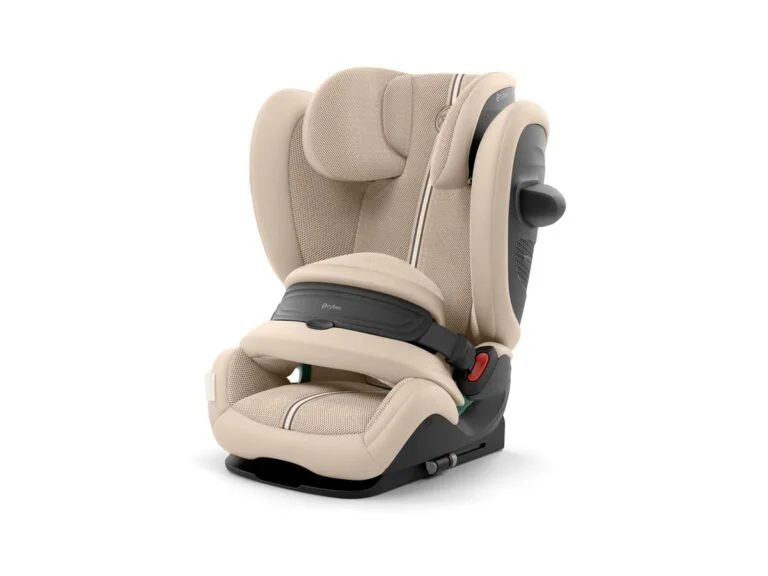
15 months to 12 years2-in-1 seat with impact shield
Cybex Pallas G3
- Child height
- 76–150 cm, from 15 months to about 12 years
- Direction
- forward-facing only
- Up to 105 cm
- impact shield, ISOFIX and Top Tether
- From 100 cm
- vehicle belt; ISOFIX and Top Tether optional
- Weight
- 8.9 kg
- Standard
- UN R129/04 (i-Size)
- ADAC, May 2026
- 2.5 (safety 2.6)
Price€289.95checked 30 September 2026
For a child over two who has outgrown a rotating seat: one seat up to about age 12, as long as your child is happy with the impact shield.
- One seat from 15 months to 12 years
- Low injury risk in a side crash
- Ergonomics 1.9: a comfortable fit
- Average injury risk in a frontal crash
- Forward-facing only; ADAC advises rear-facing to age 2
- Not every child likes the impact shield
The Pallas G3 matches the Sirona Ti’s overall 2.5 but is a different kind of seat. A child 76–105 cm tall is held by an impact shield instead of a five-point harness; once the child passes 100 cm or 21 kg, you remove the shield and use the car’s own seat belt. ADAC rated the injury risk as low in a side crash and average in a frontal one.
The seat installs forward-facing only, so it’s approved from 15 months at the earliest. ADAC advises keeping children rear-facing until at least age two, so the Pallas G3 makes more sense after a rotating seat, once your child turns two. Not every child likes the impact shield, so ADAC recommends trying the seat before you buy; the manufacturer rates its service life at up to 11 years.
6. Britax Römer Kidfix Pro
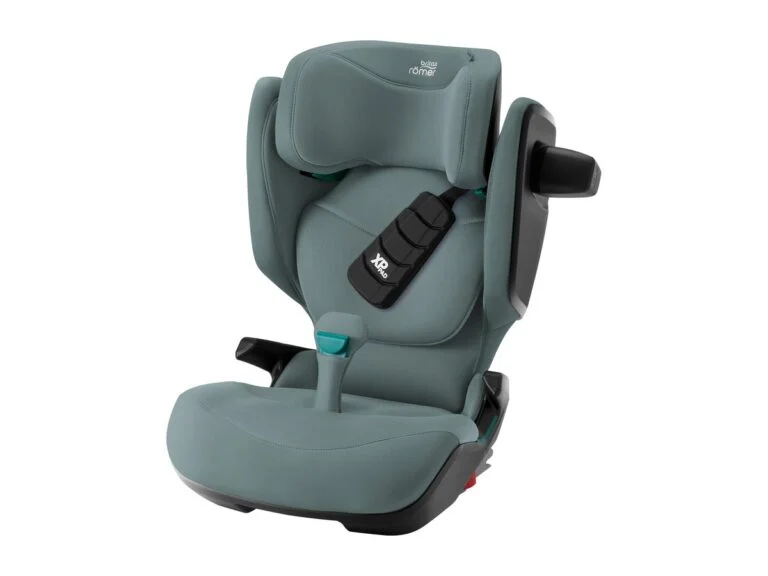
Best booster in ADAC testsHigh-back booster
Britax Römer Kidfix Pro
- Child height
- 100–150 cm (about 3.5–12 years)
- Installation
- forward-facing with the vehicle belt; ISOFIX as an extra
- Weight
- 6.4 kg measured by ADAC
- Standard
- i-Size (UN R129)
- ADAC, October 2025
- 1.8 (safety 1.7), CLASSIC version tested
Price€219.90–269.90checked 30 September 2026
For kids from 100 cm: the best score among boosters in ADAC’s 2025–2026 tests and a very low injury risk in a side crash.
- Very low injury risk in a side crash
- Light: 6.4 kg
- Easy to install and move between cars
- Thin padding
- ADAC rated the manual as merely adequate
- ADAC tested only the CLASSIC version
The Kidfix Pro was the top seat in ADAC’s fall 2025 test: an overall score of 1.8 and safety 1.7, with a low injury risk in a frontal crash and a very low one in a side crash. The child is buckled in with the car’s own seat belt, while ISOFIX just attaches the booster to the vehicle seat, making it more stable and keeping it from tipping over in turns.
According to Britax Römer, ADAC tested the CLASSIC version, while the pricier STYLE and LUX versions were not tested. In the official German store, CLASSIC costs €219.90 (it was out of stock on September 30, 2026), and STYLE and LUX cost €249.90 and €269.90. Other boosters rated “good” in 2025 include the Axkid Up (2.0), Cybex Solution G2 and Recaro Axion 1 (2.1 each).
7. Kinderkraft Junior Fix 2 i-Size
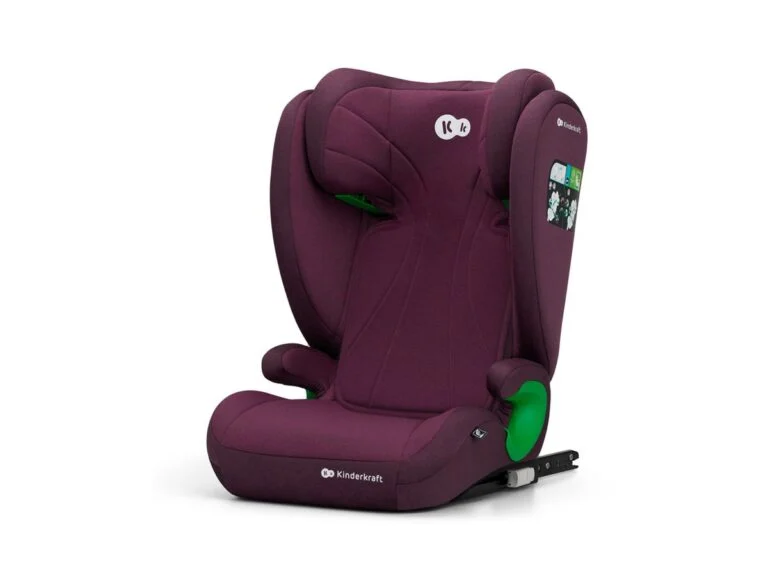
Budget pickHigh-back booster
Kinderkraft Junior Fix 2 i-Size
- Child height
- 100–150 cm (about 3.5–12 years)
- Installation
- forward-facing with the vehicle belt; ISOFIX as an extra
- Weight
- 6.4 kg per Kinderkraft, 6.0 kg measured by ADAC
- Standard
- UN R129 (i-Size)
- ADAC, May 2026
- 2.5 (safety 2.9)
Price€74.90checked 30 September 2026
For a second car, grandparents or a tight budget: the only booster rated “good” overall in ADAC’s spring 2026 test.
- Price: €74.90
- Easy to buckle and install
- Takes up little space in the car
- Average injury risk in frontal and side crashes
- Safety rated only “satisfactory”
The Junior Fix 2 i-Size is the only booster rated “good” overall in the spring 2026 test and one of the cheapest seats in it. With an overall score of 2.5, it scores well for ease of use and ergonomics (1.9 each), but ADAC rated its injury risk in frontal and side crashes as average: 2.9 for safety, which means “satisfactory.”
A light seat is easy to move between cars, for example when grandparents often drive the child — ADAC points out this advantage too. But if your budget allows, the Britax Römer Kidfix Pro offers noticeably better protection.
Comparison
| Model | Best for | Key strength | Price |
|---|---|---|---|
| Maxi-Cosi Pebble S + FamilyFix S | Newborns, car with ISOFIX | ADAC 1.8, safety 1.7 | €329.98 with base |
| Joie i-Level Pro | Newborns, no ISOFIX | Safe without a base: 2.3 | — |
| Joie i-Pivot 360 | Birth to 4 years | Score 2.4, lighter than Sirona Ti | — |
| Cybex Sirona Ti | Birth to 4 years | Best toddler seat, ADAC 2026 | €399.95 (special price) |
| Cybex Pallas G3 | Age 2 (approved from 15 mo) to 12 | One seat for most of childhood | €289.95 |
| Britax Römer Kidfix Pro | Kids 100–150 cm tall | ADAC 1.8, safety 1.7 | €219.90–269.90 |
| Kinderkraft Junior Fix 2 i-Size | 100–150 cm, tight budget | Price and low weight | €74.90 |
How to choose a car seat
Start with your child’s height and your car, not the brand. The seat should match the height range, fit securely on your vehicle seat and let your child ride rear-facing as long as possible.
| Child height | Seat type | Installation direction | Models in this list |
|---|---|---|---|
| 40–83 or 87 cm | Infant car seat | Rear-facing | Pebble S, i-Level Pro |
| 40–105 cm | Rotating seat | Rear-facing; forward from 15 mo | i-Pivot 360, Sirona Ti |
| 76–150 cm | 2-in-1 seat with impact shield | Forward-facing only | Pallas G3 |
| 100–150 cm | High-back booster | Forward-facing, vehicle belt | Kidfix Pro, Junior Fix 2 |
R129 vs. R44: what changed
The current UN R129 standard, also known as i-Size, sizes seats by the child’s height, while the old UN ECE R44 used weight groups: group 1 is 9–18 kg, group 2 is 15–25 kg and group 3 is 22–36 kg. R129 was introduced in 2013: it requires a side-impact test and bans forward-facing travel before 15 months. A seat marked i-Size can be installed in any vehicle seating position marked i-Size.
In the EU, R44 seats haven’t been made or imported since September 2023, and since September 2024 stores sell only R129 seats. R44/03 and R44/04 seats that people already own can still be used there, while 44/01 and 44/02 have been banned in Germany since April 2008. Ukraine’s traffic rules name no specific standard: a seat must meet the rules and regulations in force in Ukraine (clause 21.12).
What Ukraine’s traffic rules require
A child under 150 cm may not ride without a child restraint that lets you buckle them in with the car’s own seat belts (clause 21.11(b)). The rules set no age limit; the 150 cm threshold comes from Cabinet of Ministers Resolution No. 1105 of October 20, 2023 (it used to be 145 cm). Only buses on scheduled and non-scheduled passenger routes and emergency vehicles on urgent duty are exempt; taxis are not.
The seat must be installed according to the instructions of both the seat and the vehicle manufacturer, it must suit the child’s height and weight, and the child must be buckled in (clauses 21.14–21.16).
Breaking the child transport rules costs the driver UAH 510 (30 tax-exempt minimum incomes), and a repeat offense within a year costs UAH 850 (Article 121, parts 10 and 11, of the Code of Ukraine on Administrative Offenses, as amended by Law No. 224-IX). You can check online whether a car has any unpaid fines.
Why rear-facing longer is safer
In a frontal crash, a rear-facing seat supports the child’s back and head at the same time. According to ADAC, head and neck loads in such a seat are usually much lower than in a forward-facing one, where the harness holds only the torso and the head is thrown forward. This matters because young children’s heads are large and heavy relative to their bodies, and their neck muscles are not yet developed.
That’s why ADAC recommends keeping children rear-facing until at least age two, even though R129 allows turning the seat forward at 15 months. According to the club, only seats with a built-in airbag, such as the Cybex Anoris T2 i-Size, offer comparable protection facing forward: in the May 2025 test it scored 1.3 for safety, but only 2.8 overall because of PFAS in the tested fabric, which the manufacturer has since discontinued.
Some seats are designed for rear-facing use up to 125 cm, or roughly age six — for example, BeSafe Beyond seats. In the fall 2025 test, the Beyond 360 with the Beyond Base was the only toddler seat rated “good” for both safety and overall (2.4). These seats take up a lot of space, so be sure to try one in your own car before buying.
How to check whether a seat fits your car
If you’re still choosing a family car — for example, from our ranking of the best cars of 2026 — check how many ISOFIX and i-Size positions it has. If you already have a car, go through this checklist:
- Look for the i-Size label on the vehicle seat or in the owner’s manual: i-Size seats fit those positions without restrictions. For other positions, check the vehicle compatibility list on the seat maker’s website — Cybex and Britax Römer offer online fit checkers by car model.
- Try the seat in your own car with your child. It should sit firmly without wobbling, and the ISOFIX and support leg indicators should show green.
- Raise the headrest all the way and rotate the shell: the seat shouldn’t hit the roof, door or front seat, and all buttons and levers should stay within reach.
- For a rear-facing seat, check the space in front: sometimes the front seat has to slide so far forward that it becomes uncomfortable to sit in.
- If an infant seat or an impact-shield seat is installed with the vehicle belt, make sure the belt is long enough.
- With a booster, the belt should retract on its own when the child leans forward and back. If it doesn’t, choose a model whose shoulder belt guide suits your car better.
- Buy the seat and the ISOFIX base as a set: a brand’s base doesn’t fit all of its seats.
- Most cars have ISOFIX in only two seating positions: the middle rear seat, the front passenger seat and the third row usually don’t have it.
- Take off your child’s bulky jacket before the ride: the belts should fit snugly against the body.
Is a used car seat OK?
Yes, if you know its history. ADAC advises against buying a seat that has been in a crash or dropped on the floor: internal latches can bend without visible damage, and the shell may no longer lock securely onto the base. Before buying, check:
- The approval label, usually orange: R129, R44/03 and R44/04 are acceptable. If the number under the “E” mark starts with 01 or 02, the seat is outdated.
- The shell, including under the cover: cracks, deformation or whitened areas in the plastic are a reason to walk away.
- The harness and buckle: the straps should have no tears, creases or fraying, and the buckle should latch and release easily.
- The rotation mechanism, if there is one: the shell should rotate and lock precisely, and the indicators should switch to green.
- Completeness: the manual and all parts are there.
- Service life per the manual: up to 8 years for the Cybex Sirona Ti and up to 11 for the Pallas G3. During certification, the buckle is tested with 5,000 opening cycles and ISOFIX connectors with 2,000; with daily use, a seat reaches those numbers in 6–10 years.
Sources and methodology
Analysis of public sourcesChecked 30 September 2026
- ADAC Kindersitztest, spring 2026 adac.de
- ADAC: test results for all models adac.de
- ADAC: UN R129 and R44 standards adac.de
- Road Traffic Rules of Ukraine zakon.rada.gov.ua
- Law No. 224-IX on fines for breaking child transport rules zakon.rada.gov.ua
FAQ
Until what height does a child need a car seat in Ukraine?
Until the child is 150 cm tall: under Ukraine’s traffic rules, they must ride in a child restraint system, either a car seat or a booster (clause 21.11(b)). The rules don’t specify an age; the 150 cm threshold has applied since amendments in October 2023, and before that it was 145 cm.
Can a child ride in a car seat in the front seat?
Only a child under three, in a rear-facing seat with the front airbag turned off (clause 21.13 of the traffic rules). All other child seats and boosters go in the second row or further back.
Do you need a car seat in a taxi?
Yes. The traffic rules exempt only buses on passenger routes and emergency vehicles on urgent duty; taxis are not on the list of exceptions.
Can you still use an R44 car seat?
In the EU, new R44 seats haven’t been sold since September 2024, but R44/03 and R44/04 seats can still be used there; the 44/01 and 44/02 versions have been banned in Germany since 2008. Ukraine’s traffic rules don’t name a specific standard and require compliance with the rules in force in Ukraine.
When should a baby move out of an infant car seat?
When the baby’s head reaches the top edge of the seat shell or the baby exceeds its height limit. According to ADAC, legs touching the vehicle seatback are not a reason to switch.





Leave a Reply