
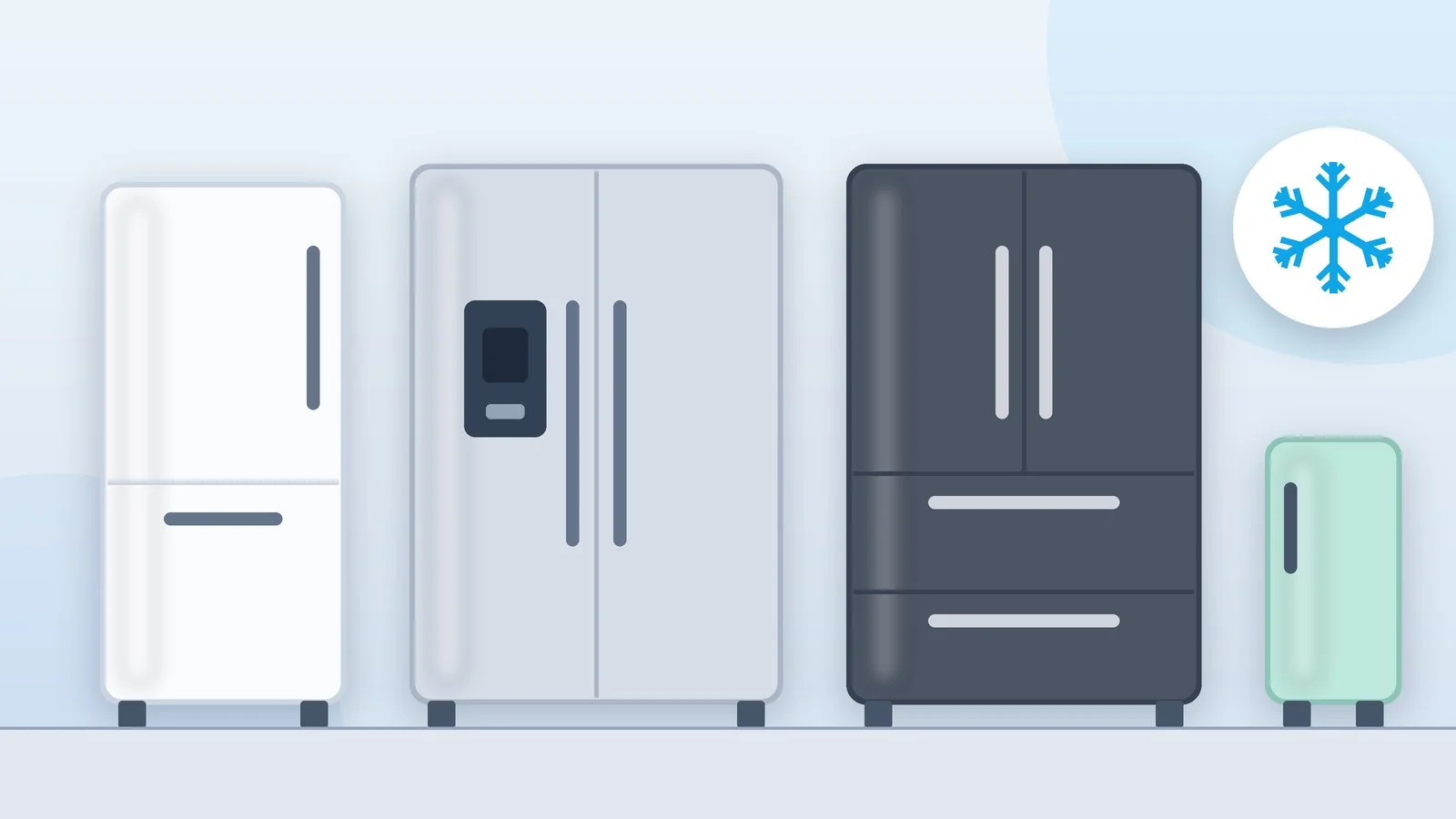
Types of refrigerators differ in three ways: how the compartments and doors are arranged, how the appliance is installed and how it cools. For most apartments, the right fit is a freestanding fridge freezer 60 cm wide with the freezer at the bottom. Side-by-side and French door models make sense if you need about 600 L and have a 90 cm wide space, and a built-in one if the fridge has to disappear into the kitchen cabinetry.
Below are typical sizes of each type from manufacturers’ catalogs, the difference between static cooling and No Frost, what an inverter compressor and dual cooling circuits change, how to pick a climate class and how to read the A–G energy label, which Ukraine has also used for refrigerators since October 18, 2025. At the end you will find a comparison table and a buying checklist.
Types of refrigerators by compartment and door layout
The layout determines the width, the capacity and the convenience: what ends up at eye level and what you have to bend down for. The sizes below come from current Bosch, Liebherr and LG catalogs; check them against the listing of the specific model.
Single-door fridges
A single-door fridge has one door and one fresh-food compartment. Some have a small freezer compartment behind a separate small door, others have none, and the full height goes to shelves and drawers. In Liebherr’s catalog, tall single-door models measure 185.5 × 59.7 cm and hold 382–399 L, while low models for under or on top of a counter are 85 cm high, 50–60 cm wide and hold 98–141 L.
Freezer compartments are marked with stars. Under the EU regulation, one star means −6 °C, two stars −12 °C and three stars −18 °C. Four stars is a proper freezer: −18 °C plus the ability to freeze fresh food, at least 4.5 kg per day per 100 L of volume. A tall single-door fridge can be paired with a freezer of the same size — Samsung describes this as a modular setup.
Bottom-freezer fridge freezers
Bosch calls the two-compartment fridge freezer the most common type for the home. In the classic layout, the fridge is on top and the freezer with pull-out drawers is at the bottom, each behind its own door. The standard width is about 60 cm. Bosch makes such models 176, 186 and 203 cm tall, and the 2-meter KGN39VL316 holds 279 L in the fridge and 89 L in the freezer.
Narrow models are 55 cm wide — Liebherr’s are 137–181 cm tall and hold 210–296 L. Wide ones are 70–75 cm: Bosch makes 2-meter models 70 cm wide, and the Liebherr CNd 7723 holds 485 L at a width of 74.7 cm.
Top-freezer fridges
The freezer is on top and the fridge below. Liebherr’s 55 cm wide models of this type are 124–157 cm tall. Their freezer is smaller: in the 157 cm tall CTe 2931 it takes 52 L of 270 L, while in the CUe 3331 of the same width with a bottom freezer it takes 84 L of 296 L.
Side-by-side
Two full-height vertical doors: one opens the fridge, the other the freezer. The width is about 91 cm: the LG GSLC40EPPE measures 91.3 × 179 × 73.5 cm and has a total capacity of 638 L, of which 417 L is the fridge. The door may have a water and ice dispenser. LG makes two kinds: plumbed models connect to the water supply, non-plumbed ones have a refillable tank inside.
The downside is narrow compartments. Samsung’s comparison table lists difficulty storing larger items among the drawbacks of side-by-side models, so a large platter or box is easier to fit into a French door fridge.
French door and multi-door
Two hinged doors on top open onto one wide fridge compartment, with a pull-out freezer below — sometimes several drawers or an extra compartment. The Bosch KFN96VPEA of this type measures 183 × 90.5 × 73.1 cm and holds 405 L in the fridge plus 200 L in the freezer. Samsung notes that narrow hinged doors save space in front of the fridge.
Freestanding, built-in and compact
A freestanding fridge goes anywhere with a power outlet and the ventilation clearances given in the manual. It is easy to move or replace. A built-in fridge hides in a tall cabinet behind a furniture panel and has to match the niche exactly.
Built-in
Most built-in models in Liebherr’s catalog are designed for a niche 178 cm high and 56–57 cm wide. There are also 88, 122, 140, 194 and 213 cm niches, as well as wide ones at 71–72 cm. For example, the built-in Bosch KBN96ADD0 measures 193.5 × 70.8 × 54.8 cm and holds 284 L in the fridge and 98 L in the freezer.
The furniture panel is mounted in one of two ways — on fixed or on sliding hinges; Samsung describes both. According to the same Samsung table, the main drawbacks of the type are a higher price and installation into cabinetry. Under-counter models are made for 82–88 cm niches: single-door fridges, small freezers and beverage coolers.
Compact fridges, minibars and car coolers
Small fridges about 85 cm tall or lower go into offices, country houses or bedrooms; Liebherr has a 68 cm tall single-door model with 92 L. Hotel minibars also use absorption cooling without a compressor: Dometic calls these models totally silent and says compressor models may produce noise.
Portable thermoelectric coolers work differently: they cool relative to the surrounding air. The 7 L Dometic TropiCool TCX 07 runs on 12 or 230 V and cools to 25 °C below the ambient temperature. In hot weather this limit shows: at 35 °C in a car, the inside will be about 10 °C at best.
Wine cabinets
A wine cabinet keeps +5 to +20 °C — the same range the EU regulation sets for wine storage compartments. Liebherr’s single-zone models are designed for storing and aging wine, dual-zone ones for keeping different wines at serving temperature. The manufacturer also lists humidity above 50% for the corks, low-vibration compressors and UV-resistant glass. The energy label of a wine cabinet shows how many standard bottles it holds.
Freezers: upright or chest
A separate freezer is either upright (a cabinet with drawers) or a chest with a lift-up lid. The upright Bosch GSN33VWE0N measures 176 × 60 cm and holds 225 L. Liebherr’s chest freezer page shows models 104 and 167 cm wide with 281 and 497 L, so a chest needs floor space rather than height.
If power outages are frequent, look at the “storage time during a power failure”: the number of hours it takes the freezer to warm from −18 to −9 °C. For the Bosch GSN33VWE0N upright freezer it is 9 hours, for the Bosch and Liebherr fridge freezers in the table below 12–20 hours, and for the 359 L Liebherr CFd 2505 chest freezer 50 hours.
Static cooling, No Frost and hybrids
In static (drip) cooling, the evaporator sits in the back wall of the fridge compartment. While the compressor runs, frost forms on the wall; during pauses it melts, and the water runs into a drain hole and on to a tray, where the compressor’s heat evaporates it. Drops on the back wall are normal, and Liebherr advises cleaning the drain hole regularly.
A freezer with static cooling has to be defrosted by hand. Frost builds up faster if you open the door often or put in warm food, and a thick layer of ice increases power consumption. The manufacturer forbids speeding up defrosting with heaters, steam, open flames, sprays or sharp tools; you may put a pan of hot, but not boiling, water on a shelf.
In a No Frost system, the evaporator is hidden in a closed compartment, and a fan circulates chilled air through the cabinet and carries moisture away. Frost does not build up on the walls or the food, and the freezer never needs manual defrosting. The flip side is drier air, so keep unwrapped food in containers or wrap.
Manufacturers use different names. Total No Frost at Bosch and LG means No Frost in both compartments. A hybrid has No Frost only in the freezer and static cooling in the fridge: the built-in Bosch KBN96ADD0, for example, works this way. An in-between option is freezers with reduced frost build-up, which Liebherr calls SmartFrost: they still need defrosting, but according to the manufacturer at most every few years.
Dual cooling circuits
A conventional No Frost fridge has one evaporator, and the air of the two compartments is connected. Samsung says that with this design, odors from the fridge can reach food in the freezer.
Models with two evaporators or two separate circuits cool the compartments independently, with no air exchange between them: Liebherr calls this DuoCooling, Samsung Twin Cooling Plus and Beko NeoFrost. Samsung claims up to 70% humidity in the fridge compartment for such models.
Compressor: conventional or inverter
A conventional compressor works on an on/off basis: it runs at full power, then stops. An inverter compressor changes its speed with the load. Samsung says its Digital Inverter runs in five modes based on humidity and usage patterns, keeps a more consistent temperature, wears less and keeps noise to a minimum.
Digital Inverter (Samsung), Inverter Linear Compressor and Smart Inverter Compressor (LG) are trade names. In LG’s linear compressor, the piston moves in a straight line without rotating, and the company claims 32% higher efficiency than its own conventional compressor — based on a 2014 VDE test of two LG models.
For an actual purchase, the kWh per year line on the energy label shows the real difference. Inverter air conditioners work on the same principle — see our guide to buying an air conditioner.
Climate class: where the fridge will stand
The climate class shows the room temperatures at which the fridge keeps the required cold. The ranges are set in EU Regulation 2019/2016 and in Ukraine’s technical regulation on energy labeling, and Liebherr lists the same values. The class is shown on the rating plate inside the fridge and in the product listing.
| Class | Name | Room temperature, °C |
|---|---|---|
| SN | Extended temperate | +10 to +32 |
| N | Temperate | +16 to +32 |
| ST | Subtropical | +16 to +38 |
| T | Tropical | +16 to +43 |
Classes can be combined: SN-T means +10 to +43 °C. Some reference tables give +18 °C as the lower limit for ST and T, but the current EU and Ukrainian rules set it at +16 °C.
Any class works in an apartment, but for an unheated country house, porch or garage the lower limit matters. Liebherr warns that below +10 °C proper operation is no longer guaranteed. In a two-compartment fridge with one compressor and one thermostat, the compressor may barely run in a cold room, and the freezer does not get cold enough. For such models, the EU regulation describes a “winter setting” that keeps the compressor running below +16 °C.
For cold rooms, there are models protected down to −15 °C: Liebherr calls this FrostProtect, Beko calls it Freezer Guard.
The A–G energy label and noise
Since March 1, 2021, the EU has used a label with an A to G scale instead of the old one with A+, A++ and A+++ classes. In Ukraine, the same label was introduced by the technical regulation on energy labeling of refrigerating appliances (Order No. 796 of the Ministry for Communities, Territories and Infrastructure Development, September 8, 2023). It has been in force since October 18, 2025, when the previous 2013 regulation expired.
Appliances placed on the market earlier under the old rules may still be sold, so both labels can still be seen in stores. The new one shows the class, consumption in kWh per year, the volume of the freezer and other compartments, noise in dB(A) with a class from A to D, and a QR code. It leads to the EU’s EPREL database with detailed model data.
The class is not based on kilowatt-hours directly but on an index: actual consumption divided by a “standard” consumption for an appliance of the same volume with the same compartment types. That is why a large and a small fridge can both be class E with different consumption — compare the kWh.
When the new scale was introduced, the European Commission noted that over 90% of models had been rated A+, A++ or A+++, while the most efficient ones would typically get B, C or D on the new scale.
Noise classes: A is below 30 dB(A), B is 30 to 35, C is 36 to 41, D is 42 and above. The table below lists real models of different types from manufacturers’ catalogs.
| Type and model | Size H × W × D, cm | Capacity, L | Class and kWh/year | Noise, dB(A) | Cold without power, hours |
|---|---|---|---|---|---|
| Top freezer: Liebherr CTe 2931 | 157.1 × 55 × 63 | 270 | E, 190 | 37 | 20 |
| Bottom freezer: Liebherr CUe 3331 | 181.2 × 55 × 63 | 296 | E, 224 | 38 | 16 |
| Bottom freezer: Bosch KGN39VL316 | 203 × 60 × 66 | 368 | E, 238 | 39 | 12 |
| Wide: Liebherr CNd 7723 | 201.5 × 74.7 × 67.5 | 485 | D, 231 | 35 | 20 |
| Built-in: Bosch KBN96ADD0 | 193.5 × 70.8 × 54.8 | 382 | D, 204 | 33 | 13 |
| French door: Bosch KFN96VPEA | 183 × 90.5 × 73.1 | 605 | E, 333 | 38 | 15 |
| Side-by-side: LG GSLC40EPPE | 179 × 91.3 × 73.5 | 638 | E, 347 | 36 | no data |
| Chest freezer: Liebherr CFd 2505 | 82 × 167 × 71 | 359 | D, 188 | 33 | 50 |
Class E means 347 kWh per year for the 638 L side-by-side, but 238 kWh for the 60 cm Bosch. And the 91 cm wide Liebherr CBNste 8872, at 42 dB(A), already falls into noise class D.
Freshness zones and other features
Under the EU regulation, a regular fridge compartment is designed for storage at 0 to +8 °C, and a separate freshness zone (a chill compartment in the regulation) at −3 to +3 °C. In such a zone, meat and dairy are kept near zero, and the vegetable drawer closes tightly and keeps humidity high.
Liebherr calls it BioFresh — just above 0 °C and up to 90% humidity for vegetables; Bosch calls it VitaFresh and lists −1 to +3 °C.
Fast freeze temporarily lowers the freezer temperature so fresh food freezes faster. A dispenser, app control and lighting are a matter of convenience and budget.
Types of refrigerators compared
| Type | Width and capacity | Pros | Cons | Best for |
|---|---|---|---|---|
| Single-door | 50–60 cm, 92–399 L | Whole cabinet for fresh food | No freezer or a tiny one | Singles, cottages, pairing with a freezer |
| Bottom freezer | 55–75 cm, 210–485 L | Fridge at eye level | You bend down for the freezer | Most families |
| Top freezer | 55 cm, 196–270 L | Low, 124–157 cm | Small freezer | Small kitchens, 1–2 people |
| Side-by-side | About 91 cm, about 640 L | Large capacity, dispenser | Narrow shelves, needs space | Large families |
| French door | About 90 cm, about 600 L | Wide fridge, narrow doors | Pricier, needs space | Large families |
| Built-in | Niche 56–57 or 71–72 cm | Hidden behind a panel | Pricier, needs installation | Kitchens with a unified look |
| Compact, minibar | Up to 85 cm tall, up to 141 L | Small footprint, absorption is silent | Small capacity | Offices, hotels, bedrooms |
| Wine cabinet | +5 to +20 °C | Zones for different wines | Wine only | Wine collectors |
| Freezer | Upright 60 cm, chest 104–167 cm | Chest holds cold longer | Chest takes floor space | Stockpiling, country houses |
How to choose a refrigerator: checklist
- Measure the space. Height, width and depth of the niche or corner, the path through doorways, and room to open the door and pull out the drawers. Ventilation clearances are listed in the manual.
- Pick the capacity. Beko’s buying guide suggests 150–250 L for one person, 250–350 L for a couple and over 350 L for a family.
- Decide how much freezer you need. For large stocks, a separate freezer is more practical, and in top-freezer models the freezer is noticeably smaller, as in the example above.
- Choose the defrost system. No Frost spares you manual defrosting, a hybrid keeps a static fridge compartment, and dual circuits keep odors from mixing.
- Check the climate class. Any class works in an apartment. Class SN is rated for rooms from +10 °C, while an unheated country house or garage in winter needs a model protected down to −15 °C.
- Compare kWh and noise. The class letter is a hint; the yearly consumption and dB(A) on the label let you compare models of the same size fairly.
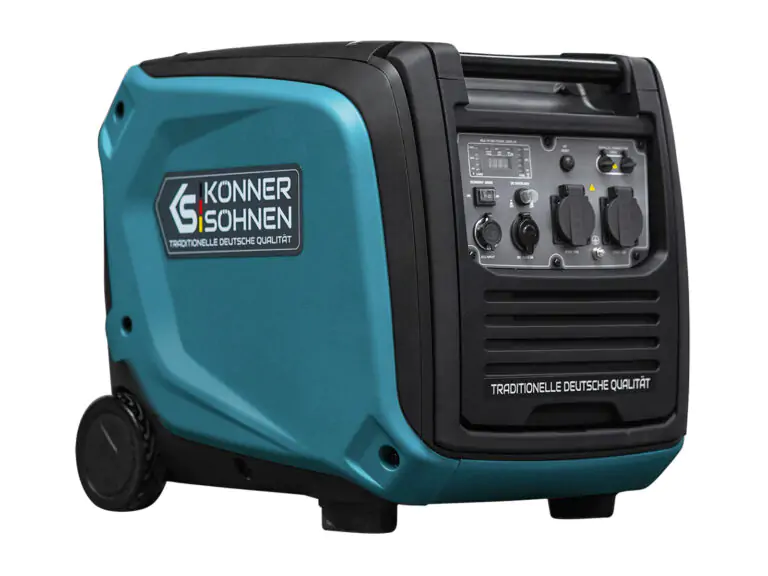
- Plan for power outages. Check the storage time during a power failure in the specs, and for long outages consider backup power — for example, an inverter generator.
- For built-in models, check the niche and hinges. Compare the niche with the installation drawing and check how the panel is mounted. If you are equipping a kitchen from scratch, see our list of 10 kitchen appliances.
Sources and methodology
Analysis of public sourcesChecked 30 September 2026
- Regulation (EU) 2019/2016 on energy labeling of refrigerating appliances eur-lex.europa.eu
- Ukraine’s technical regulation on energy labeling of refrigerating appliances (Order No. 796) zakon.rada.gov.ua
- European Commission: energy label for fridges and freezers energy-efficient-products.ec.europa.eu
- Liebherr: FAQ on climate classes and storage liebherr.com
- Samsung: what type of fridge is best for me samsung.com
FAQ
Which refrigerator should a family of 3–4 choose?
Most often, a 60 cm wide fridge freezer with a bottom freezer: Beko recommends models over 350 L for families. If you need about 600 L and have a 90 cm wide space, look at French door or side-by-side models.
Which is better: No Frost or static cooling?
No Frost spares you manual defrosting but dries the air, so keep food wrapped. A static fridge compartment defrosts itself, but the freezer in such a model has to be defrosted by hand from time to time. A compromise is a hybrid with No Frost only in the freezer.
Can a refrigerator stand in an unheated country house?
Only if its climate class allows it: the lower limit is +10 °C for SN and +16 °C for N, ST and T. For cold rooms, there are models protected down to −15 °C, such as Liebherr FrostProtect and Beko Freezer Guard.
How long does a refrigerator stay cold without power?
Check the storage time during a power failure in the specs: the number of hours the freezer takes to warm from −18 to −9 °C. For the Bosch and Liebherr fridge freezers in our table it is 12–20 hours, for the Bosch GSN33VWE0N upright freezer 9 hours, and for the Liebherr CFd 2505 chest freezer 50 hours.
What does the noise class on the energy label mean?
It is the noise level in dB(A): A is below 30, B is 30 to 35, C is 36 to 41, D is 42 and above. Most models in our table are class C, the quiet ones class B.





Leave a Reply