
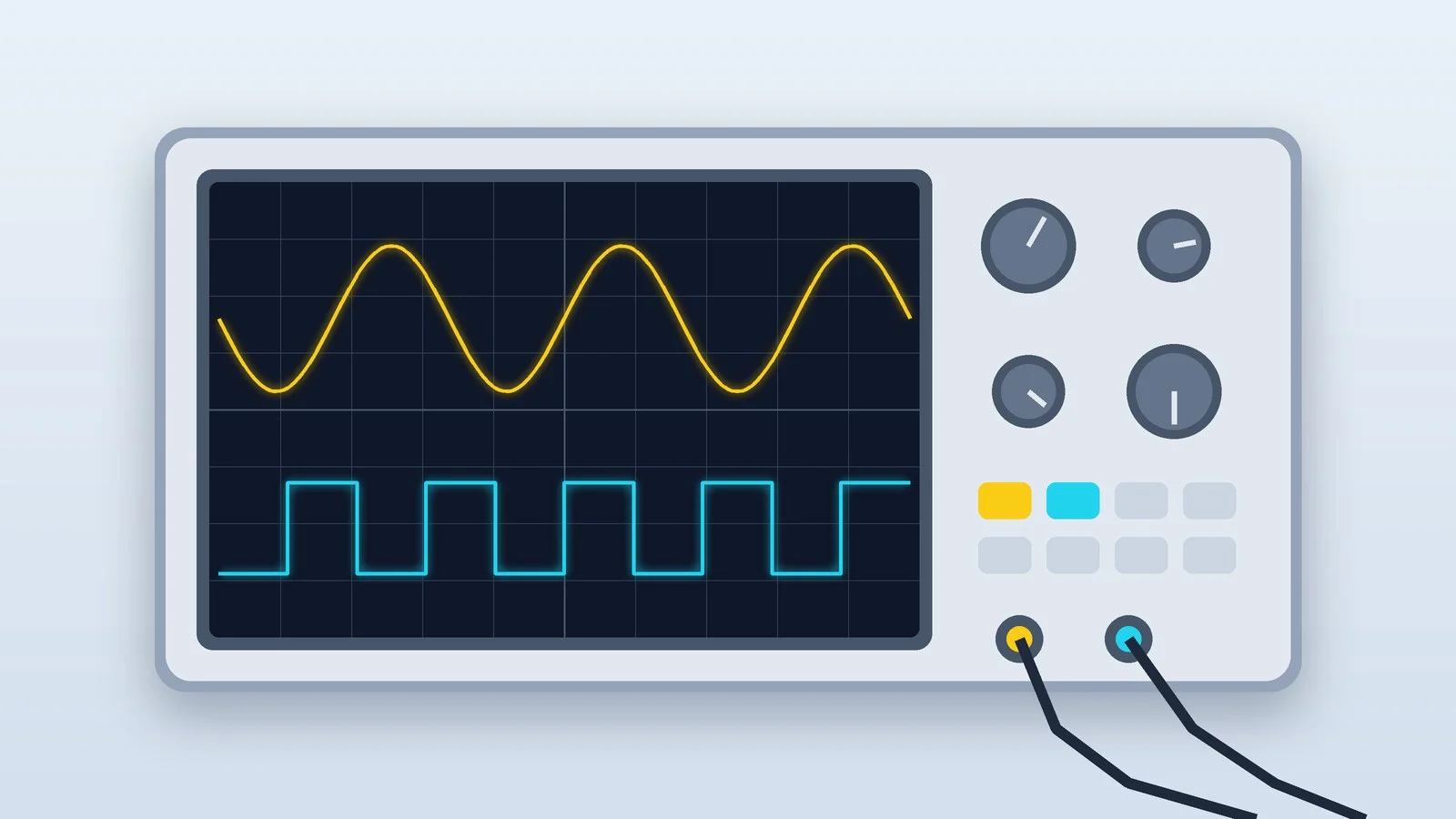
Types of oscilloscopes differ by architecture — the ordinary digital storage scope (DSO), the mixed signal oscilloscope (MSO), the scope with a built-in spectrum analyzer (MDO) and the sampling scope — and by form factor: benchtop, portable, USB and pocket. According to Tektronix, analog models with a cathode-ray tube are no longer made, so the choice is among digital ones.
Below: how these types differ, what bandwidth, sample rate, memory and 12 bits mean according to guides from Tektronix, Keysight and Rohde & Schwarz, why an ordinary scope can’t measure 230 V mains, plus models with prices, a comparison table and a buying checklist.
Analog and digital oscilloscopes
In an analog oscilloscope, the amplified signal deflects an electron beam that draws the trace on a cathode-ray tube screen. The picture appears instantly, but according to Keysight and Tektronix these scopes have few features, limited accuracy and modest recording capabilities. Tektronix says they are no longer manufactured, and Keysight recommends used models for education and for repairing older equipment.
A digital oscilloscope first converts voltage into numbers with an analog-to-digital converter (ADC), stores the samples in memory and only then draws the trace. That is why it can capture one-off events — Tektronix calls them transients — measure parameters automatically, save waveforms and decode digital buses. The price is “dead time”: while the scope processes a record, it doesn’t see the new signal.
Input and amplifier
The probe and input stage scale the signal to the ADC range
ADC
Turns voltage into samples: a 12-bit ADC has 4,096 levels
Memory
Holds the record: number of points = sample rate × time
Processing and display
Triggering, measurements, decoding and drawing the trace
Types of digital oscilloscopes by architecture
DSO: digital storage oscilloscope
Tektronix defines the DSO (digital storage oscilloscope) as the conventional digital oscilloscope. Most affordable benchtop, portable and USB models are DSOs. They calculate the signal spectrum mathematically with a fast Fourier transform (FFT), which the Rigol DHO800 and Siglent SDS800X HD both offer, for example.
DPO: a Tektronix term
Tektronix uses the name digital phosphor oscilloscope (DPO) for its scopes with parallel processing and its DPX acquisition technology. They show a third dimension — how often the signal passes through each point of the screen: frequent areas are brighter. For a buyer this is more a feature than a separate type: a Keysight product manager writes that nearly all of Keysight’s DSOs also use trace-intensity modulation. On other brands, look for intensity grading.
MSO: mixed signal oscilloscope
An MSO (mixed signal oscilloscope) adds digital channels to the analog ones — 16 in Tektronix’s definition — on a common time base. It is essentially a built-in logic analyzer: you can see how an analog signal lines up with the state of a bus, and the protocols are decoded right away.
All Rigol DHO900 models have digital channels, but they need the PLA2216 logic probe, which is sold separately. On the Siglent SDS800X HD and SDS1000X HD, 16 channels come with the SLA1016 option, and the PicoScope 2000 is also available in MSO versions with two analog and 16 digital inputs.
MDO: with a built-in spectrum analyzer
An MDO (mixed domain oscilloscope) combines an MSO or DPO with a hardware spectrum analyzer. One example is the Tektronix 3 Series MDO: an oscilloscope with 100 MHz to 1 GHz bandwidth plus a spectrum analyzer up to 1 GHz, or up to 3 GHz as an option; on the Tektronix website it starts at $5,490 for the MDO32. Keysight names wireless and IoT device development as the main use for such instruments.
Sampling and flagship oscilloscopes
A sampling oscilloscope takes one sample on each repetition of the signal, slightly later each time, and builds the picture in equivalent time. According to Tektronix, this gives ten times higher bandwidth, but only for repetitive signals and usually with an input range of about 1 V peak-to-peak. The Keysight DCA-X N1000A takes up to 250,000 samples per second, yet with plug-in modules it works at bandwidths above 100 GHz.
One-off signals at such frequencies are captured by real-time flagships such as the Keysight Infiniium UXR-B: up to 110 GHz, 256 GSa/s on every channel and a 10-bit ADC.
Types of oscilloscopes by form factor
Benchtop
The classic choice for a workshop or lab: a 7- to 11.6-inch screen, mains power, usually 2 or 4 channels, plus 16 digital ones on MSOs. Entry-level 12-bit models already exist: the Rigol DHO800 (70–100 MHz, 1.25 GSa/s, 25 Mpts) and the Siglent SDS800X HD (70–200 MHz, 2 GSa/s, up to 100 Mpts). The main limitation: on most models the common lead of the channels is tied to protective earth (see the safety section).
Portable and handheld scopes
Portable scopes run on batteries — on site, at an electrical panel, in a car. On professional models the channels can be isolated from each other and from earth. The Fluke 190 Series III (ScopeMeter is a Fluke trademark) has up to four isolated inputs, CAT III 1000 V and CAT IV 600 V ratings, 60–500 MHz bandwidth and up to 7 hours on battery, but only 10,000 points per waveform.
The Siglent SHS1000X costs less: two isolated channels at 100 or 200 MHz, 12 Mpts, a multimeter, CAT II 1000 V and CAT III 600 V. Budget “three-in-one” tools like the OWON HDS200 (25–200 MHz, 8 bits, 8,000 points, a multimeter and, on S models, a generator) and tablet scopes like the Micsig STO1000 are simpler: if the maker doesn’t mention isolated channels and a CAT rating for the inputs, treat them as ordinary ones.
USB and PC-based oscilloscopes
A USB oscilloscope is a box with inputs and an ADC, and the computer serves as the screen: a large monitor, free software updates and deep memory. The PicoScope 2204A is powered over USB and offers two channels, 10 MHz and 100 MSa/s at 8 bits; the PicoScope 3000E offers four channels, up to 500 MHz, 5 GSa/s and up to 10 bits.
It doesn’t work without a computer, and its ground is connected to the computer through the USB cable. Pico warns that the scope has no protective safety ground, that voltage on its ground input will damage both the scope and the computer, and that mains may be measured only through a CAT-rated isolating differential probe. For cars there is the PicoScope 4425A: four floating inputs, 20 MHz, 12 bits, up to ±200 V; the starter kit costs £1,349.
Pocket scopes and DIY kits
Pocket models cost a few dozen dollars: the FNIRSI DSO-152 has 200 kHz and 2.5 MSa/s, the DSO-153 1 MHz. The JYE Tech DSO138mini is a kit you solder yourself: 200 kHz, 1 MSa/s, 1,024 points, input up to 50 V peak. These are tools for audio, slow PWM and first experiments, not for digital buses and certainly not for mains.
Oscilloscope specs: what the numbers mean
Bandwidth
Bandwidth is the frequency at which a sine wave on screen is attenuated to 70.7% of its amplitude, i.e., by 3 dB (Tektronix’s definition). Above it, amplitude is understated and edges get rounded. According to Tektronix, bandwidth five times the highest frequency component of the signal keeps the error below ±2% — this is the “5 times rule.”
Keysight recommends bandwidth at least five times the fastest clock rate for digital signals (Rohde & Schwarz suggests a 3–5× margin) and three times the highest frequency for analog ones. For scopes up to 1 GHz, rise time is roughly 0.35 divided by the bandwidth: 3.5 ns for the 100 MHz Rigol DHO800, and per Tektronix it should be five times faster than the signal’s edge.
Sample rate
According to Tektronix, accurate reconstruction with sin(x)/x interpolation needs a sample rate at least 2.5 times the highest frequency component of the signal, and 10 times with linear interpolation. Keysight adds that most scopes up to 1 GHz specify bandwidth at 1/4–1/5 of the sample rate, and a 4:1 ratio is enough for reliable measurements.
The trap: on many models the sample rate is shared between channels. The four-channel Rigol DHO804 and DHO814 sample at 1.25 GSa/s on one channel, 625 MSa/s on two and 312.5 MSa/s on four; the Siglent SDS800X HD at 2, 1 and 0.5 GSa/s. Compare the figure for the number of channels you will actually use.
Memory depth
Record length equals sample rate multiplied by time — that is how Tektronix and Rohde & Schwarz calculate it. 25 Mpts at 1.25 GSa/s is 20 ms, one cycle of 50 Hz mains. To record one second, the scope will drop to 25 MSa/s and, by the 2.5-samples-per-period rule, will reliably show components only up to 10 MHz.
The Rigol DHO800 has 25 Mpts, the Siglent SDS800X HD 50–100 Mpts and the PicoScope 3000E 2 billion samples, while pocket and many portable models count in thousands: 1,024 points on the DSO138mini, 8,000 on the OWON HDS200.
Vertical resolution: 8, 10 or 12 bits
An 8-bit ADC distinguishes 256 levels, a 10-bit one 1,024 and a 12-bit one 4,096 (Rohde & Schwarz). At 10 mV/div with 8 divisions, the step of an 8-bit scope is about 0.31 mV and of a 12-bit one about 0.02 mV, so small ripple, noise and distortion stay visible on top of a large signal.
Real accuracy is lower because of noise: for the 12-bit Siglent SDS800X HD the specified effective number of bits (ENOB) is 8.4. The HD mode of the Rohde & Schwarz MXO 3 gives up to 18 bits at the cost of bandwidth, the PicoScope 3000E adds 4 bits in software, and the Keysight InfiniiVision HD3 has a 14-bit ADC.
Waveform update rate
While the scope processes a record, it is blind. Tektronix writes that DSOs with serial processing capture 10 to 5,000 waveforms per second, so rare glitches slip between records. The Rigol DHO800 delivers 30,000 waveforms per second in normal mode and up to 1,000,000 in UltraAcquire mode, the Siglent SDS800X HD 80,000–120,000 and up to 500,000 in Sequence mode, and the Rohde & Schwarz MXO 3 up to 4,500,000.
Triggering and bus decoding
The trigger decides when to start drawing the waveform so that it stays still on screen. Besides edge triggering, the Rigol DHO800 can trigger on pulse width, on a runt — a pulse that fails to reach the second threshold — on a window, timeout, setup/hold violation, Nth edge and bus events.
Decoding turns pulses into bytes right on the screen. The DHO800 includes parallel, RS232/UART, I2C, SPI and CAN decoding as standard, the Siglent SDS800X HD includes I2C, SPI, UART, CAN and LIN, and the SDS1000X HD adds CAN FD and FlexRay. Before buying, check which protocols are included and which are sold as options.
Probes and safety: grounding and CAT ratings
The standard probe is a passive 10:1 probe: according to Tektronix, its resistance is about 10 MΩ, so resistive loading of the circuit is negligible. In the 1× position the bandwidth is much narrower: the Rigol PVP3150 probe supplied with the DHO800 passes up to 150 MHz at 10× and only up to 20 MHz at 1×.
Before use, compensate the probe: connect it to the calibration output (a 1 kHz, 3 V square wave on the Rigol DHO800 and Siglent SDS800X HD) and turn the trimmer screw until the square wave has flat tops. Use the shortest ground lead: Tektronix notes that a long one adds inductance and ringing on fast edges.
Why an ordinary scope can’t measure mains
On most mains-powered oscilloscopes, the common lead of the inputs is connected to protective earth through the third pin of the plug. If you clip the probe’s ground lead to a point that is live relative to earth — a phase conductor or a circuit without an isolation transformer — you get a short circuit, Tektronix warns.
Disconnecting the scope’s ground is a dangerous practice that Tektronix strongly recommends against: the chassis and connectors end up at the voltage of the connection point. The protective conductor is part of shock protection; how it works in an apartment together with circuit breakers and RCDs is covered in our guide to choosing a circuit breaker.
The second limit is the input category. The Rigol DHO800 and Micsig STO1000 inputs are rated CAT I 300 V, and Rigol states plainly that this does not apply to CAT II–IV. As Fluke explains, the IEC 61010-1 standard divides circuits as follows:
- CAT I — low-energy circuits: electronics, battery-powered devices;
- CAT II — single-phase outlets and the appliances plugged into them, household wiring;
- CAT III — distribution circuits: three-phase systems, industrial equipment, solar PV arrays;
- CAT IV — everything close to the utility connection: service entrance, main disconnects, meters, transformers.
The higher the category, the better the instrument withstands transient overvoltages: outlets need at least CAT II, distribution panels CAT III.
What to use on mains and power circuits
Tektronix lists safe options: a high-voltage differential probe on an ordinary scope, an oscilloscope with isolated inputs and isolation amplifiers. Of the models above, the Fluke 190 Series III and Siglent SHS1000X have isolated inputs. Rigol’s differential probes are rated from 1,400 to 7,000 V peak-to-peak, and Pico allows only CAT-rated isolating differential probes for mains.
Examples of current models by class
This is not a ranking but a guide by class; specs come from manufacturers’ websites and datasheets.
| Class | Model | Key specs | Price |
|---|---|---|---|
| FNIRSI DSO-152 | 200 kHz, 2.5 MSa/s | — | |
| USB | PicoScope 2204A | 2 channels, 10 MHz, 100 MSa/s, 8-bit | — |
| Benchtop, 12-bit | Rigol DHO804 | 4 channels, 70 MHz, 25 Mpts | $459 |
| Benchtop, 12-bit | Siglent SDS804X HD | 4 channels, 70 MHz, 50 Mpts | $461 |
| Benchtop MSO | Rigol DHO924 | 4 + 16 channels, 250 MHz, 50 Mpts | $769 |
| Benchtop, 12-bit | Siglent SDS1104X HD | 4 channels, 100 MHz, 100 Mpts | $1,399 |
| Mid-range | Rohde & Schwarz MXO 3 | 4 or 8 channels, 0.1–1 GHz | from $5,890 |
| MDO | Tektronix 3 Series MDO | up to 1 GHz, spectrum analyzer to 3 GHz | from $5,490 |
| Portable, isolated | Siglent SHS1102X | 2 channels, 100 MHz, CAT III 600 V | $2,184 |
| Portable, isolated | Fluke 190-062-III | 2 channels, 60 MHz, CAT IV 600 V | $4,946.54 |
| Automotive USB | PicoScope 4425A | 4 inputs, 20 MHz, 12-bit, ±200 V | from £1,349 |
At almost the same price, the Rigol DHO804 and Siglent SDS804X HD differ in sample rate (1.25 vs. 2 GSa/s on one channel), memory (25 vs. 50 Mpts) and capture rate in special modes (1,000,000 vs. 500,000 waveforms per second).
In Ukraine, you can buy an oscilloscope from specialist stores such as radio-shop.com.ua. Before buying, check the model’s specs against the manufacturer’s website.
Types of oscilloscopes compared
| Type | What it is | Bandwidth | Pros | Cons | Best for |
|---|---|---|---|---|---|
| Analog (CRT) | A beam draws the signal on a tube | No longer made | Instant picture | Few features, little recording | Education, old equipment |
| Benchtop DSO | Digital scope powered from mains | 70–250 MHz at entry level | 12-bit, deep memory | Inputs tied to earth | Workshop, study, repair |
| MSO | DSO plus 16 digital channels | 25 MHz – 1 GHz | Analog and logic on one time base | Pricier, needs a logic probe | Microcontrollers, buses |
| MDO | MSO plus spectrum analyzer | Up to 1 GHz, spectrum to 3 GHz | Time and spectrum in one box | From $5,490 | RF and IoT development |
| Portable, isolated | Battery, isolated inputs | 60–500 MHz | CAT II–IV, field work | Expensive, some have little memory | Electricians, power, cars |
| USB and PC | ADC box plus software on a PC | 10–500 MHz | Big screen, deep memory | Needs a PC, ground via USB | Lab, study, cars |
| Pocket and DIY kit | Mini scope or solder-it-yourself kit | 0.2–110 MHz | Costs a few dozen dollars | Modest specs | Audio, PWM, first steps |
| Sampling and flagships | Equivalent time or real time | 50–110 GHz and up | Ultimate bandwidth | Price on request | Optics, links up to 224 Gb/s |
How to choose your first oscilloscope: checklist
- Hobby electronics, Arduino, repair. A 12-bit benchtop DSO at 70–100 MHz with four channels, such as the Rigol DHO804 or Siglent SDS804X HD.
- Audio. The audio range goes up to 20 kHz, so any model has enough bandwidth; what matters more is 12 bits, FFT and a 20 MHz bandwidth limit against noise, which the Rigol DHO800 and Siglent SDS800X HD have.
- Power electronics and mains. A differential probe or an instrument with isolated inputs of the right CAT rating. 12 bits help you see 100 Hz ripple at the output of an LED driver or power supply, and the Bode plot function on the Rigol DHO914S and DHO924S lets you check the feedback loop. The output waveform of a UPS is also viewed through a differential probe.
- Microcontrollers and buses. An MSO with 16 digital channels and decoding for the protocols you need. Keysight recommends bandwidth at least five times the clock rate: 100 MHz or more for 20 MHz SPI.
- Cars. Battery power, floating or isolated inputs and deep memory for rare glitches — like the PicoScope 4425A with 250 million samples or the Siglent SHS1000X with CAN and LIN decoding.
- Study on a minimal budget. A PicoScope 2204A or a pocket scope will teach the basics, but the 2204A has 10 MHz bandwidth and a 35 ns rise time — not enough for digital buses.
Sources and methodology
Analysis of public sourcesChecked 1 October 2026
- Tektronix: Evaluating Oscilloscope Bandwidth, Sample Rate, and Performance Specs tek.com
- Tektronix: Oscilloscope Types tek.com
- Keysight: Oscilloscope Sample Rates versus Sampling Fidelity (5989-5732EN) keysight.com
- Rohde & Schwarz: Oscilloscope buyer’s guide rohde-schwarz.com
- Tektronix: The Three Facets of Floating Measurement Solutions tek.com
FAQ
Which oscilloscope should a beginner buy?
A 70–100 MHz benchtop digital scope with a 12-bit ADC and four channels, such as the Rigol DHO804 or Siglent SDS804X HD: as of October 1, 2026, they cost $459 and $461 in the official US stores. The two-channel Rigol DHO802 is $329.
What is the difference between a DSO and an MSO?
An MSO is a DSO with extra digital channels, usually 16, that work as a logic analyzer on a common time base. An MSO is handier for debugging microcontrollers, while a DSO is enough for audio and power electronics.
Can I measure outlet voltage with an ordinary oscilloscope?
No. The probe ground of a benchtop scope is connected to protective earth, and the inputs of affordable models are rated CAT I. You need a high-voltage differential probe or an instrument with isolated inputs rated at least CAT II.
How much bandwidth does an oscilloscope need?
Keysight recommends bandwidth at least three times the highest frequency for analog signals and at least five times the clock rate for digital ones. According to Tektronix, a fivefold margin keeps the error below ±2%.
Why 12 bits if there are 8-bit models?
A 12-bit ADC distinguishes 4,096 levels instead of 256, so ripple, noise and distortion are visible without changing the scale. Noise lowers the real resolution — 8.4 bits ENOB on the Siglent SDS800X HD — but that is still more than 8 bits can give.







Leave a Reply