
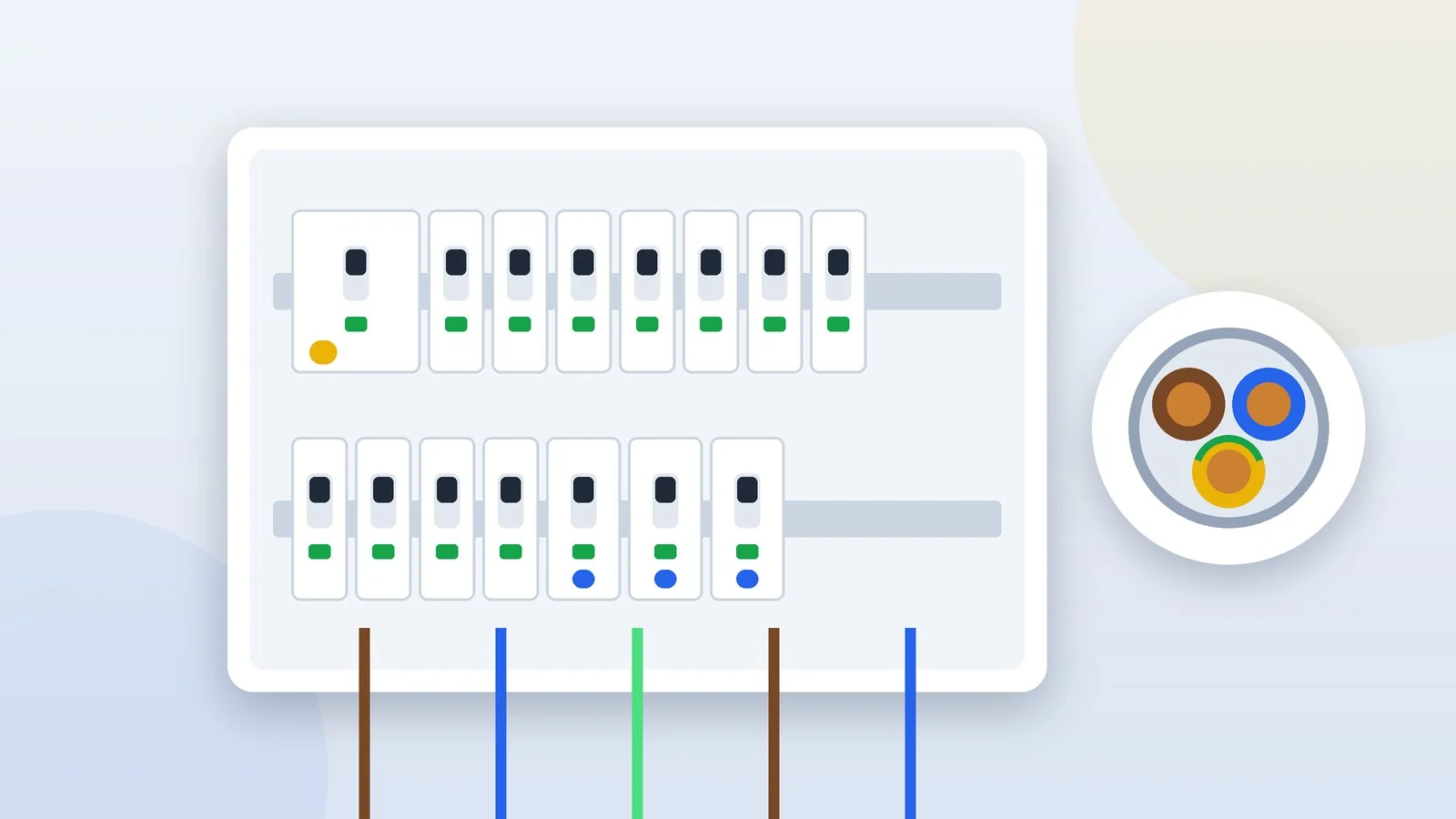
To choose the right circuit breaker for an apartment, start with the cable, not with the power of your appliances. A 1.5 mm² copper cable gets a 10 A breaker, 2.5 mm² gets 16 A, and a single-phase electric cooker on a cable of 6 mm² or more gets 32 A. Use a B or C curve and a breaking capacity no lower than the short-circuit current at the panel; Ukraine’s building code (DBN) also requires an RCD of 30 mA or less on socket circuits.
Below: what a breaker does and does not do, how to read its markings, how the rating relates to cable size under Ukraine’s PUE:2026 and DSTU standards, which circuits an apartment has, where RCDs and RCBOs are mandatory, how selectivity works and how to avoid fakes. The requirements come from the rules in force in Ukraine on September 30, 2026.
What a breaker does and what it does not cover
A circuit breaker protects the wiring against overcurrent. The thermal release trips the circuit on a sustained overload, and the magnetic release trips almost instantly on a short circuit. Manufacturers state plainly that household breakers are there to protect cables, so the rating is chosen for the cable, not for the appliance that will be plugged in.
Other hazards are invisible to a breaker. PUE:2026, Ukraine’s Rules for Electrical Installations approved by Energy Ministry Order No. 283 of June 5, 2026, splits protection this way: breakers and fuses against overcurrent, the measures of Chapter 1.7 against electric shock, and voltage relays against voltage deviations (clause 3.1.8).
| Hazard | Protection | Where it is set out |
|---|---|---|
| Circuit overload | Breaker, thermal release | PUE:2026, cl. 3.1.8 |
| Short circuit | Breaker, magnetic release | PUE:2026, cl. 3.1.8 |
| Leakage through a person | RCD or RCBO, 30 mA or less | PUE:2026, cl. 1.7.76; DBN |
| Sparking and arcing in wiring | AFDD (PVDP in the DBN) | DBN V.2.5-23:2025 |
| Surges and voltage dips | Voltage relay, SPD | PUE:2026, cl. 3.1.8; DBN |
A breaker will not notice a leak of a few dozen milliamps: its tripping currents are measured in amps. So a 30 mA RCD is not a duplicate of the breaker but separate protection for people. At the same time, PUE:2026 treats an RCD as an additional measure that cannot be the only protection against direct contact (clause 1.7.76).
How to read breaker markings
A household breaker carries several mandatory markings. Take a Legrand DX³ 6000, 16 A, curve C (catalog number 407670) as an example:
- C16: the tripping curve letter and the rated current in amps. The rating applies at an air temperature of 30 °C.
- 6000 in a rectangle: the rated short-circuit capacity Icn in amps under IEC/EN 60898-1, i.e. 6 kA. The figure 3 next to it is the energy limiting class, which describes how much energy the breaker lets through during a short circuit; class 3 is the strongest limitation.
- 230/400 V~: the rated voltage. Ukrainian networks are designed for 230/400 V, so the current of a heating appliance is its power divided by 230 V: a 2,000 W kettle draws about 8.7 A.
- IEC/EN 60898-1: the standard for household breakers meant for use by untrained people. In Ukraine it applies as DSTU EN 60898-1:2019.
If the body shows only IEC/EN 60947-2 and Icu in kiloamps, the device is meant for trained personnel. Many modular breakers carry both markings: the same DX³ 6000 has an Icn of 6 kA under EN 60898 and an Icu of 10 kA under IEC 60947-2.
B, C and D curves
The letter shows at what current the magnetic release trips instantly, in other words how tolerant the breaker is of inrush currents. The ranges are set by IEC/EN 60898-1; the typical loads come from BEAMA, the UK association of electrical equipment manufacturers:
| Curve | Trips instantly at | Typical load |
|---|---|---|
| B | 3–5 In, 48–80 A for a B16 | Heaters, cookers, sockets |
| C | 5–10 In, 80–160 A for a C16 | Motors, lighting, power supplies |
| D | 10–20 In, 160–320 A for a D16 | Transformers, motors |
IEC 60898-1 has no A curve: it was left out to avoid confusion with the symbol for amps. Apartment panels use B or C. C copes better with inrush from appliances with motors and switch-mode power supplies. B trips instantly at a lower current, so on a long circuit, where the fault current is lower, it is easier to meet the required disconnection time of 0.4 s at 230 V in a TN system (PUE:2026, cl. 1.7.82).
Why a 16 A breaker carries 18 A
The thermal release works within a tolerance set by the standard. Under IEC/EN 60898-1, a B, C or D breaker must not trip within an hour at 1.13 times its rating and must trip within an hour at 1.45 times its rating. For a 16 A breaker, that is about 18 A and 23 A. This is why PUE:2026 checks not only the rating but also the tripping current, as explained in the cable section.
The rating applies at 30 °C. ABB gives corrections: for every 10 °C of extra heat the tripping currents drop by about 6%, and when loaded breakers sit side by side, the rating is multiplied by 0.9 for three units, by 0.8 for five and by 0.75 for six or more. So in a crowded, hot panel a breaker may trip below its rating.
Breaking capacity: 4.5, 6 or 10 kA
Icn is the largest short-circuit current the breaker is guaranteed to clear. PUE:2026 requires the breaking capacity to be no lower than the short-circuit current at the point of installation (cl. 3.1.12), and the DBN says the same. IEC/EN 60898-1 allows values from 1,500 to 25,000 A; the household series in the table below are rated 4.5, 6 and 10 kA.
The short-circuit current at the panel depends on the transformer size and on the length and cross-section of the supply lines. It is calculated or derived from the measured phase-neutral loop impedance, which is an electrician’s job. PUE:2026 allows a breaker with a lower Icn only if a device upstream instantly clears such a fault current (cl. 3.1.25); manufacturers publish such pairs in back-up protection tables.
After clearing a current close to Icn, a breaker may lose its properties. The service breaking capacity Ics, after which it remains fit for use, equals Icn under IEC 60898-1 for breakers up to 6 kA and 75% of Icn for breakers from 6 to 10 kA, but no less than 6 kA.
How to choose a circuit breaker by cable size
The main rule is in PUE:2026 (cl. 3.1.32): design load current ≤ breaker rating ≤ continuous current-carrying capacity of the cable. A second formula in the same clause checks the breaker’s conventional tripping current, which for household breakers equals 1.45 times the rating, so the rating is never chosen above the cable’s capacity.
DBN V.2.5-23:2025 sets the minimum copper cross-sections in dwellings (Table 8.1): 1.5 mm² for final circuits, 2.5 mm² for the line from the floor panel to the apartment panel and the meter, and 4 mm² for risers. The size is chosen by heating under continuous current according to DSTU HD 60364-5-52 and checked for voltage drop.
| Copper size, mm² | Cable in plaster, A (PUE:2026) | In conduit in insulated wall, A (DSTU) | Breaker, A |
|---|---|---|---|
| 1.5 | 19 | 14 | 10 |
| 2.5 | 27 | 18.5 | 16 |
| 4 | 38 | 25 | 25 |
| 6 | 50 | 32 | 32 |
| 10 | 70 | 43 | 40 |
The difference between the columns is cooling. In an insulated wall, in a bundle or in a hot spot, a cable sheds heat less well and its capacity drops: under PUE:2026 at +40 °C it is multiplied by 0.81, and if a conduit or trunking holds more than four loaded conductors, the current is taken as for open installation with a factor of 0.68–0.6. That is why 1.5 mm² gets 10 A, and 16 A only if a calculation confirms it.
Do not raise the rating if the breaker keeps tripping. For example, a 25 A breaker on a 2.5 mm² cable fails the PUE:2026 check even for a cable in plaster. Frequent trips are a reason to split the load between circuits and find the cause, not to fit a bigger breaker.
Typical apartment circuits: cable, breaker, RCD
DBN V.2.5-23:2025 recommends separate circuits in an apartment for living room sockets, lighting, and kitchen and hallway sockets; where justified, they may be reduced to two. An electric cooker and electric heating need their own final circuit. Living rooms need at least one socket for every full or partial 4 m², and kitchens at least five.
| Circuit | Copper, mm² | Breaker | RCD |
|---|---|---|---|
| Lighting | 1.5 | 10 A, B or C | Per the design |
| Room sockets | 2.5 | 16 A | Required, 30 mA or less |
| Kitchen and hallway sockets | 2.5 | 16 A | Required, 30 mA or less |
| Bathroom sockets | 2.5 | 16 A | 30 mA or less, plus AFDD |
| Washing machine, dishwasher | 2.5 | 16 A or per the manual | 30 mA or less, type A or F |
| Water heater, air conditioner | 2.5 | 16 A or per the manual | 30 mA or less if plugged in |
| Single-phase electric cooker | 6 or more | 32 A, 32 A socket | Per the design |
For a single-phase electric cooker, the DBN requires a copper line of at least 6 mm² and a 32 A socket with a protective contact, and recommends a design load of 6 kW, which is about 26 A. If the design load at the apartment’s supply exceeds 10 kW, the DBN requires a three-phase supply.
Single-phase circuits are protected by single-pole or 1P+N breakers. A single-pole device goes only in the phase conductor: the DBN forbids it in the neutral. Single-pole breakers are not allowed in two- and three-phase final circuits.
Electric heating, including an electric boiler, runs on its own circuit; there is a separate guide on how to choose an electric boiler. If you are rewiring during a renovation, it is easier to plan the circuits before the rough work; see how to start an apartment renovation.
RCDs and RCBOs: where they are mandatory
Under DBN V.2.5-23:2025, final circuits that feed sockets are protected by RCDs with a rated residual operating current of 30 mA or less. The bathroom socket circuit also gets an arc fault detection device (AFDD, called PVDP in Ukrainian norms). At the apartment’s supply, an RCD of up to 300 mA is recommended for fire protection.
An AFDD disconnects the circuit when there is sparking or arcing in the wiring and sockets. The DBN requires it for bathroom and shower sockets and lighting, and recommends it for the other final circuits in new apartment buildings.
There are prohibitions too. RCDs must not be used in a TN-C system, that is, in old wiring without a separate protective conductor (PUE:2026, cl. 1.7.81), or on circuits whose sudden disconnection is dangerous, such as security and fire alarms. When RCDs are installed in series, the upstream one must have at least three times the setting and operating time of the downstream one.
RCD type: AC, A, F or B
- AC: responds only to sinusoidal AC residual current. ABB assigns simple loads such as ovens and lighting to this type.
- A: also responds to pulsating DC. It suits appliances with switch-mode power supplies, dimmers, fans and air conditioners.
- F: also detects mixed-frequency currents up to 1 kHz. It is designed for single-phase inverters in washing machines, dishwashers, vacuum cleaners and pumps, and tolerates smooth DC leakage of up to 10 mA.
- B: also responds to smooth DC, for example from three-phase frequency converters.
Standards in Ukraine: RCDs without overcurrent protection are covered by DSTU EN 61008-1:2019, RCBOs by DSTU EN 61009-1:2019, and types F and B by DSTU EN 62423:2015.
RCD or RCBO
An RCD protects against leakage but not against overload. The DBN allows RCDs without overcurrent protection only if the final circuits have overcurrent protective devices. Hager advises choosing an RCD rated no lower than the breaker in front of it, or making sure the ratings of the breakers after it do not add up to more than the RCD rating.
An RCBO combines a breaker and an RCD in one housing. With one on each circuit, a leak on one circuit will not cut power to the others. A single RCD feeding several breakers disconnects all of its circuits at once when it trips on a leak.
Main breaker and selectivity
The main breaker protects the supply cable and disconnects the whole apartment. Its rating is set by the design and by the permitted capacity in your contract with the distribution system operator (DSO). To select protection at the supply, the DBN uses the design load of one apartment of 30–100 m²: 5 kW with a gas stove, 10 kW with an electric cooker up to 8.5 kW and 12 kW with a cooker up to 10.5 kW.
Final circuit breakers must be rated lower than the main breaker: then an overload on one circuit trips that circuit’s breaker. In a short circuit, ordinary modular breakers are selective only up to the instantaneous trip threshold of the main breaker, which is 160–320 A for a C32. Above that, the main breaker may trip too. ABB calls this partial selectivity.
PUE:2026 requires a short circuit in any circuit to be cleared by that circuit’s device without affecting the others (cl. 3.1.17). Manufacturers’ selectivity tables help, as do selective main circuit breakers such as the ABB S750DR, which ABB says provides total selectivity with the breakers downstream.
A backup source is connected to the panel through a changeover switch that rules out parallel operation with the grid unless the installation is designed for it: the DBN requires such devices to comply with DSTU EN 60947-6-1. For more on the sources themselves, see the article on inverter gasoline generators.
Fakes and brands
A fake breaker looks like the original but may fail to trip on an overload or a short circuit. Eaton warns that counterfeits are often built from inferior parts and misstate their voltage, current and interrupting ratings. What lowers the risk:
- Buy from official distributors and stores listed by the manufacturer. Eaton considers searching by part number alone at random sellers risky.
- Check the catalog number against the manufacturer’s catalog: the series, curve, Icn and standard on the body must match the documentation.
- Inspect the packaging and labels: branded packaging with the logo, crisp printing, labels with no signs of re-sticking.
- Find the manufacturer and the importer: Ukraine’s Technical Regulation on low-voltage electrical equipment requires their name and contact address on the product, its packaging or an accompanying document.
- Do not judge by the conformity mark alone: during martial law and for 90 days after it ends, breakers (customs code 8536) may be sold in Ukraine without a declaration of conformity and without that mark.
Household series from major manufacturers differ above all in breaking capacity:
| Manufacturer | Series | Icn under IEC/EN 60898-1 |
|---|---|---|
| ABB | S200, S200 M | 6 and 10 kA |
| Eaton | xPole PL4, PL6, PL7 | 4.5, 6 and 10 kA |
| Hager | MY and MCN (MY116, MCN116) | 4.5 and 6 kA |
| Legrand | DX³ 6000 | 6 kA, Icu 10 kA |
| Schneider Electric | Resi9 | 4.5 or 6 kA |
Pre-purchase checklist
- You know the size and material of each circuit’s cable, and the rating does not exceed the cable’s capacity: 10 A for 1.5 mm² copper, 16 A for 2.5 mm².
- Curve B or C; D only for equipment with heavy starting currents.
- Icn no lower than the short-circuit current at the panel; your electrician knows that figure.
- The body shows IEC/EN 60898-1, the rated voltage and the manufacturer.
- Socket circuits are protected by RCDs or RCBOs of 30 mA or less; type A for electronics, type F for single-phase inverters.
- The RCD is rated no lower than the breaker in front of it.
- Bathroom sockets: an RCD of 30 mA or less plus an AFDD.
- Final circuit breakers are rated lower than the main breaker; the main breaker follows the design and the permitted capacity.
- Bought from an official distributor, catalog number checked.
- Installation and connection are done by a qualified electrician.
Sources and methodology
Analysis of public sourcesChecked 30 September 2026
- DBN V.2.5-23:2025, Ministry for Development registry e-construction.gov.ua
- PUE:2026, Energy Ministry Order No. 283 ua.energy
- ABB: B, C and D tripping curves under IEC/EN 60898-1 library.e.abb.com
- ABB: RCD types AC, A, F and B library.e.abb.com
- Technical Regulation on low-voltage electrical equipment (Ukraine) zakon.rada.gov.ua
FAQ
What breaker should protect the sockets in an apartment?
A 16 A breaker on a 2.5 mm² copper cable. Under DBN V.2.5-23:2025, the socket circuit also needs an RCD or RCBO with a residual current of 30 mA or less.
Which is better for an apartment: a B or C curve breaker?
Both work. C copes better with inrush from motors and power supplies, while B trips instantly at a lower current, which helps on long circuits. The D curve is chosen for equipment with heavy starting currents.
Can I fit a bigger breaker if it keeps tripping?
Not if the rating would exceed the cable’s current-carrying capacity: under PUE:2026 the rating must not exceed it. Split the load between circuits and find the cause of the trips with an electrician.
What breaking capacity do I need: 4.5 or 6 kA?
No less than the short-circuit current at the point of installation (PUE:2026, cl. 3.1.12). An electrician calculates or measures it; household series from major manufacturers come in 4.5, 6 and 10 kA.
Do I need an RCBO if there is already an RCD?
No, if the circuits after the RCD are protected by breakers and the RCD is rated no lower than the breaker in front of it. RCBOs on each circuit are more convenient because a leak on one circuit will not trip the others.




Leave a Reply