
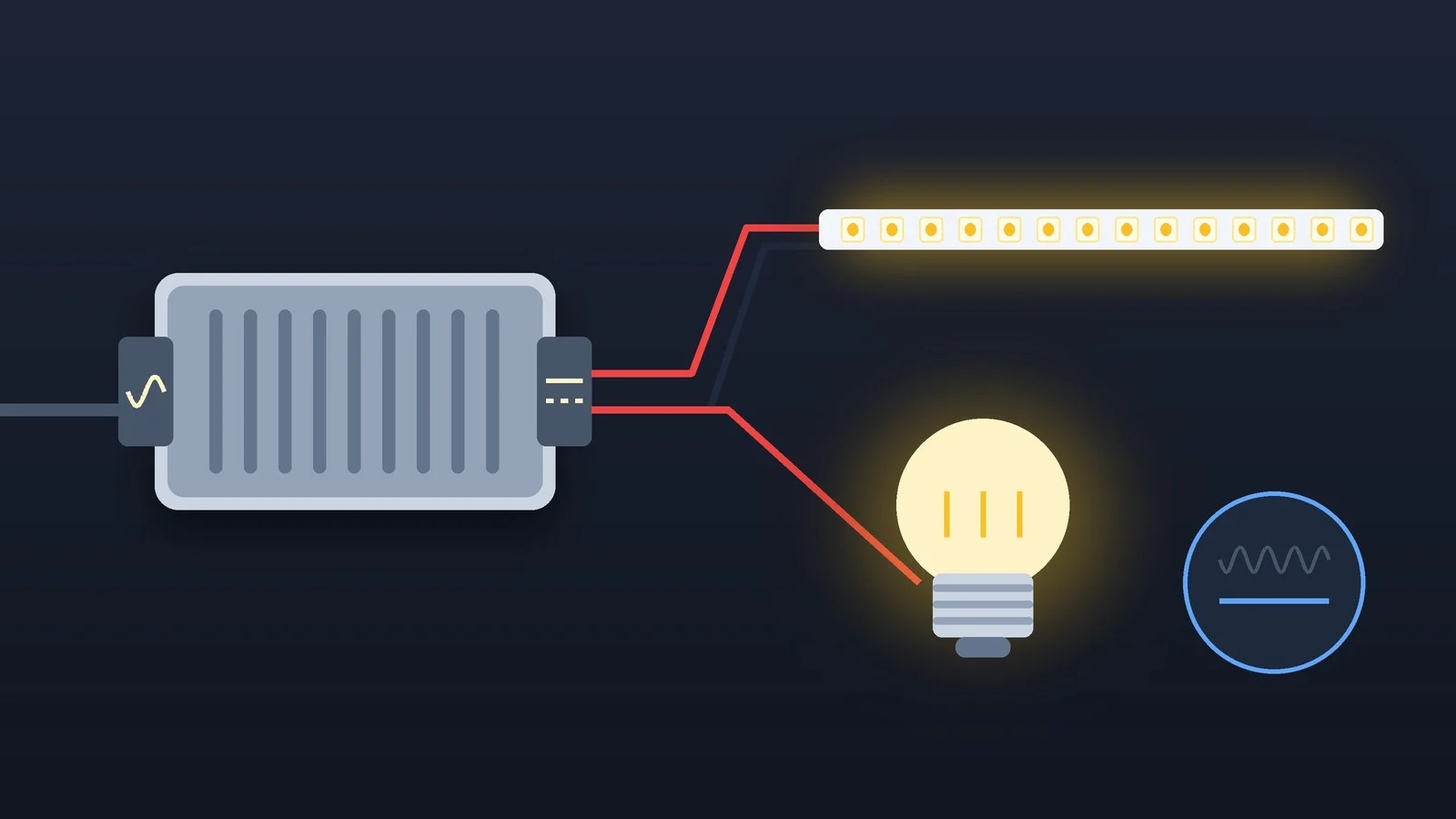
An LED driver is a power supply for LEDs that turns 230 V mains into a steady DC current of the right value and holds it there. You can’t do without one: the current through an LED shoots up with even a small rise in voltage, and excess current shortens the life of the chip or burns it out.
Below: how a driver works, how a constant-current driver differs from a constant-voltage supply for 12 V and 24 V strips, which specs to check when choosing one, how to recognize a fault and what matters when wiring it up.
What is an LED driver and why do LEDs need one
An LED is a semiconductor device. It starts to glow once the voltage across it exceeds a threshold, and from there the current climbs steeply and nonlinearly: a small increase in voltage produces a large increase in current. Both brightness and heating depend on current, so powering an LED “with just a voltage” is risky.
There are two more complications. An LED’s forward voltage drops as it heats up, so with a fixed supply voltage the current rises as the LED warms, and the temperature rises with it. On top of that, LEDs differ even within one group: in an ams OSRAM simulation, LEDs wired in parallel through a shared resistor showed a current spread of up to about 40%.
A driver removes these problems: it measures the output current and adjusts the voltage so the current stays at the set value. This constant-current mode is what LED makers such as ams OSRAM recommend. An E27 or GU10 LED bulb has a driver too: a small circuit board is hidden in its body, which is why the bulb can go straight into an ordinary light socket.
Filter and rectifier
Suppresses interference and rectifies the AC mains
Power factor correction
Evens out the current drawn from the mains
Converter
Switches running at about 100 kHz step the voltage down
Regulation and protection
The circuit compares the output current with the set value and shuts the output down on a fault
These blocks appear in the block diagram in the Mean Well HLG-240H datasheet, a 240 W driver for light fixtures.
Constant current vs constant voltage: the difference
Drivers come in two families. A constant-current (CC) driver holds the current, for example 700 mA, while the output voltage adjusts to the load within the driver’s range. A constant-voltage (CV) supply delivers exactly 12, 24 or 48 V, and the current depends on how much the load draws.
| Parameter | Constant-current driver (CC) | Constant-voltage supply (CV) |
|---|---|---|
| What it holds steady | Current: 350, 700, 1,050 mA | Voltage: 12, 24, 48 V |
| Label example | 700 mA, 50–86 V, 60 W | 24 V, 4.2 A, 100.8 W |
| What it powers | COB arrays, modules, LED chains | Strips, bars, 12/24 V modules |
| How the load is wired | In series | In parallel |
| If you mix them up | A 12/24 V strip will be destroyed | Nothing limits the module’s current |
12 V and 24 V LED strips
An LED strip is designed for a specific voltage, and circuitry on the strip itself limits the current in each segment. That’s why a strip is powered from a constant-voltage supply of the same rating. Tridonic’s documentation for its LLE FLEX 24V strip is explicit: connect it only to a constant-voltage driver, because a constant-current driver will damage it irreversibly.
The main limit of a strip is the voltage drop along its thin conductive traces: the farther from the feed point, the dimmer the light. At the same power, a 24 V strip draws half the current of a 12 V one, so the voltage drops less and a single run can be longer.
Manufacturers state the maximum run length. For the 24 V Inventronics LINEARlight FLEX INFINITE strip, it is 9 m at 4 W per meter, 6 m at 9.4 W/m and only 3 m at 19.2–25.2 W/m. A long line is split into sections, each fed by its own wires from the supply.
COB arrays and LED modules
COB arrays, high-power LEDs and modules without their own current-limiting circuit run only from a constant-current driver. Their documentation lists the operating current, for example 350, 700 or 1,050 mA, and the forward voltage at that current. Modules are wired in series so that the same current flows through each one.
Wired in parallel, the current splits unevenly, and if one chain fails, the others get more current. ams OSRAM allows such circuits only with LEDs of the same type matched by forward voltage, and advises building series chains first.
Hybrid and programmable drivers
The Mean Well HLG-240H acts as a constant-voltage supply until the load needs more than the rated current, then switches to constant-current regulation. Mean Well’s XLG series holds constant power: the XLG-75-H delivers its full 75 W anywhere from 36 to 58 V by adjusting the current. Many modern drivers have the current set in software: the Tridonic LCA 75W, from 100 to 400 mA in 1 mA steps.
How to choose an LED driver
Take the figures from the label of the old driver and from the documentation for the strip or module.
Current and voltage range
A 12 V or 24 V strip or module needs a constant-voltage supply of exactly the same rating. Tridonic warns that exceeding the operating voltage overloads the strip and can sharply shorten its life or destroy it.
With a constant-current driver, two figures matter. The current must match the module’s operating current, and the chain’s total forward voltage must sit within the driver’s range, clear of the edges, since it shifts with temperature and dimming. The Mean Well PCD-60-700B delivers 700 mA over 50–86 V, which suits chains of roughly 35 to 60 W. Tridonic notes that below the minimum voltage the driver may shut down.
Power with headroom
Add up the load: for a strip, watts per meter times length. Never exceed the driver’s rating, and leave headroom to extend its life: for reliability, Mean Well suggests a power supply rated 30% above the actual load. In hot conditions the load has to be reduced; the derating curve in the datasheet shows by how much.
Example: the Tridonic LLE FLEX 24V 9W strip draws 8.5 W per meter. A 5 m reel is 42.5 W, about 55 W with 30% headroom, so you need a 24 V supply rated 60 W. That headroom also covers the ±15% tolerance Tridonic gives for the strip’s power draw.
Efficiency, power factor and harmonics
Efficiency shows what share of the energy from the mains reaches the LEDs; the rest turns into heat inside the driver. Power factor (PF) shows how evenly the driver draws current from the mains: the closer to 1, the less excess current flows through the wiring.
Drivers with power factor correction have a PF close to 1: 0.95 at 230 V for the Mean Well HLG-240H and XLG-240, over 0.9 for the PCD-60. Lighting also has its own harmonic limits, Class C of IEC 61000-3-2. The table in the next section shows how these figures compare on a basic power supply and on a driver for light fixtures.
Ripple and flicker
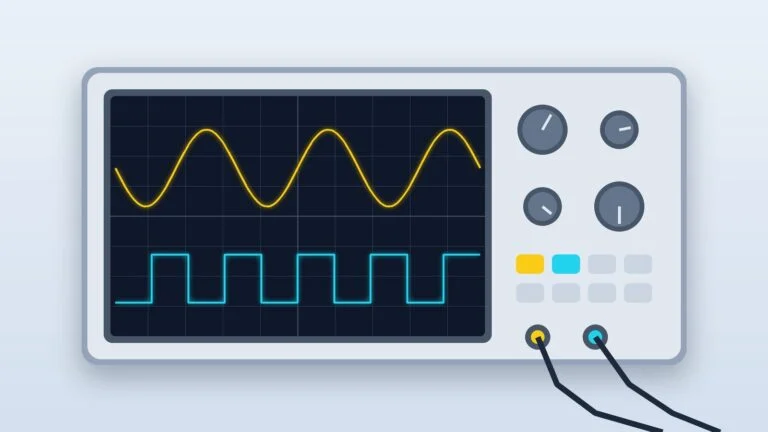
On 50 Hz mains, rectification leaves a ripple at 100 Hz. If the driver smooths it poorly, the light fluctuates. The eye may not notice, but, as LEDVANCE warns, flicker can cause discomfort, eye fatigue and headaches, and the stroboscopic effect can make it harder to see moving and rotating objects correctly.
In the EU, lamps and modules that run directly from the mains have had to meet PstLM ≤ 1 (visible flicker) and SVM ≤ 0.9 (stroboscopic effect) since September 1, 2021, and SVM ≤ 0.4 since September 1, 2024, with exemptions for outdoor and industrial lighting.
Fixtures with a separate driver aren’t covered, but driver makers list these values anyway: the Tridonic LCA 75W is rated at PstLM ≤ 1, SVM ≤ 0.4 and low-frequency ripple of 2% or less.
The IEEE 1789-2015 recommended practice offered a simple rule: the percent modulation of the light should not exceed the frequency multiplied by 0.08. At 100 Hz that’s 8%, and for sensitive people about 3% (a factor of 0.0333); from 1,250 Hz up, any modulation depth is considered low risk. On March 26, 2026, IEEE moved the document to inactive status.
If you spend long hours at a desk under artificial light, pay particular attention to this spec.
IP rating and temperature
In an IP code under IEC 60529, the first digit stands for protection against objects and dust, the second against water. IP20 protects only against objects larger than 12.5 mm, such as fingers: it’s meant for dry rooms and for mounting inside a fixture. IP65 means dust-tight and protected against water jets; IP67 adds protection against temporary immersion.
Mean Well adds that drivers rated IP64–IP66, as well as IP67 versions with adjustment potentiometers, must be installed indoors or under shelter, and none may be submerged in water. For outdoor and damp locations, choose sealed models rated IP65/IP67, such as the HLG-240H.
A driver’s life depends on the temperature at the tc point on its case. Mean Well rates the HLG-240H for more than 62,000 hours when tc is about 75 °C or lower. For the Tridonic LCA 75W at 300–340 mA, the rated life is 85,000 hours at a tc of 74 °C and 50,000 hours at 80 °C, with a failure probability below 10%.
Mean Well estimates life from the heating of the electrolytic capacitors, and according to Nippon Chemi-Con their lifetime is roughly halved for every 10 °C rise. So never cover a driver with anything, and Mean Well asks for 10–15 cm of clearance from any nearby heat source.
Dimming: 1–10 V, DALI, PWM and TRIAC
The dimming method is chosen together with the driver, since one series often comes in several versions. On the Mean Well HLG-240H, for example, control by a 1–10 V signal, PWM or a resistor is available only on types B and AB.
| Method | How it is controlled | Main limitation |
|---|---|---|
| 1–10 V (0–10 V) | A separate pair of wires | Many won’t dim to off without a relay |
| DALI (IEC 62386) | Digital bus, each driver addressed | Up to 64 drivers per line |
| PWM | Current delivered in pulses | Flicker at low frequencies |
| TRIAC (phase-cut) | A standard dimmer chops the sine wave | Dimmer compatibility required |
1–10 V. Analog control per Annex E of IEC 60929: 10 V gives full brightness, 1 V and below the minimum. On many drivers the minimum is a dim glow rather than off, so a relay is added to switch the light off fully, as Mean Well shows in the HLG-240H datasheet. Lutron warns of an incompatible “0–10 V” variant from stage lighting, where 0 V means off.
DALI. A digital protocol standardized as IEC 62386. Bus power and data share one pair of wires, polarity doesn’t matter, and each driver can be given its own address. One line takes up to 64 drivers plus up to 64 sensors or push buttons. DALI-2 certification confirms that devices from different brands work together.
PWM. The current is delivered in pulses, and brightness is set by the share of time the current is on. This is how Inventronics strips, for example, are dimmed, through a dimmable constant-voltage supply. Constant-current drivers can also reduce the current itself: the Tridonic LCA 75W uses amplitude dimming. The lower the pulse frequency, the higher the risk of visible flicker.
TRIAC. A standard wall dimmer “chops off” part of each mains half-cycle, and a driver built for this mode (such as the Mean Well PCD-60) lowers its current in response. Lutron and the U.S. Department of Energy’s PNNL list the typical problems of such a pairing: flicker, buzzing, a faint glow when off and drop-out at the low end. That’s why manufacturers publish lists of tested dimmers.
Protections and standards
Look in the datasheet for short-circuit, overload, overvoltage and overtemperature protection. Safety requirements for LED drivers are set by IEC 61347-1 and IEC 61347-2-13 (new editions came out in June 2024), and interference is tested to CISPR 15 (EN 55015) and IEC 61547.
How a driver differs from a regular power supply
Strictly speaking, a driver is a source of stable current, and a power supply is a source of stable voltage. Stores call both “drivers,” and Mean Well describes its LED power supplies as devices with a constant-current or constant-voltage output. What matters is not the name but the purpose.
A 12 V or 24 V power supply is fine for a strip but not for a COB array, because it doesn’t limit the current through it. Models built for light fixtures differ in other specs, too. Two Mean Well units with a 24 V output show this well:
| Criterion | LPV-100-24 | HLG-240H-24 |
|---|---|---|
| Output mode | 24 V (CV) | 24 V or 10 A current (CV+CC) |
| Power | 100.8 W | 240 W |
| Efficiency | 88% | 92.5% |
| Power factor | Not specified | 0.95 at 230 V |
| Harmonics, IEC 61000-3-2 | Class A | Class C (lighting) |
| Safety standard | IEC 62368-1 | IEC 61347-1 and 61347-2-13 |
| Dimming | None | 1–10 V, PWM, resistor (type B) |
| Housing | Plastic, IP67 | Metal, IP65/IP67 |
| Best for | Signs, decorative lighting | Light fixtures, including outdoor |
The LPV-100 datasheet states outright that the model is not intended for light fixtures in the EU and China; for those, Mean Well recommends the LPF, NPF, XLG and other series. For lighting a shop window or a sign, a basic constant-voltage supply is enough.
Common faults and how to spot them
The way the light behaves often tells you what happened to the driver or its load.
| Symptom | Likely cause | What to check |
|---|---|---|
| Light blinks rhythmically | Hiccup protection: short, overload | Wiring, power, load voltage |
| Won’t turn on at all | Failed driver or latched protection | Power, switching it off and on |
| Flickers when dimmed | Incompatible dimmer | List of compatible dimmers |
| Glows when switched off | Dimmer, pickup, no ground | Dimmer type, driver grounding |
| Strip dimmer toward the end | Voltage drop along the strip | Run length, power feed |
| Buzzes with a dimmer | Phase-cut dimmer doesn’t suit driver | Compatibility, another dimmer |
| Failed early | Overheating, dried-out capacitors | Ventilation, tc, power headroom |
Rhythmic blinking is a typical sign of protection: on a short circuit or overload, the driver in hiccup mode, as Mean Well calls it, switches the output on and off again and again until the cause is removed. Some protections, such as overvoltage protection on the HLG-240H, shut the output down until power is cycled. Tridonic suggests grounding the driver to reduce the faint glow of switched-off LEDs.
Don’t try to repair a driver yourself: Mean Well asks that faults be checked by a qualified technician and that the case not be opened. It’s simpler to replace it with a model that has the same output specs, dimming method, IP rating and suitable dimensions.
Safety and wiring
- Before installation, switch off the circuit breaker and make sure it can’t be switched back on by accident; this is the first step in Mean Well’s installation manual.
- Mains wires (European color code): brown is live (L), blue is neutral (N), green-yellow is protective earth (PE). A Class I driver with a ground terminal must always be grounded.
- Cables are chosen by the driver’s current: Mean Well requires the cable’s current rating to be at least that of the unit.
- Observe polarity on the output: many drivers, Tridonic’s among them, have no reverse-polarity protection, and wrong polarity can damage a strip or module.
- Keep the wires from the driver to the LEDs short: for the Tridonic LCA 75W their length is limited to 2 meters.
- Drivers marked SELV have a safely low output voltage: no more than 60 V on the Tridonic LC 50W. Non-SELV models can put out up to 250 V, as the Tridonic LCA 75W does, and such an output must be treated as a hazardous voltage.
At switch-on, a driver briefly draws a large inrush current; Mean Well gives a range of 20 to 100 A depending on the model. That’s why the manufacturer states how many drivers can share one circuit breaker: for the HLG-240H, no more than two on a B16 breaker and four on a C16, and up to 32 for the small PCD-60. Keep these figures in mind when choosing the breaker.
Glossary
- CC (constant current): a driver that holds the current while the voltage adjusts to the load.
- CV (constant voltage): a supply that holds 12, 24 or 48 V while the current depends on the load.
- Forward voltage (Vf): the voltage across an LED at its operating current. It drops as the LED heats up.
- Power factor (PF): how evenly a device draws current from the mains; the ideal is 1.
- Ripple: fluctuations in the output current or voltage. For lighting, the less the better.
- PstLM and SVM: measures of visible flicker and the stroboscopic effect used in EU Regulation 2019/2020.
- SELV: safety extra-low voltage, with the output reliably separated from the mains.
- tc: a point on the driver’s case whose temperature is used to calculate its lifetime.
- Hiccup: a protection mode in which the driver repeatedly switches its output off and back on.
Sources and methodology
Analysis of public sourcesChecked 30 September 2026
- Mean Well: HLG-240H datasheet (2026) meanwell.com
- Tridonic: Driver LCA 75W 100–400mA one4all lp PRE datasheet resources.tridonic.com
- ams OSRAM: Application Note AN040 on LED circuits look.ams-osram.com
- LEDVANCE: FAQ on EU Regulation 2019/2020 ledvance.com
- IEC 61347-2-13:2024 webstore.iec.ch
FAQ
Can you connect an LED strip without a driver?
No. A 12 V or 24 V strip is designed for a constant voltage of its rating and is never connected directly to 230 V mains. It needs a constant-voltage supply, and, as Tridonic warns, a constant-current driver will damage the strip irreversibly.
What driver do I need for a 5-meter 24 V strip?
Multiply the strip’s watts per meter by its length and add about 30% headroom. For an 8.5 W/m strip that’s 42.5 W, or about 55 W with headroom, so you need a 24 V supply rated 60 W. Also check the maximum length of a single run in the strip’s documentation.
Can I use a more powerful driver than I need?
With a constant-voltage supply, yes, as long as the voltage matches: the strip will draw only as much current as it needs. With a constant-current driver, the current itself must match, and the chain’s voltage must fall within the driver’s operating range; extra power capacity does no harm.
Why does my LED light fixture blink?
Rhythmic blinking is a typical sign of driver protection: on a short circuit or overload, the driver repeatedly shuts its output off. If the light flickers only when dimmed, the dimmer and driver are probably incompatible.
How long does an LED driver last?
It depends on temperature. Mean Well rates the HLG-240H for more than 62,000 hours at a tc point temperature of about 75 °C, and Tridonic rates the LCA 75W for up to 100,000 hours with a failure probability below 10%. Heat shortens that: at a tc of 80 °C, the same Tridonic driver is rated for 50,000–60,000 hours.





Leave a Reply