
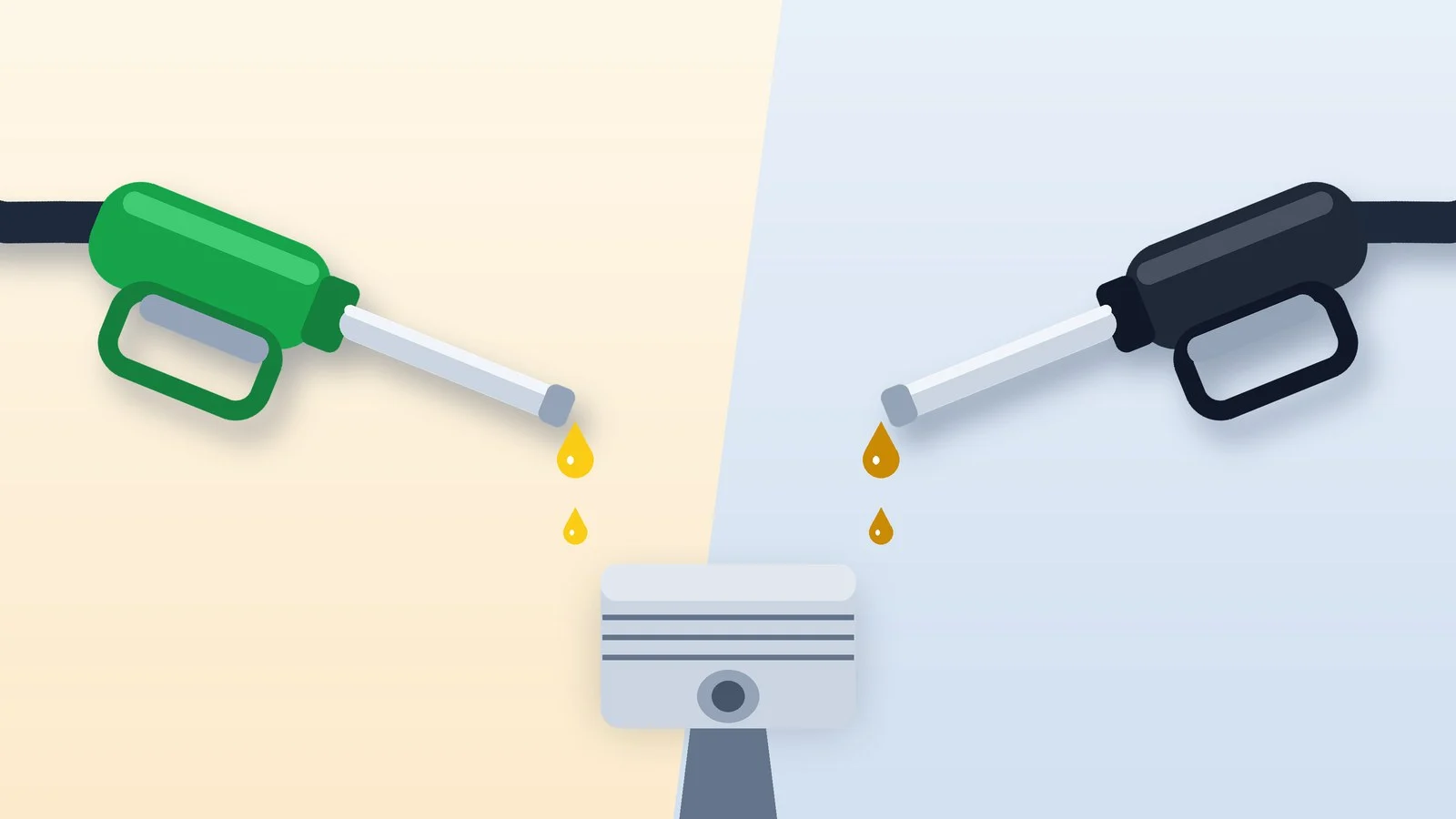
Which engine is better, diesel or gasoline, depends on how much and how you drive. A diesel burns fewer liters and pulls harder, so it pays off with high highway mileage and in heavy vehicles. For city driving, short trips and moderate mileage, gasoline makes more sense, ideally a mild hybrid: on September 30, 2026, a liter of diesel in Ukraine cost UAH 7–9 more than A-95 gasoline.
Below: how both engines work, how much fuel the Škoda Octavia and Kodiaq use with gasoline and diesel engines under WLTP, and what that costs at WOG, OKKO and UPG prices. We also cover maintenance, winter, LPG conversion, Euro 7, restrictions on diesels in EU cities and the import excise tax. A “who should buy what” checklist closes the article.
How a diesel differs from a gasoline engine
The key difference is how the fuel ignites. In a gasoline engine, a spark from the spark plug ignites the air-fuel mixture. A diesel has no spark plugs: air in the cylinder is compressed so hard that it gets extremely hot, and the injected fuel ignites on its own. That is how the Alternative Fuels Data Center (AFDC) of the U.S. Department of Energy describes the principle.
That is why a diesel has a higher compression ratio. For Škoda’s 2026 model-year engines it is 12.0:1 for the 1.5 TSI, 12.2:1 for the 2.0 TSI, 16.0:1 for the 2.0 TDI and 15.5:1 for the 193 PS 2.0 TDI. Both types are turbocharged today: the gasoline TSI and diesel TDI engines in the Octavia and Kodiaq are all turbo engines.
A diesel is more efficient for two reasons. A liter of diesel fuel holds 11–15% more energy than a liter of gasoline (per the AFDC fuel properties table), and the higher compression ratio raises engine efficiency. The U.S. government site fueleconomy.gov states plainly that diesels are more fuel-efficient than similar-sized gasoline engines and deliver more low-end torque.
Fuel consumption: one car, two engines
The fairest comparison is one model with a gasoline and a diesel engine of the same power. Take the 2026 model-year Škoda Octavia and Kodiaq: WLTP consumption and CO₂ figures come from Škoda Auto Deutschland technical data (Octavia dated June 16, 2026, Kodiaq dated February 12, 2026). The range depends on trim and wheels.
| Version | Power, PS | Torque, Nm | WLTP consumption, l/100 km | WLTP CO₂, g/km |
|---|---|---|---|---|
| Octavia 1.5 TSI m-HEV DSG | 150 | 250 | 5.0–5.4 | 114–123 |
| Octavia 2.0 TDI DSG | 150 | 360 | 4.5–4.8 | 118–127 |
| Kodiaq 1.5 TSI m-HEV DSG | 150 | 250 | 6.0–6.5 | 136–149 |
| Kodiaq 2.0 TDI DSG | 150 | 360 | 5.3–5.8 | 139–152 |
| Kodiaq 2.0 TSI DSG 4×4 | 204 | 320 | 7.4–8.0 | 167–181 |
| Kodiaq 2.0 TDI DSG 4×4 | 193 | 400 | 6.0–6.5 | 157–171 |
In pairs of equal power, the diesel burns 10–12% fewer liters, and in the heavy all-wheel-drive Kodiaq about 19% fewer. The diesel has 25–44% more torque, but that does not make the car faster: the 150 PS Octavia reaches 100 km/h in 8.5 s with either engine. The diesel version is also about 80 kg heavier.
Škoda’s Ukrainian website lists higher combined consumption for these versions, with a similar gap: 6.1 l of gasoline and 5.3 l of diesel per 100 km for the Octavia, 7.9 and 6.4 l for the Kodiaq 4×4.
Real-world consumption is higher than in the lab. According to the European Commission, for cars first registered in 2022 the average gap was 21.1% (1.3 l/100 km) for gasoline cars and 17.1% (1.0 l/100 km) for diesels. So on the road the difference in liters usually grows a little further in favor of the diesel.
Which engine is cheaper to run: per 100 and 20,000 km
Prices on September 30, 2026: at WOG and OKKO, a liter of A-95 cost UAH 92.90, diesel UAH 99.90, autogas UAH 45.50 and AdBlue UAH 59.90. WOG calls this the average price across Ukraine; OKKO calls them the prices most often found in its network. UPG’s average prices that day were UAH 88.90, 97.90 and 43.90. A liter of diesel costs 7.5–10% more than A-95.
| Model | Gasoline, UAH/100 km | Diesel, UAH/100 km | Diesel savings per 20,000 km, UAH |
|---|---|---|---|
| Octavia 150 PS DSG | 465–502 | 450–480 | 2,990–4,428 |
| Kodiaq 4×4, 193–204 PS | 687–743 | 599–649 | 17,612–18,770 |
Now the price premium for a diesel. According to Škoda Ukraine price lists valid from July 28, 2026, the Octavia 2.0 TDI DSG in the Essence trim costs UAH 1,412,899, while the 1.5 TSI m-HEV DSG with the same power costs UAH 1,392,290: a difference of UAH 20,609. The Kodiaq 2.0 TDI 193 PS 4×4 in the Selection trim costs UAH 172,000–176,000 more than the 204 PS gasoline 2.0 4×4.
The distance needed to recover the premium is the price difference divided by the savings per 100 km. For the Octavia that is 93,000–138,000 km, or 4.7–6.9 years at 20,000 km a year. For the Kodiaq 4×4 it is 183,000–200,000 km, or 9–10 years. At UPG prices, where diesel costs UAH 9 more than A-95, the Octavia’s savings drop to UAH 790–2,028 per 20,000 km.
Real savings are usually larger than calculated, because gasoline cars deviate more from WLTP on the road. But a diesel also has costs a gasoline car doesn’t: AdBlue, more complex fuel injection equipment and exhaust aftertreatment. If the premium is high and your mileage is low, a diesel may never pay off during ownership.
What about LPG conversion
LPG kits are fitted to gasoline engines. A liter of autogas at WOG and OKKO cost UAH 45.50, almost half the price of A-95. A liter of propane holds about 73% of the energy in a liter of gasoline (AFDC), so you burn more of it by volume, but even with that correction, energy from gas costs about a third less than energy from gasoline.
Only a company that converts at least five vehicles a year and holds a design approval certificate may install LPG equipment. Compliance is confirmed with a certificate, and the changes must be registered at a Ministry of Internal Affairs service center within 10 days; the owner gets a new registration certificate. This is required by Ukraine’s vehicle registration procedure (Cabinet of Ministers Resolution No. 1388).
Maintenance: costly parts of diesel and gasoline engines
In Germany, Škoda lists the same variable service interval for the Octavia and Kodiaq with TSI and TDI engines: the first service after 2 years or 30,000 km. Check the interval in Ukraine with your dealer. The difference lies in parts that a gasoline engine doesn’t have or that work harder in a diesel:
- Diesel particulate filter (DPF). It collects soot and burns it off periodically. On short trips it doesn’t get the chance to clean itself.
- Exhaust gas recirculation (EGR). Volkswagen’s 2.0 TDI has a low-pressure EGR loop with its own cooler.
- SCR and AdBlue. A urea solution meeting ISO 22241-1 goes into a separate tank, about 12–13 l in the Octavia. According to Škoda’s manual, once the AdBlue range reaches 0 km, the engine will not start.
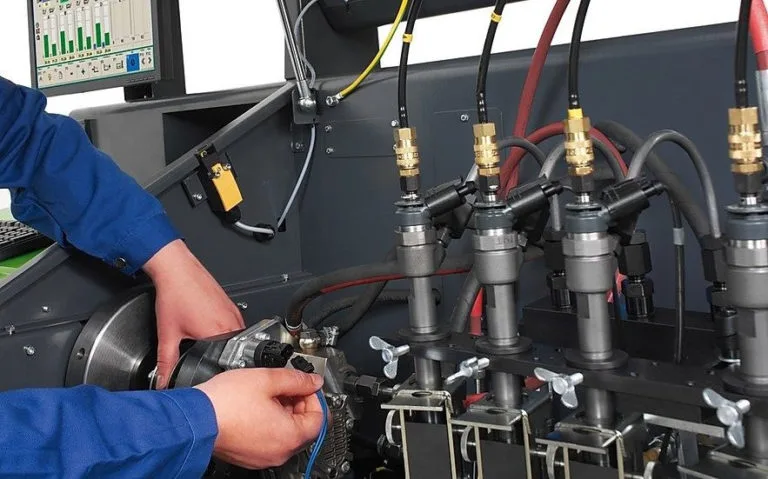
- High-pressure injection. Up to 2,200 bar in the 2.0 TDI versus up to 350 bar in the gasoline TSI evo. We explained how the pump works and fails in our article on the diesel high-pressure fuel pump and signs of its failure.
- Dual-mass flywheel. It damps the engine’s torsional vibrations; according to Schaeffler (LuK), four- and three-cylinder diesels place the highest demands on it.
Gasoline engines have their own weak spots. With direct injection (TSI), fuel no longer washes the intake valves, and carbon gradually builds up on them, as described in the SAE International journal (2016). Small turbo engines work their turbochargers hard: in the 1.0 TSI the turbo spins up to 289,000 rpm and withstands exhaust gas up to 950 °C. And gasoline TSI engines now have a particulate filter too.
When buying a used diesel, check that the DPF and EGR are in place: in the EU, missing factory emission control equipment counts as a defect at roadworthiness testing (Directive 2014/45/EU). Look at the service history of the injectors and the high-pressure pump, and check for AdBlue system errors.
Winter: seasonal diesel fuel and glow plugs
In the cold, paraffin crystals form in diesel fuel and can clog the filter. That is why diesel is graded by its cold filter plugging point (CFPP). Since December 31, 2023, Ukraine has applied DSTU EN 590:2022, the national edition of the European EN 590:2022 without changes. Summer class C fuel must pass the filter down to −5 °C, winter class F down to −20 °C.
The national standard DSTU 7688:2015 divides Euro diesel into summer (L) for air temperatures of +5 °C and above, winter (Z) for +5 to −20 °C, and arctic (Ark) for frost below −20 °C, with a CFPP of −30 °C or lower. The summer grade corresponds to class C, the winter grade to class F. Škoda’s manual requires diesel suited to the current or expected weather.
Glow plugs make cold starts easier for a diesel: Bosch ceramic glow plugs typically reach 1,000 °C in 1.4 seconds. AdBlue freezes below −11 °C, so the system has automatic heating. A gasoline engine needs neither glow plugs nor AdBlue, so it has fewer parts that can let you down in winter.
Environment and rules: Euro 7, LEZs and excise tax
CO₂ and nitrogen oxides
“Diesel is greener” is no longer a given. On CO₂, a diesel is no better than a mild-hybrid gasoline engine: the 150 PS Octavia emits 118–127 g/km as a diesel and 114–123 g/km as a gasoline car; the 150 PS Kodiaq, 139–152 versus 136–149 g/km. The reason is the fuel: a liter of diesel burned yields about 2.69 kg of CO₂, gasoline about 2.35 kg (converted from EPA data).
On nitrogen oxides, the rules are softer for diesels: Euro 6 allows passenger cars 60 mg/km of NOx for gasoline and 80 mg/km for diesel. Regulation (EU) 2024/1257, known as Euro 7, keeps these limits but adds counting of particles from 10 nm, a brake dust limit (7 mg/km for combustion-engine cars) and battery durability requirements.
Euro 7 applies to new types of passenger cars from November 29, 2026, and to all new passenger cars from November 29, 2027.
Restrictions on older diesels in the EU
In EU cities, older diesels lose access first. Since January 1, 2026, Brussels has barred Euro 5 diesels and Euro 2 gasoline cars from its LEZ: a diesel needs Euro 6, a gasoline car Euro 3. Milan’s Area B already bans Euro 0–5 diesels and Euro 0–3 gasoline cars; from October 1, 2028, the ban covers early Euro 6 diesels (classes A, B, C) and Euro 4 gasoline cars.
Excise tax on imports to Ukraine
At customs clearance, a diesel costs more because of the excise tax. Under the Tax Code (subparagraph 215.3.5-1), the rate = base rate × engine displacement in liters × age coefficient. The base rate is €50 for gasoline engines up to 3,000 cm³ and €75 for diesels up to 3,500 cm³; larger engines pay €100 and €150.
The age coefficient is the number of full calendar years from the year after manufacture to the year of customs clearance (1 for new cars, capped at 15). For a 2021 car cleared in 2026 it equals 4: the excise on a 2.0 TDI (1,968 cm³) is €590.40, and on a gasoline 2.0 TSI (1,984 cm³) €396.80.
Diesel vs gasoline comparison table
A summary based on the 150 PS Škoda Octavia with a DSG gearbox; prices and calculations as of September 30, 2026.
| Criterion | Gasoline 1.5 TSI m-HEV | Diesel 2.0 TDI |
|---|---|---|
| WLTP consumption | 5.0–5.4 l/100 km | 4.5–4.8 l/100 km |
| Fuel per liter, WOG | UAH 92.90 | UAH 99.90 |
| Fuel per 100 km | UAH 465–502 | UAH 450–480 |
| Torque | 250 Nm | 360 Nm |
| 0–100 km/h | 8.5 s | 8.5 s |
| Price, Essence trim | UAH 1,392,290 | UAH 1,412,899 |
| WLTP CO₂ | 114–123 g/km | 118–127 g/km |
| Costly parts | Turbo, particulate filter | DPF, EGR, AdBlue, 2,200-bar injection |
| Winter | No glow plugs or AdBlue | Class F fuel, glow plugs |
| Used car: what to check | Turbo, carbon, LPG paperwork | DPF and EGR in place, injectors |
| Excise, used 2021 car, 2.0 | €396.80 | €590.40 |
| Brussels LEZ | Allowed from Euro 3 | Allowed from Euro 6 |
| Best for | City, short trips, up to 20,000 km | Highway, towing, 25,000–30,000+ km/yr |
Which engine is better for you: a checklist
A diesel is worth buying if most of these apply to you:
- you drive 25,000–30,000 km a year or more, mostly on highways;
- you regularly drive on the highway for more than half an hour, which the particulate filter needs;
- the car is heavy, has all-wheel drive or tows a trailer: in the Kodiaq 4×4 the diesel burns about 19% fewer liters;
- the diesel premium is small, as with the Octavia, where it is about 1.5% of the price;
- you don’t plan to drive this car into EU cities with LEZs 10–15 years from now.
Gasoline, ideally a mild hybrid, is the smarter choice if:
- you mostly drive in the city and over short distances;
- you drive up to 15,000–20,000 km a year;
- you are buying a used car and want fewer costly parts in the exhaust and fuel system;
- you are ready to install LPG: energy from gas costs about a third less than from gasoline.
There is a third option: a hybrid or an electric car. A hybrid recovers energy when braking, so its strength is stop-and-go city traffic; we covered the different types in our article on what a hybrid car is. If you have somewhere to charge, see our ranking of 2026 electric cars.
Sources and methodology
Analysis of public sourcesChecked 30 September 2026
- Škoda Auto Deutschland — Octavia (2026) technical data skoda-media.de
- Škoda Ukraine — model price lists (MY2027) skoda-auto.ua
- WOG — fuel prices wog.ua
- Regulation (EU) 2024/1257 (Euro 7) eur-lex.europa.eu
- Tax Code of Ukraine, subparagraph 215.3.5-1 zakon.rada.gov.ua
FAQ
Which is more economical: diesel or gasoline?
In liters, the diesel: under WLTP it burns 10–11% less in the 150 PS Škoda Octavia and about 19% less in the Kodiaq 4×4. But on September 30, 2026, diesel in Ukraine cost UAH 7–9 more per liter than A-95, so in money the Octavia saves UAH 15–22 per 100 km.
At what mileage does a diesel pay off?
Divide the diesel premium by the savings per 100 km. At WOG prices on September 30, 2026, the Octavia 2.0 TDI premium (UAH 20,609) is recovered after 93,000–138,000 km, and the Kodiaq 2.0 TDI 4×4 premium (UAH 172,000–176,000) after 183,000–200,000 km.
What diesel fuel should I use in winter?
Winter class F fuel under DSTU EN 590:2022: its cold filter plugging point is −20 °C or lower. Summer class C fuel is rated only down to −5 °C, and below −20 °C you need arctic diesel.
Can I drive a diesel only in the city?
You can, but the particulate filter needs runs at speed. According to the Škoda Octavia manual, a clogged filter is cleaned by driving at no less than 60 km/h at 2,000 rpm or more, which can take up to 40 minutes. For short city trips, gasoline or a hybrid makes more sense.
Is it true that diesel is greener than gasoline?
Not clearly. Under WLTP the diesel 150 PS Octavia emits 118–127 g of CO₂ per kilometer, the mild-hybrid gasoline version 114–123 g/km. And the nitrogen oxide limit for diesels is higher: 80 mg/km versus 60 mg/km under Euro 6 and Euro 7.








Leave a Reply