
To check a used graphics card before buying, verify the paperwork and warranty terms, inspect the board and the power connector, confirm in GPU-Z that the model and BIOS are genuine, and run the card under load for 20 minutes while watching temperatures. Pay only after that. A new card costs more but comes with a warranty; a used one often has none, since NVIDIA, Sapphire, and XFX do not extend their warranty to second-hand buyers under their own terms.
Below: when a used card makes sense, a step-by-step check for meeting the seller, what is actually known about ex-mining cards, a checklist table, and what to do in the first days after buying. Set aside about an hour for the check.
New or used graphics card: which to choose
A new card means a manufacturer’s warranty from the date of purchase and zero wear. NVIDIA Founders Edition cards, for example, get three years from the date of purchase (NVIDIA’s UK terms), and ASUS also counts its warranty from the purchase date on the receipt. A used card is cheaper, but you take on the risk: worn fans and thermal pads, signs of repair, a re-flashed BIOS, and almost always no warranty.
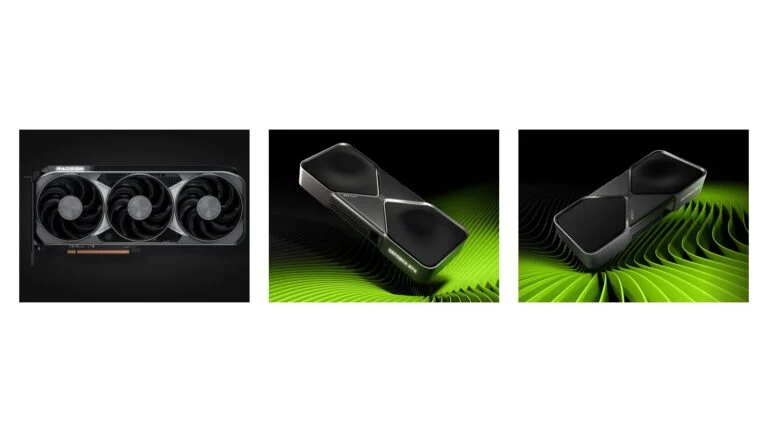
The current generations are GeForce RTX 50, Radeon RX 9000, and Intel Arc B-series, while the used market is mostly previous-generation cards. Some features are exclusive to the new ones: DLSS Multi Frame Generation, for example, works only on GeForce RTX 50. For the models that matter right now, see our ranking of the best graphics cards.
| Criterion | New | Used |
|---|---|---|
| Price | Higher | Lower |
| Warranty | From the maker, from purchase date | Usually first owner only |
| Wear | None | Fans, thermal pads, possible repairs |
| Check before paying | Not needed | Required, about an hour |
| Generation | Current | Usually previous |
| Best for | Buyers who need a warranty and new features | Buyers ready to test a card to save money |
Used makes sense if a previous-generation model is enough for your games and apps, the seller lets you test the card in a PC, and the price is clearly below a new card with a warranty. Go new if you need a warranty, current-generation features, or can’t test the card under load. Either way, check whether your CPU will hold the card back — our guide to the best CPUs for gaming and work has pointers.
Study the listing and the seller
Before meeting, ask in writing: where and when the card was bought, whether there is a receipt and box, whether it was used for mining or rendering, whether it was taken apart or had its thermal paste or pads replaced, and why it’s being sold. Ask for close-up photos of the serial number sticker on the card and on the box, plus the power connectors.
Red flags: the seller won’t let you test the card under load, wants prepayment only, uses photos from the internet, or asks far less than similar listings. Several identical cards in one listing are a reason to ask directly about mining. Check the seller’s reviews and history on the marketplace.
Result: You know where the card came from, how it was used, and whether there is paperwork.
Check the paperwork and the warranty
The serial number on the card’s sticker must match the box and the receipt. ASUS, for example, won’t provide warranty service for devices whose serial number has been altered, removed, or erased, and it counts the warranty from the purchase date on the receipt.
The key question is whether the warranty passes to you. Manufacturers handle this differently, and terms vary by country:
| Manufacturer | Warranty for a second owner |
|---|---|
| NVIDIA Founders Edition | Original purchaser only |
| Sapphire | Original purchaser only |
| XFX (US and Canada) | Bought second-hand: no warranty |
| EVGA | Transferable with proof of the sale |
| ASUS | Term from receipt, transfer not stated |
For MSI, Gigabyte, and other brands, check the terms with support in your country using the serial number before you pay. If the warranty doesn’t pass to you, the remaining term is worth nothing to you: price the card as if it had no warranty.
Result: You know whether the card has a warranty and whether it covers you.
Inspect the board, connectors, and fans
- 16-pin power connector (12VHPWR or 12V-2×6, found on GeForce RTX 40 and RTX 50 and some other cards): the plastic must not be darkened, melted, or deformed, and the pins must be free of scorch marks. Check regular 8-pin connectors the same way.
- Board: no chips, bulging components, dark spots, or signs of soldering.
- Screws: stripped heads and scratches mean the card was taken apart. Sapphire, for example, voids the warranty under its general terms if the card was dismantled or its heatsink removed.
- PCIe contacts and video outputs: no scratches, corrosion, or bent parts.
- Fans: spin freely by hand with no grinding, wobble, or rubbing against the shroud, and the blades are intact.
- Oily residue near the heatsink edges and memory chips is a reason to ask whether the thermal pads were replaced and to watch memory temperature closely in the test.
- Bending: a bent board or shroud means a heavy card hung unsupported for a long time.
About the 16-pin: after melted connectors on the GeForce RTX 4090, NVIDIA named a connector that was not fully plugged in as the common issue. In 2023, a revised version called 12V-2×6 appeared: as Corsair explains, its sense pins are 1.5 mm shorter and the power terminals 0.25 mm longer, which helps ensure the plug is properly connected. The cables themselves stayed the same.
Result: The board and connectors show no signs of overheating, repair, or damage.
Verify the model, memory, and BIOS in GPU-Z
Run GPU-Z from the USB drive. Compare the GPU name, memory size, type, and bus width, and the clock speeds with the model’s specs on the manufacturer’s website. GPU-Z flags fakes built on old relabeled NVIDIA chips: “[FAKE]” appears before the card name along with a warning icon. That list covers older generations, so comparing against the specs matters more than the icon.
The BIOS version is shown in the same window. Look up the model in TechPowerUp’s VGA BIOS Collection and compare the version: if the firmware clearly belongs to another model or another manufacturer, the card was re-flashed. Ask why and request that the factory BIOS be restored before the deal — or walk away. GPU-Z also has a load test that shows how many PCI Express lanes the card runs on; the result should match the card and the slot.
Result: The model, memory, and BIOS match the listing and the manufacturer’s website.
Run a stress test and watch the temperature
Load the card for about 20 minutes: that’s how long a 3DMark Stress Test takes at the default 20 loops, and according to developer UL, it’s usually enough to find any significant stability or cooling issues. The test passes if Frame Rate Stability is at least 97% and all loops are completed. A crash, hang, or visual artifacts during the test may indicate a reliability problem. If you don’t have 3DMark, use the free FurMark 2, which its developer calls a very intensive GPU stress test.
Watch temperatures in HWiNFO or GPU-Z. NVIDIA sets a limit for each model, listed as “Maximum GPU Temperature” in the specs on nvidia.com: 85 °C for the RTX 5070 and 88 °C for the RTX 5070 Ti. When a GPU hits that limit, the driver throttles performance, and if the temperature keeps rising, the system shuts down. A card that hits its limit within 20 minutes with working fans is a bad sign.
Hot spot is the hottest point on the GPU die. AMD shows it in AMD Software on the Radeon VII, RX 5000 series, and newer, and for the GeForce RTX 50 series, GPU-Z reports the hot spot and the hottest memory chip temperature starting with version 2.71.0, released September 23, 2026. Don’t panic if a Radeon’s fans stand still at idle: AMD’s Zero RPM mode is on by default, and the fans should spin up under load. You can also compare a 3DMark benchmark score with systems that have the same CPU and GPU; a big gap is worth raising with the seller.
Result: The stress test passes without errors, and the temperature stays below the model’s limit.
Test the outputs, the noise, and a real game
- Connect the monitor to each HDMI and DisplayPort output in turn.
- Play a demanding game for 15–20 minutes and look for colored dots, stripes, flickering triangles, black screens, and driver resets.
- Listen: coil whine under load, especially at very high FPS in game menus, happens on new cards too. If the sound bothers you, factor it in before buying — it won’t go away on its own.
- Under load, the fans should spin smoothly, without rattling, and at similar speeds — you can see this in HWiNFO.
Result: Every output shows a picture, and the game runs without crashes or artifacts.
Graphics cards after mining: what’s actually known
Manufacturers don’t publish failure statistics for ex-mining cards. So both “a mining card is surely dead” and “it’s healthier than a gaming card” are opinions, not data. Check specific things instead: the fans, the thermal pads, the firmware, and behavior under load.
What is known for sure. On September 15, 2022, Ethereum switched to proof-of-stake, and mining it became impossible, so the mining question matters most for cards made before fall 2022. In the US and Canada, XFX’s household warranty doesn’t cover cards used for mining or in mining farms; commercial use falls under separate terms. And for farms, NVIDIA made dedicated CMP HX processors (30HX, 40HX, 50HX, 90HX) with a fully open bracket for airflow — if a listing shows a CMP card, it was built for mining, not gaming.
On a card with a mining past, check these especially carefully:
- the BIOS — does it match the factory version for this model;
- the fans — wobble, bearing noise, uneven speeds;
- memory temperature under load, if HWiNFO or GPU-Z shows it;
- signs of disassembly and oil near the thermal pads;
- stability in the 3DMark Stress Test — at least 97%.
Replaced thermal paste and pads aren’t a minus in themselves, but some brands void the warranty once a card has been taken apart. You can see what that kind of work involves in our guide to replacing laptop thermal paste; a graphics card adds thermal pads of the right thickness on the memory and power circuitry.
Checklist: what to check before paying
| What to check | How | Red flag |
|---|---|---|
| Seller | Reviews, history, answers | No reviews, prepayment only |
| Paperwork | Serial number on card, box, receipt | Numbers don’t match or are erased |
| Warranty | Brand’s terms for a second owner | Doesn’t transfer, priced as if it does |
| Power connector | Inspect 16-pin and 8-pin with a light | Darkening, melting, scorch marks |
| Board and screws | Inspect in good light | Soldering marks, stripped screws |
| Fans | Spin by hand, listen during the test | Wobble, grinding, one not spinning |
| Model and memory | GPU-Z vs. manufacturer’s site | “[FAKE]”, wrong GPU, less memory |
| BIOS | GPU-Z and TechPowerUp collection | Firmware from another model |
| Stability | 3DMark Stress Test, 20 loops | Below 97%, crash, artifacts |
| Temperature | HWiNFO or GPU-Z under load | Hits the model’s limit |
| Video outputs | Monitor on each HDMI and DisplayPort | No picture on one output |
| Game | 15–20 minutes in a demanding game | Driver resets, stripes, black screen |
After buying: the driver and the first days
If your PC previously had a card from another brand or the driver behaves oddly, do a clean install. NVIDIA describes it this way: run the driver installer as administrator, choose “Custom (Advanced)”, check “Perform a clean installation”, then restart the PC. AMD’s AMD Software installer has a Factory Reset option: it removes all prior versions of AMD Software and temporarily pauses Windows Updates, and you can’t roll back to the previous driver afterward.
For a full cleanup, AMD offers the AMD Cleanup Utility; the company recommends running it in Windows safe mode, and the utility creates a restore point before cleaning. Display Driver Uninstaller (DDU), as its developer describes it, is meant for cases where the standard driver uninstall fails or the driver needs to be wiped completely. Start with NVIDIA’s and AMD’s built-in methods and keep DDU as a fallback.
In the first few days:
- play your usual games and watch for crashes and artifacts;
- after a gaming session, check the maximum temperatures in HWiNFO — they shouldn’t approach the model’s limit;
- keep the receipt or a signed note, your messages with the seller, and the box;
- agree on a return window in advance and in writing. Buyer rights depend on the country and on who the seller is: a store usually has its own warranty and return policy, while a private seller offers only what you agreed on.
If something’s wrong
- The seller won’t let you test under load — don’t buy, or agree in writing on a period for testing and returns.
- GPU-Z shows a different model, less memory, or “[FAKE]” — walk away.
- The 3DMark Stress Test fails — make sure the card has enough memory for the chosen test: according to UL, a failure caused by insufficient video memory is not a sign of a hardware problem. Run it again; if it crashes again or stays below 97%, walk away.
- The temperature hits the limit — dust, dried-out thermal paste, or a faulty fan may be the cause. Buy such a card only if you’re ready to service it and don’t count on a warranty.
- One output shows no picture — swap the cable and monitor; if that doesn’t help, it’s a defect: walk away or negotiate hard.
- The power connector is darkened or melted — don’t buy the card, and don’t use that cable or adapter.
- A problem shows up a few days later — record it on video and contact the seller or store right away.
Sources and methodology
Analysis of public sourcesChecked 9 October 2026
- NVIDIA — NVIDIA GPU maximum operating temperature and overheating nvidia.custhelp.com
- NVIDIA — How do I manually clean install the NVIDIA driver nvidia.custhelp.com
- AMD — Install AMD Software: Adrenalin Edition amd.com
- UL — 3DMark Stress tests screen support.benchmarks.ul.com
- TechPowerUp — GPU-Z techpowerup.com
FAQ
Is it worth buying a graphics card after mining?
It can be, if it passes the same checks as any used card: a factory BIOS, working fans, 20 minutes of stress testing without errors, and temperatures below the model’s limit. Manufacturers don’t publish failure statistics for such cards, and Ethereum mining has been impossible since September 15, 2022.
Does a graphics card warranty transfer to a second owner?
It depends on the brand and the country. NVIDIA Founders Edition and Sapphire warranties cover only the original purchaser, XFX in the US and Canada offers no warranty on cards bought second-hand, and EVGA has a separate transferable warranty. For other brands, ask support using the serial number.
What is a normal graphics card temperature under load?
There’s no single number. NVIDIA lists a limit for each model as “Maximum GPU Temperature” on nvidia.com — for example, 85 °C for the GeForce RTX 5070. A healthy card stays below it without dropping clock speeds; once the limit is reached, the driver throttles performance.
How long should you stress test a card when buying?
About 20 minutes: that’s how long a 3DMark Stress Test runs at the default 20 loops, and the developer considers it enough to find significant problems. Then add 15–20 minutes of real gameplay.
Should you reinstall the driver after buying a used graphics card?
If your PC had a card from another brand, yes, as a clean install: with NVIDIA, via the “Perform a clean installation” option in the installer; with AMD, via Factory Reset or the AMD Cleanup Utility. DDU is a fallback if the standard uninstall fails.





Leave a Reply